What it is
Bill would repeal crimes that restrict freedom of expression
It is a members’ bill. Introduced by parliamentary groups, the Senate, regional governments or citizens. It was introduced on 27 February 2020. Introduced by: Grupo Parlamentario Confederal de Unidas Podemos-En Comú Podem-Galicia en Común.
Official title: Private member's bill amending Organic Law 10/1995, of 23 November, the Penal Code, for the protection of freedom of expression.
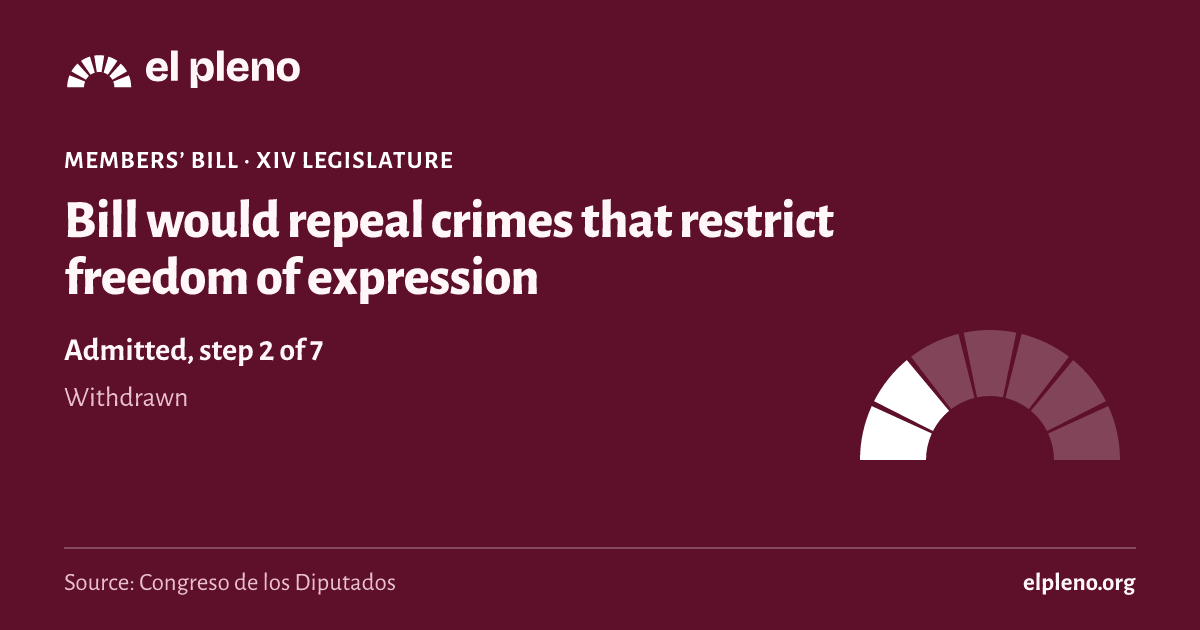
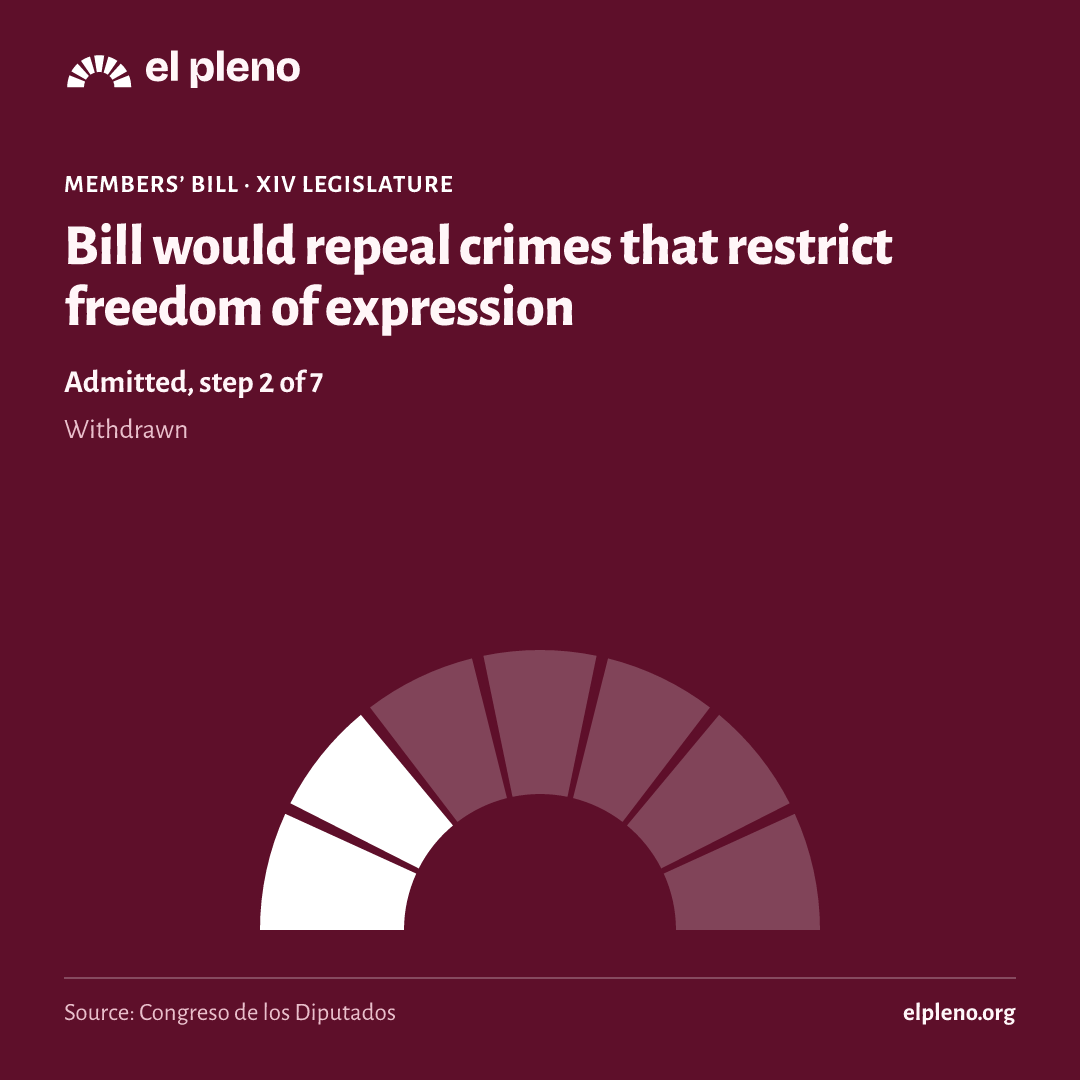
Source: Congreso de los Diputados, file 122/000042· updated 11 Nov
Automatic summary, not yet reviewed
- The bill would repeal several crimes in the Criminal Code: offending religious feelings, insulting the Crown, slandering Spain and its symbols, insulting institutions such as the Government or the courts, and glorifying terrorism.
- It would rewrite Article 510, on hate crimes, so that only direct incitement to hatred or violence is punished, with more proportionate penalties and no extra penalty for using the internet or social media.
- It would add victims of terrorism to the groups protected by the discrimination aggravating factor in Article 22, so they remain covered once the glorification of terrorism offense is repealed.
- It would create a new crime for authorities and public officials who identify people in order to monitor their participation in political, union or religious activities, punishable by disqualification from office and a fine.
- It would add to Article 538 a punishment for any authority or official who, outside cases allowed by law, prevents one or more people from exercising freedom of expression.
- The Government would be empowered to issue the rules needed to apply the law, which would take effect the day after its publication in the Official State Gazette.
Who it affects
- People who criticize institutions, symbols or religious beliefs: They could no longer be convicted under the crimes that would be repealed.
- Victims of terrorism: They would be expressly protected by the discrimination aggravating factor.
- Vulnerable groups (by ethnicity, religion, sexual orientation, disability or other grounds): They would remain protected against direct incitement to hatred, with reformed penalties.
- Authorities and public officials: They could be punished if they identify people to monitor their political activity or prevent freedom of expression.
Words worth knowing
- Derogar
- To repeal, that is, to remove a rule or article from the law so it no longer applies.
- Tipo penal
- The legal description of conduct that is a crime and the penalty it carries.
- Agravante
- A circumstance that makes a crime punishable more severely.
- Inhabilitación especial
- A penalty that bars someone from holding a job, office or profession for a period of time.
- Proposición de Ley Orgánica
- A bill to amend an organic law, which affects fundamental rights, needs a special majority to pass and is not yet approved.
It summarizes the text as it was introduced. It is written by artificial intelligence and may contain mistakes: the official text is what counts. Read the official text · How we make summaries
Where it stands
How far did it get?
It took 2 of 7 steps. It reached Admitted, and today it is withdrawn.
- Introduced27 February 2020Someone registers the text in the Congreso.
- Admitted3 March 2020The Bureau of the Congreso accepts it and, for a members’ bill, the plenary decides whether to consider it.
- Amendmentsnot reachedGroups propose changes.
- Committeenot reachedA committee goes through the text in detail.
- Plenarynot reachedAll 350 deputies vote.
- Senatenot reachedThe Senate can pass it, amend it or veto it.
- BOEnot reachedIt is published in the Official State Gazette (BOE) and comes into force.
See the 6 official steps on a timeline
Was there a plenary vote?
We have no plenary vote linked to this law in the Congreso’s data.
What happens next
What happens now?
Whoever introduced it withdrew it, or it was merged into another one. It goes no further.
Sources
Where does all this come from?
- Congreso de los Diputados, file 122/000042
Official title, type, author, dates and stage.
Retrieved 11 November 2026
- The data comes from the open files of the Congreso, the Senate and the BOE, unaltered.
- Each deputy’s province is the one of their seat on the day of the vote.
- We only say “passed” or “rejected” when the majority needed is certain; otherwise we say which side had more votes.