What it is
Bill would require ideological neutrality from Spanish public universities
It is a members’ bill. Introduced by parliamentary groups, the Senate, regional governments or citizens. It was introduced on 27 February 2020. Introduced by: Grupo Parlamentario VOX.
Official title: Private member's bill amending Organic Law 6/2001, of 21 December, on Universities.
Source: Congreso de los Diputados, file 122/000040· updated 11 Nov
Automatic summary, not yet reviewed
- The bill relies on a 1981 ruling by the Constitutional Court stating that public schools must be ideologically neutral. According to the text, that neutrality limits academic freedom and requires teachers not to indoctrinate students.
- The text claims that the governing bodies of some universities, especially in Catalonia, have taken sides in political debate through statements and partisan symbols on their premises and official communications.
- The bill would amend Article 1 of the Universities Law to state that the university carries out research, teaching and study subject to constitutional principles and ideological neutrality.
- It would also amend Article 2 so that university governing bodies could not use academic freedom or university autonomy to carry out acts against constitutional principles and ideological neutrality. The law would take effect the day after its publication in the official state gazette.
Who it affects
- Universities and their governing bodies, which could not take political sides in their institutional activity.: They would be barred from using university autonomy for acts against ideological neutrality.
- University teachers.: They would have to respect the center's ideological neutrality and avoid indoctrination.
- Students and the rest of the university community.: They would have the right to study and work in ideologically neutral public centers.
Words worth knowing
- Proposición de ley
- A bill introduced by a parliamentary group so it can become law. It is not an approved law yet.
- Ley orgánica
- A type of Spanish law reserved for major matters, such as fundamental rights, which needs a higher majority to pass.
- Libertad de cátedra
- Teachers' right to freely express their ideas and knowledge in class.
- Tribunal Constitucional
- The body that interprets the Constitution and decides whether laws comply with it.
- Autonomía universitaria
- The ability of universities to govern themselves without depending on the government.
It summarizes the text as it was introduced. It is written by artificial intelligence and may contain mistakes: the official text is what counts. Read the official text · How we make summaries
Where it stands
How far did it get?
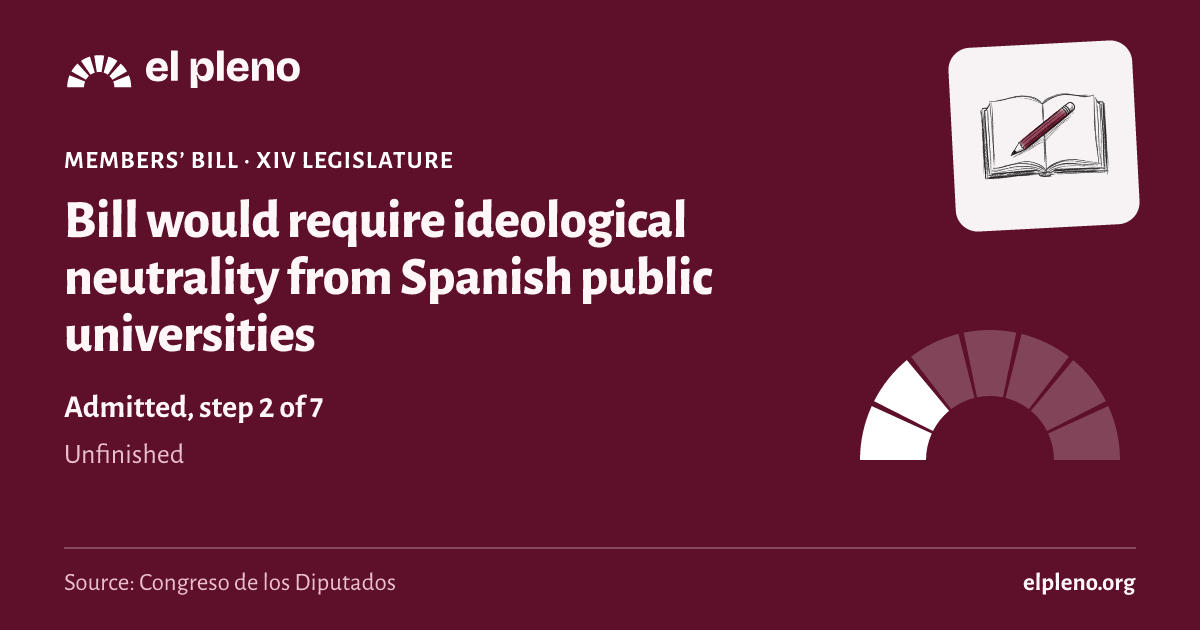
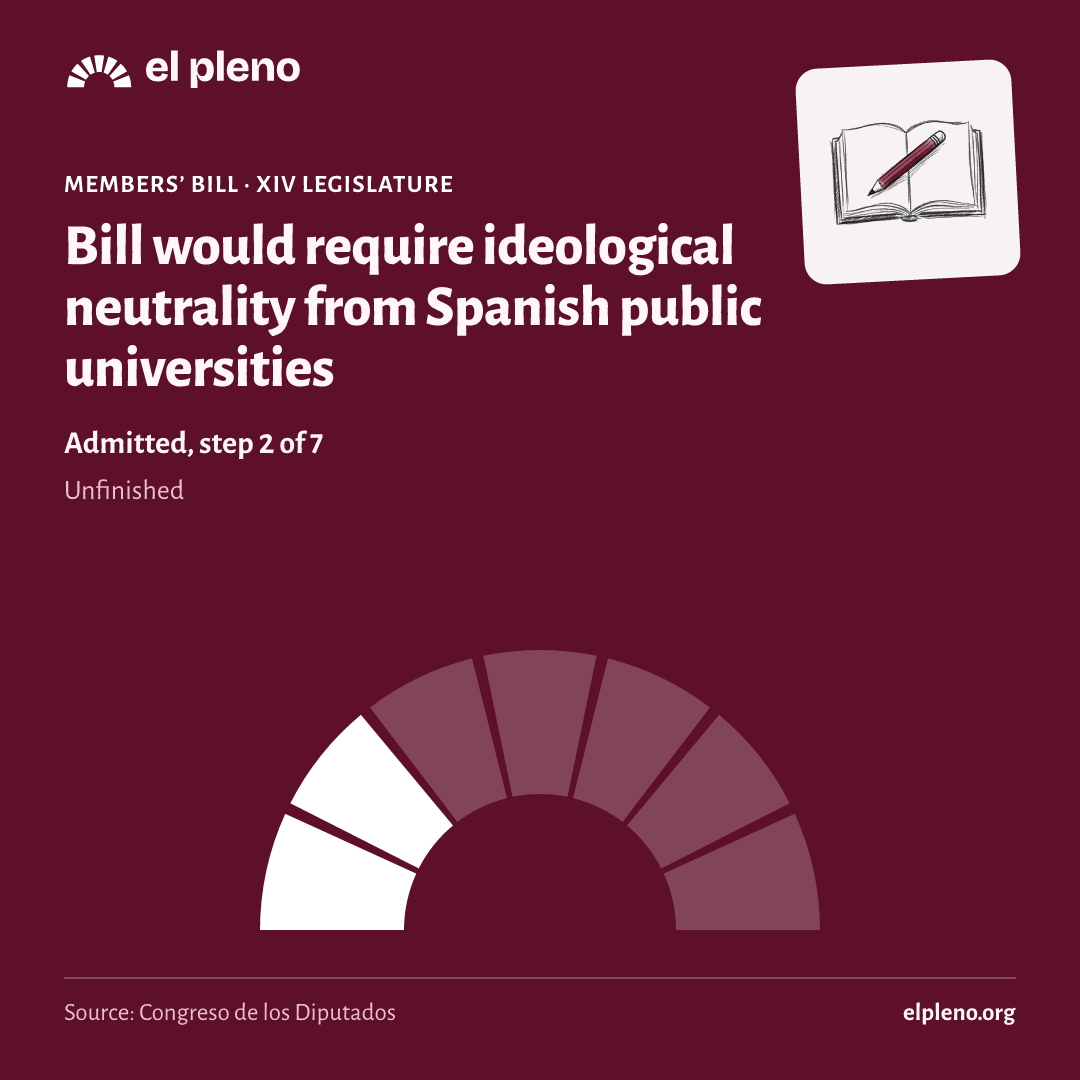
It took 2 of 7 steps. It reached Admitted, and today it is unfinished.
- Introduced27 February 2020Someone registers the text in the Congreso.
- Admitted3 March 2020The Bureau of the Congreso accepts it and, for a members’ bill, the plenary decides whether to consider it.
- Amendmentsnot reachedGroups propose changes.
- Committeenot reachedA committee goes through the text in detail.
- Plenarynot reachedAll 350 deputies vote.
- Senatenot reachedThe Senate can pass it, amend it or veto it.
- BOEnot reachedIt is published in the Official State Gazette (BOE) and comes into force.
See the 6 official steps on a timeline
Was there a plenary vote?
We have no plenary vote linked to this law in the Congreso’s data.
What happens next
What happens now?
The legislature ended before it finished. To go on, someone would have to introduce it again in the new Cortes.
It has not been presented again yet.
Sources
Where does all this come from?
- Congreso de los Diputados, file 122/000040
Official title, type, author, dates and stage.
Retrieved 11 November 2026
- The data comes from the open files of the Congreso, the Senate and the BOE, unaltered.
- Each deputy’s province is the one of their seat on the day of the vote.
- We only say “passed” or “rejected” when the majority needed is certain; otherwise we say which side had more votes.