What it is
Bill to promote patronage, crowdfunding and volunteering
It is a members’ bill. Introduced by parliamentary groups, the Senate, regional governments or citizens. It was introduced on 13 February 2020. Introduced by: Grupo Parlamentario Ciudadanos.
Official title: Private member's bill on the promotion and recognition of Patronage, Micropatronage, and Volunteering.
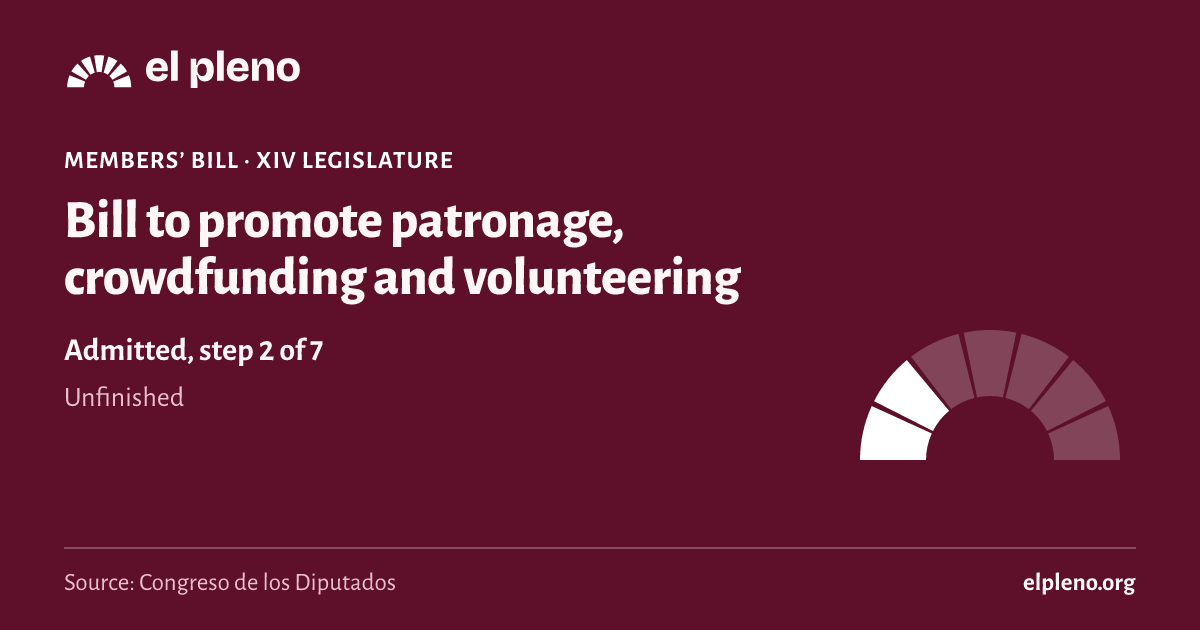
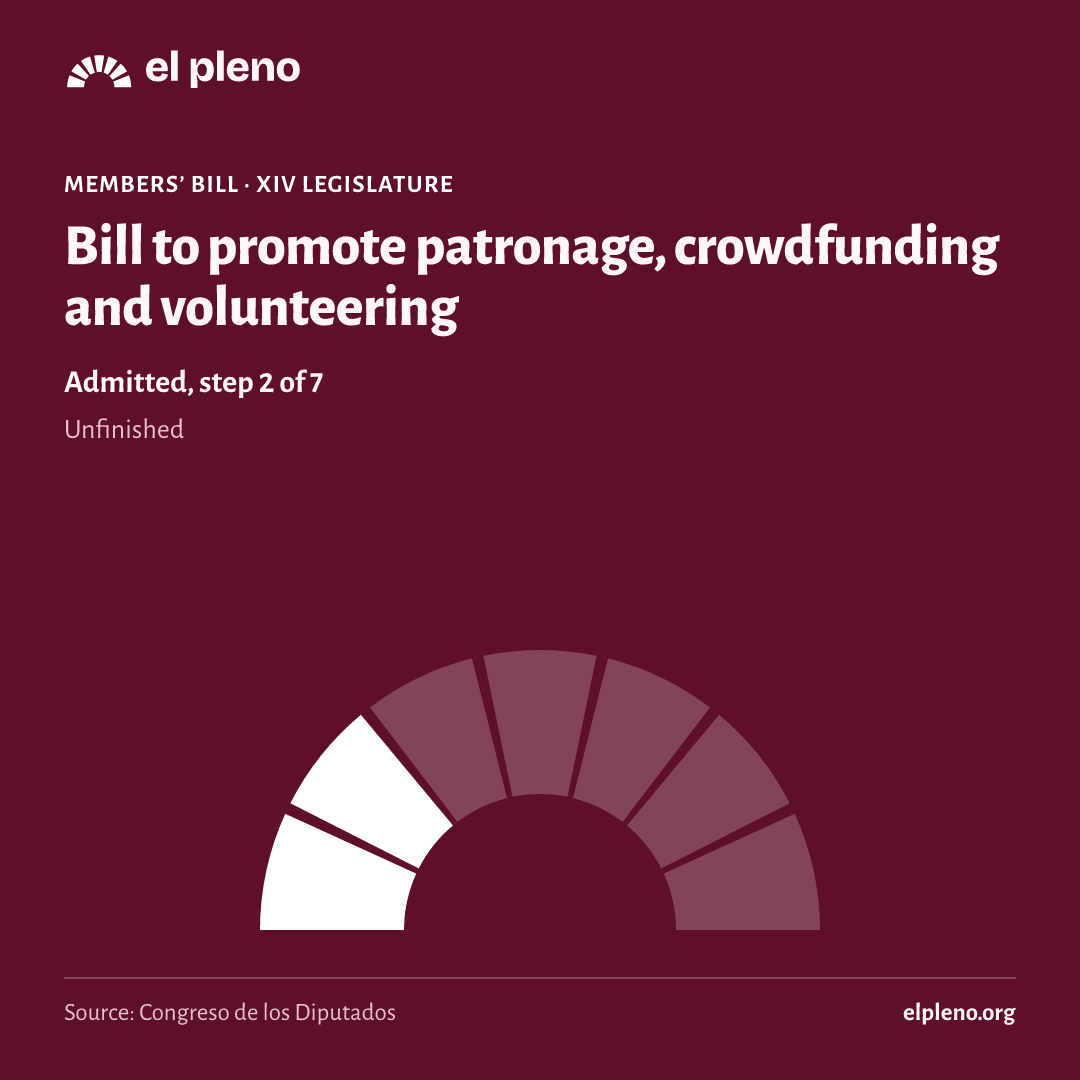
Source: Congreso de los Diputados, file 122/000032· updated 11 Nov
Automatic summary, not yet reviewed
- The bill proposes a law to recognize and promote patronage, understood as any private contribution to activities of general interest, especially culture, non-professional sports and scientific research. It expands the ways to collaborate: donations, interest-free loans, lending of assets, services or rights to works and patents.
- It creates the Patronage Council (Consejo del Mecenazgo), an advisory body attached to the Ministry of Culture and Sport that would draft the State Patronage Strategy, authorize special contributions and arbitrate disputes. Its positions would be unpaid and honorary.
- It proposes equal tax deductions for individuals and companies: 50% of the contribution, rising to 55% for social causes such as childhood, disability or victims of gender violence Violence a woman suffers from a current or former partner because she is a woman.. It removes the 10% taxable base limit in personal income tax The personal income tax (IRPF in Spain): what people pay on what they earn from work, business or savings. and allows a full deduction of the first 150 euros.
- It regulates special forms of patronage: micro-patronage (contributions up to 150 euros a year, fully deductible), non-profit crowdfunding, and volunteering, with the figure of the volunteer patron, who could deduct justified expenses.
- It establishes non-tax benefits, such as public recognition of patron status, naming spaces or scholarships after the patron, priority access to events and facilities, or a patron card, unless the patron expressly declines.
- It gives state museums, archives and libraries more autonomy to accept donations, inheritances and bequests, and creates a public online registry of beneficiary entities. The Council must be set up within six months and the Government would approve the implementing regulations within one year.
Who it affects
- People who donate or collaborate with cultural, scientific, sports or social causes: They could deduct 50% of their contribution from personal income tax, with a full deduction of the first 150 euros, and receive public recognition.
- Corporate patrons: They could deduct 50% of the contribution from corporate income tax, capped at 20% of the taxable base.
- Beneficiary entities, such as nonprofits, public universities, state museums or public hospitals: They could receive more forms of private support and would need to register in the public patronage registry.
- Volunteers: They would receive non-tax benefits and could deduct the justified expenses of their activity.
- State-owned museums, archives and libraries: They would gain autonomy to accept donations and manage the assets received.
Words worth knowing
- Mecenazgo (patronage)
- A private contribution, in money, assets or work, to support activities of general interest such as culture or science.
- Micromecenazgo (micro-patronage)
- Small money contributions, in this bill up to 150 euros a year, to fund projects.
- Herencia yacente (unclaimed inheritance)
- An inheritance that has not yet been accepted by the heirs.
- Base imponible (taxable base)
- The amount of money on which a tax is calculated, that is, the income or gains subject to the tax.
- Cuota íntegra (gross tax liability)
- The amount resulting from applying the tax rate to the taxable base, before applying deductions.
- gender violence
- Violence a woman suffers from a current or former partner because she is a woman.
- income tax
- The personal income tax (IRPF in Spain): what people pay on what they earn from work, business or savings.
It summarizes the text as it was introduced. It is written by artificial intelligence and may contain mistakes: the official text is what counts. Read the official text · How we make summaries
Where it stands
How far did it get?
It took 2 of 7 steps. It reached Admitted, and today it is unfinished.
- Introduced13 February 2020Someone registers the text in the Congreso.
- Admitted18 February 2020The Bureau of the Congreso accepts it and, for a members’ bill, the plenary decides whether to consider it.
- Amendmentsnot reachedGroups propose changes.
- Committeenot reachedA committee goes through the text in detail.
- Plenarynot reachedAll 350 deputies vote.
- Senatenot reachedThe Senate can pass it, amend it or veto it.
- BOEnot reachedIt is published in the Official State Gazette (BOE) and comes into force.
See the 6 official steps on a timeline
Was there a plenary vote?
We have no plenary vote linked to this law in the Congreso’s data.
What happens next
What happens now?
The legislature ended before it finished. To go on, someone would have to introduce it again in the new Cortes.
It has not been presented again yet.
The same initiative in the other chamber:
- XIV Legislature, Senate Private member's bill for the promotion and recognition of patronage, micropatronage and volunteering.
Presented before in:
- XII Legislature, Congreso de los Diputados· Unfinished Bill to reward private donors to culture, science and sport with tax breaks
Sources
Where does all this come from?
- Congreso de los Diputados, file 122/000032
Official title, type, author, dates and stage.
Retrieved 11 November 2026
- The data comes from the open files of the Congreso, the Senate and the BOE, unaltered.
- Each deputy’s province is the one of their seat on the day of the vote.
- We only say “passed” or “rejected” when the majority needed is certain; otherwise we say which side had more votes.