What it is
Bill to remove the crime of coercion in strike pickets
It is a members’ bill. Introduced by parliamentary groups, the Senate, regional governments or citizens. It was introduced on 31 January 2020. Introduced by: Grupo Parlamentario Confederal de Unidas Podemos-En Comú Podem-Galicia en Común.
Official title: Private member's bill, Organic Law amending Organic Law 10/1995, of November 23, of the Penal Code.
Source: Congreso de los Diputados, file 122/000025· updated 11 Nov
Automatic summary, not yet reviewed
- The bill would remove section 3 of Article 315 of the Penal Code. That section punishes with prison or a fine those who coerce others to start or continue a strike.
- According to the statement of reasons, that rule is used to repress workers and union members who organize informational strike pickets. The text argues that punishing these pickets goes against the fundamental rights to strike and to union freedom.
- The text notes that the Penal Code already covers the crime of coercion in its Articles 172, 172 bis and 172 ter. For that reason, it considers it unnecessary to keep a specific aggravated offense for strikes.
- Provisions of equal or lower rank that conflict with the law would be repealed. It would take effect the day after its publication in the Boletín Oficial del Estado (official state gazette).
Who it affects
- Striking workers and union members: They could no longer be punished with the specific aggravated offense for taking part in informational strike pickets.
- Employers and people who report coercion during strikes: They would lose the route of Article 315.3 to pursue coercion in strikes, though they could still use the general crime of coercion.
- Public Prosecutor's Office and judges: They would no longer apply the aggravated offense of Article 315.3 in their criminal actions.
Words worth knowing
- Piquete informativo
- A group of people who inform workers at the workplace that there is a strike and peacefully encourage them to join it.
- Libertad sindical
- Union freedom: the fundamental right to form and join unions to defend workers' interests.
- Proposición de Ley Orgánica
- A text proposed by parliamentary groups to change a law affecting fundamental rights. It is not a law until approved.
- Coacciones
- Coercion: forcing someone, through violence or intimidation, to do or not do something.
It summarizes the text as it was introduced. It is written by artificial intelligence and may contain mistakes: the official text is what counts. Read the official text · How we make summaries
Where it stands
How far did it get?
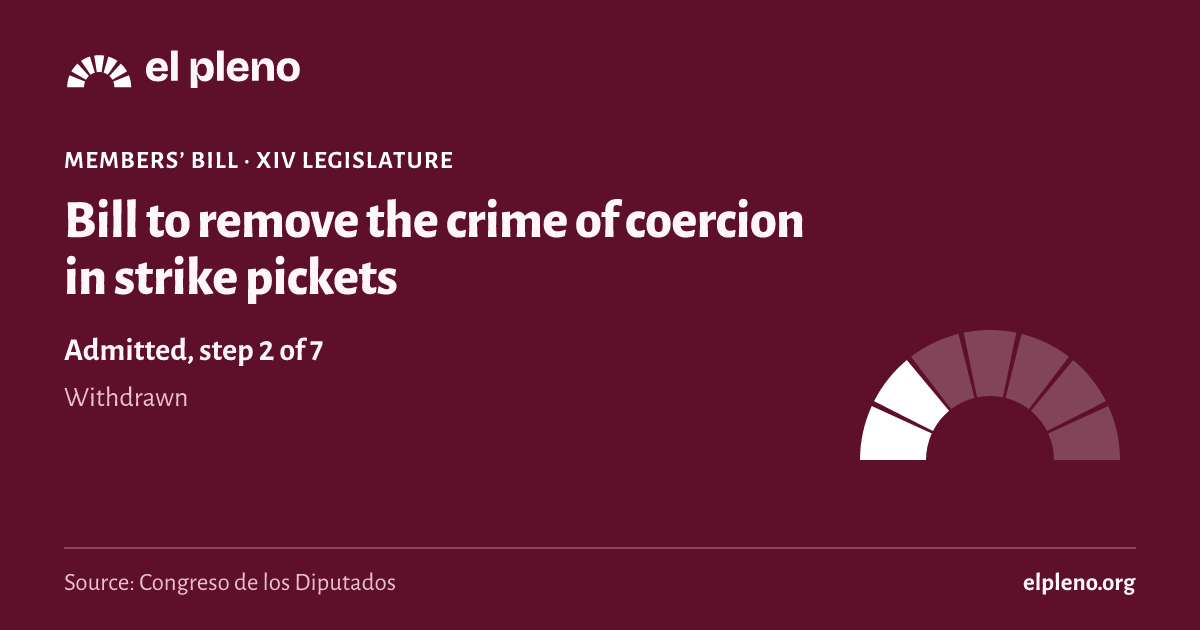
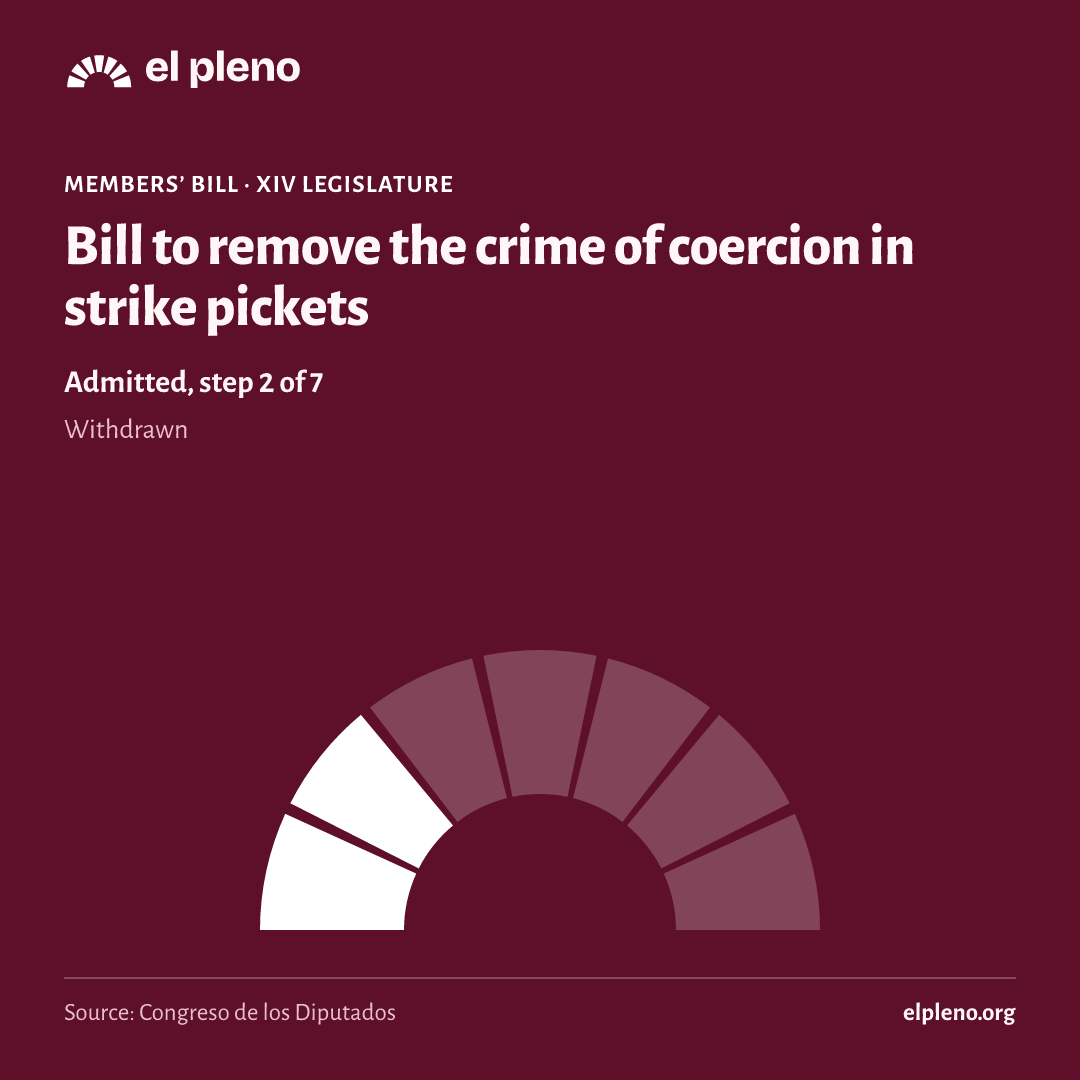
It took 2 of 7 steps. It reached Admitted, and today it is withdrawn.
- Introduced31 January 2020Someone registers the text in the Congreso.
- Admitted4 February 2020The Bureau of the Congreso accepts it and, for a members’ bill, the plenary decides whether to consider it.
- Amendmentsnot reachedGroups propose changes.
- Committeenot reachedA committee goes through the text in detail.
- Plenarynot reachedAll 350 deputies vote.
- Senatenot reachedThe Senate can pass it, amend it or veto it.
- BOEnot reachedIt is published in the Official State Gazette (BOE) and comes into force.
See the 6 official steps on a timeline
Was there a plenary vote?
We have no plenary vote linked to this law in the Congreso’s data.
What happens next
What happens now?
Whoever introduced it withdrew it, or it was merged into another one. It goes no further.
Sources
Where does all this come from?
- Congreso de los Diputados, file 122/000025
Official title, type, author, dates and stage.
Retrieved 11 November 2026
- The data comes from the open files of the Congreso, the Senate and the BOE, unaltered.
- Each deputy’s province is the one of their seat on the day of the vote.
- We only say “passed” or “rejected” when the majority needed is certain; otherwise we say which side had more votes.