What it is
The bill would replace trial courts with Courts of First Instance
It is a government bill. Introduced by the Government. It was introduced on 13 April 2022. Introduced by: Gobierno.
Official title: Government bill for an Organic Law on the organizational efficiency of the public Justice service, amending Organic Law 6/1985, of 1 July, on the Judiciary, for the implementation of Instance Courts and Justice Offices in municipalities.
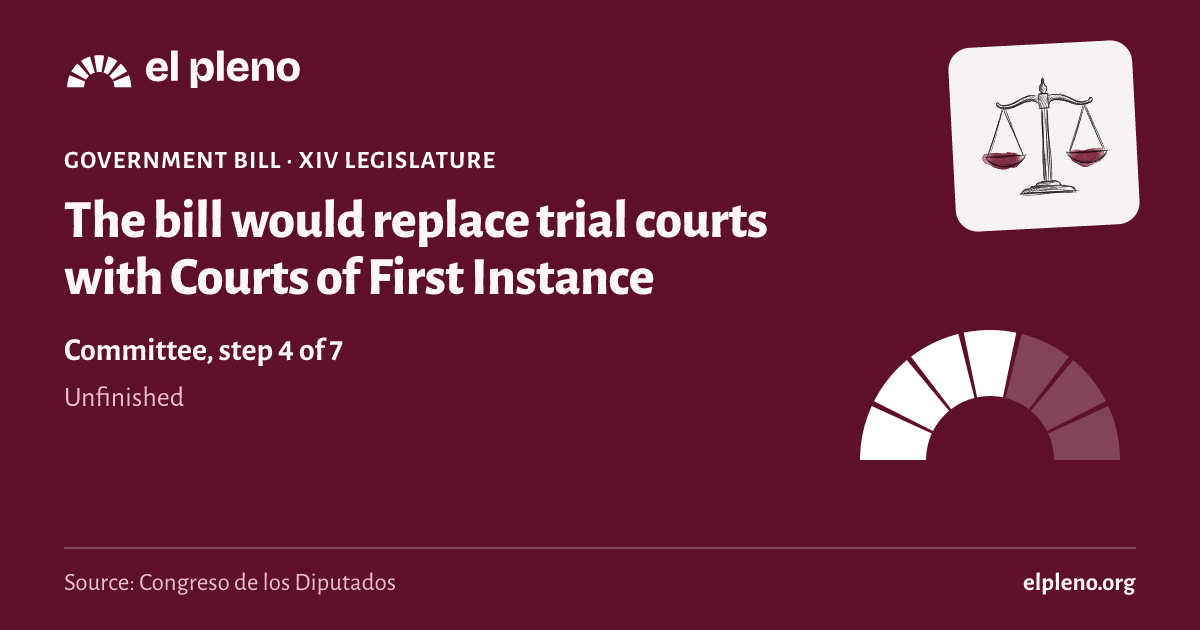
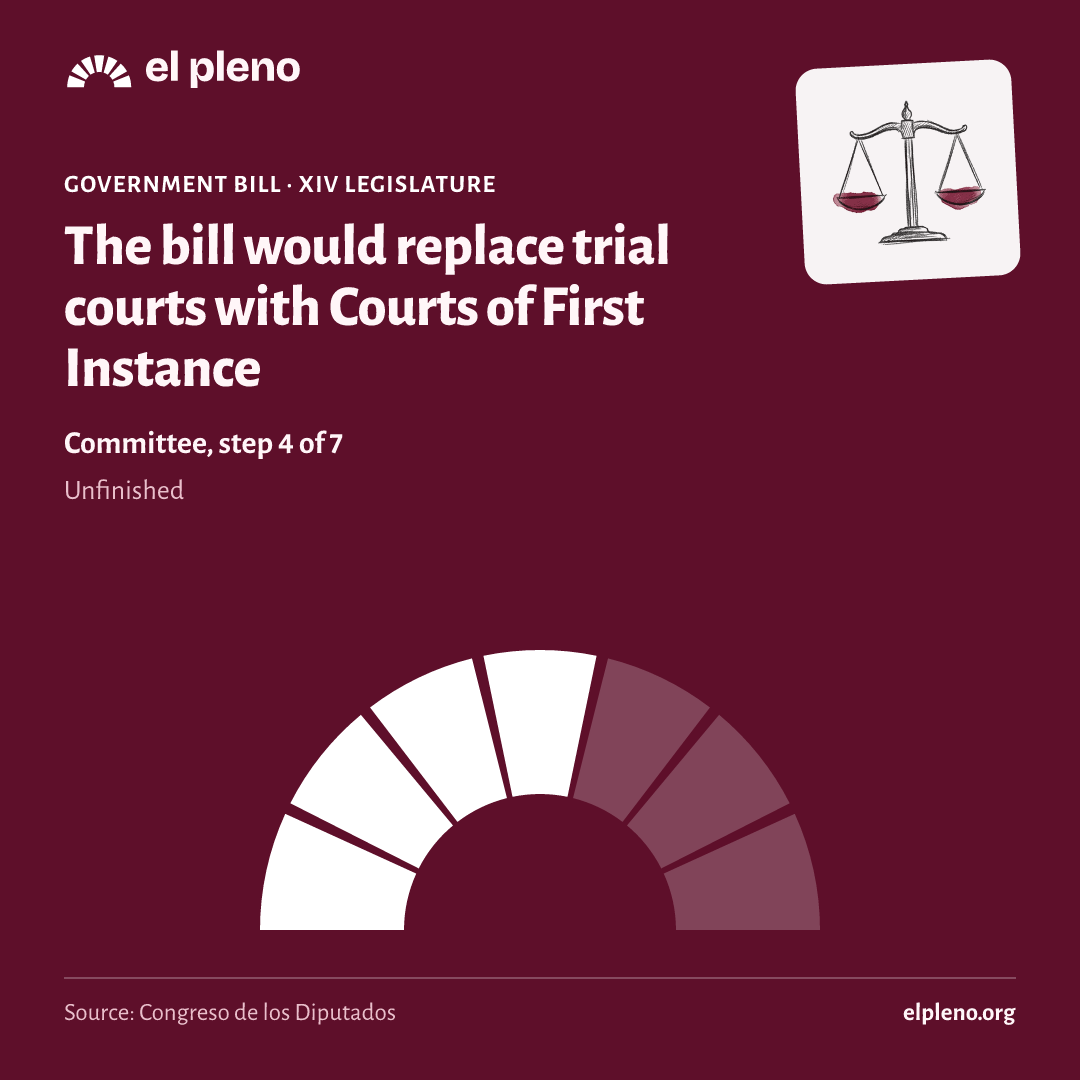
Source: Congreso de los Diputados, file 121/000098· updated 11 Nov
Automatic summary, not yet reviewed
- The bill would create Courts of First Instance (Tribunales de Instancia), collegiate bodies that would replace the current single-judge courts as the first level of the justice system. There would be one in each judicial district.
- The Courts of First Instance could have specialized divisions: civil, criminal investigation, commercial, violence against women, violence against children and adolescents, minors, prison oversight, administrative and social.
- The bill would transform Justices of the Peace courts into Justice Offices in municipalities. These offices would offer more services than the current justice of the peace courts and would avoid trips to provincial capitals.
- The court office would be reorganized into procedural processing units, led by a court clerk (letrado de la Administración de Justicia), and into shared procedural services.
- It would create a Commission for the Quality of the public justice service, with state and regional representation, which would issue an annual report on service quality and propose improvements.
- The Courts of First Instance would be set up in stages: at three, six and twelve months after the law takes effect, depending on the type of courts in each district. The Central Courts would become the Central Court of First Instance within twelve months.
- When each Court of First Instance is set up, justices of the peace would leave office and their pending cases would go to the sole or civil division of the district. If only the final ruling was missing, the justice of the peace would issue it.
- The bill would also amend other laws: the Insolvency Law, the Foundations Law, the Capital Companies Law, the consumer alternative dispute resolution law and the organic law A law on fundamental rights, the electoral system or other matters the Constitution reserves. It needs an absolute majority in the Congreso: 176 votes. on full guarantee of sexual freedom.
Who it affects
- The general public: The first level of the justice system would move from single-judge courts to Courts of First Instance, and municipalities would have Justice Offices with more services.
- Judges and magistrates: Their courts would become divisions of the new tribunals, with new presidencies, assemblies and case assignment rules.
- Court staff: They would be integrated into the new procedural processing units, shared services and municipal Justice Offices.
- Town councils: They would be responsible for the premises of the Justice Offices and would receive a subsidy from the State budget.
- People in small or rural municipalities: They could handle justice-related paperwork in their own municipality without traveling to the provincial capital.
Words worth knowing
- Tribunal de Instancia
- New collegiate court that would replace the current single-judge courts as the first level of the justice system.
- Partido judicial
- Judicial district: a territory made up of one or several municipalities that groups the area's courts.
- Oficina judicial
- Court office: the administrative structure that supports judges and tribunals, processing cases and managing shared services.
- Órgano colegiado
- Collegiate body: an organ made up of several people (judges or magistrates), as opposed to a single-judge one.
- Sección
- Division: each of the parts into which a tribunal is split, usually specialized in one area of law (civil, criminal, social, etc.).
- organic law
- A law on fundamental rights, the electoral system or other matters the Constitution reserves. It needs an absolute majority in the Congreso: 176 votes.
It summarizes the drafting committee report. It is written by artificial intelligence and may contain mistakes: the official text is what counts. Read the official text · How we make summaries
Where it stands
How far did it get?
It took 4 of 7 steps. It reached Committee, and today it is unfinished.
- Introduced13 April 2022Someone registers the text in the Congreso.
- Admitted19 April 2022The Bureau of the Congreso accepts it and, for a members’ bill, the plenary decides whether to consider it.
- Amendments22 April 2022Groups propose changes.
- Committee15 September 2022A committee goes through the text in detail.
- Plenarynot reachedAll 350 deputies vote.
- Senatenot reachedThe Senate can pass it, amend it or veto it.
- BOEnot reachedIt is published in the Official State Gazette (BOE) and comes into force.
See the 7 official steps on a timeline
Was there a plenary vote?
We have no plenary vote linked to this law in the Congreso’s data.
What happens next
What happens now?
The legislature ended before it finished. To go on, someone would have to introduce it again in the new Cortes.
It has not been presented again yet.
Sources
Where does all this come from?
- Congreso de los Diputados, file 121/000098
Official title, type, author, dates and stage.
Retrieved 11 November 2026
- The data comes from the open files of the Congreso, the Senate and the BOE, unaltered.
- Each deputy’s province is the one of their seat on the day of the vote.
- We only say “passed” or “rejected” when the majority needed is certain; otherwise we say which side had more votes.