What it is
Bill would align several Spanish laws with EU directives
It is a government bill. Introduced by the Government. It was introduced on 13 May 2021. Introduced by: Gobierno.
Official title: Government bill on the transposition of European Union directives in the areas of competition, prevention of money laundering, credit institutions, telecommunications, tax measures, prevention and repair of environmental damage, posting of workers in the provision of cross-border services, and consumer protection (originating from Royal Decree-Law 7/2021, of April 27)
Source: Congreso de los Diputados, file 121/000055· updated 11 Nov
Automatic summary, not yet reviewed
- The bill would strengthen the powers of the National Markets and Competition Commission (CNMC) to investigate cartels and abuses: more cooperation duties, interviews, broader inspections and revised fines, to comply with the EU ECN+ directive.
- It would tighten anti-money laundering rules: virtual currency exchangers and electronic wallet custodians would have to register, and a central Register of Beneficial Owners would be created at the Ministry of Justice with limited public access.
- It would adapt banking rules to EU solvency and resolution directives: new approval rules for financial holding companies, dividend limits for banks that fail capital buffer requirements, and changes to the shareholder exit right linked to missing dividends.
- It would extend the duration of radio spectrum licenses: a minimum of 20 years, with a possible extension of 5 to 20 more, to give security to 5G investments, especially in the 700 MHz band.
- It would reform VAT on electronic commerce: new rules for distance sales within the EU, removal of the exemption for imports under 22 euros, and three one-stop-shop schemes to declare VAT in a single member state.
- It would improve the rights of workers posted to Spain: after 12 months of posting (18 if justified), almost all Spanish labor law would apply to them, and rules on housing, travel expenses and chained posting by temp agencies would be regulated.
- It would broaden who can request prevention or repair of environmental damage: any natural or legal person affected or potentially affected, not only those with standing as an interested party.
- It would strengthen consumer protection for goods and digital content: a 3-year warranty period for goods, a presumption that defects existed during the first 2 years, spare parts and repair service for 10 years, and new rules for contracts where consumers pay with their personal data.
Who it affects
- Companies investigated for anticompetitive practices: They would face more cooperation duties toward the CNMC and broader inspections and fines.
- Crypto and digital wallet operators: They would have to register with the Bank of Spain and comply with anti-money laundering rules.
- Consumers who shop online: They would get longer warranties on goods and new protection when paying with personal data.
- Workers posted to Spain from other EU countries: Postings longer than 12 months would bring almost all Spanish labor law into play for them.
- Telecommunications operators: They could get longer spectrum licenses, giving more security to their 5G investments.
Words worth knowing
- Directiva europea (EU directive)
- An EU rule that requires each member country to adapt its laws to reach a common goal.
- Blanqueo de capitales (money laundering)
- Giving a legal appearance to money that comes from criminal activity.
- Titular real (beneficial owner)
- The natural person who ultimately owns or controls a company, even if someone else is listed.
- Ventanilla única (one-stop shop, VAT)
- A system that lets a business declare and pay VAT for the whole EU in a single country.
- Desplazamiento de trabajadores (posting of workers)
- When a company temporarily sends its workers to work in another country.
It summarizes the text as it was introduced. It is written by artificial intelligence and may contain mistakes: the official text is what counts. Read the official text · How we make summaries
Where it stands
How far did it get?
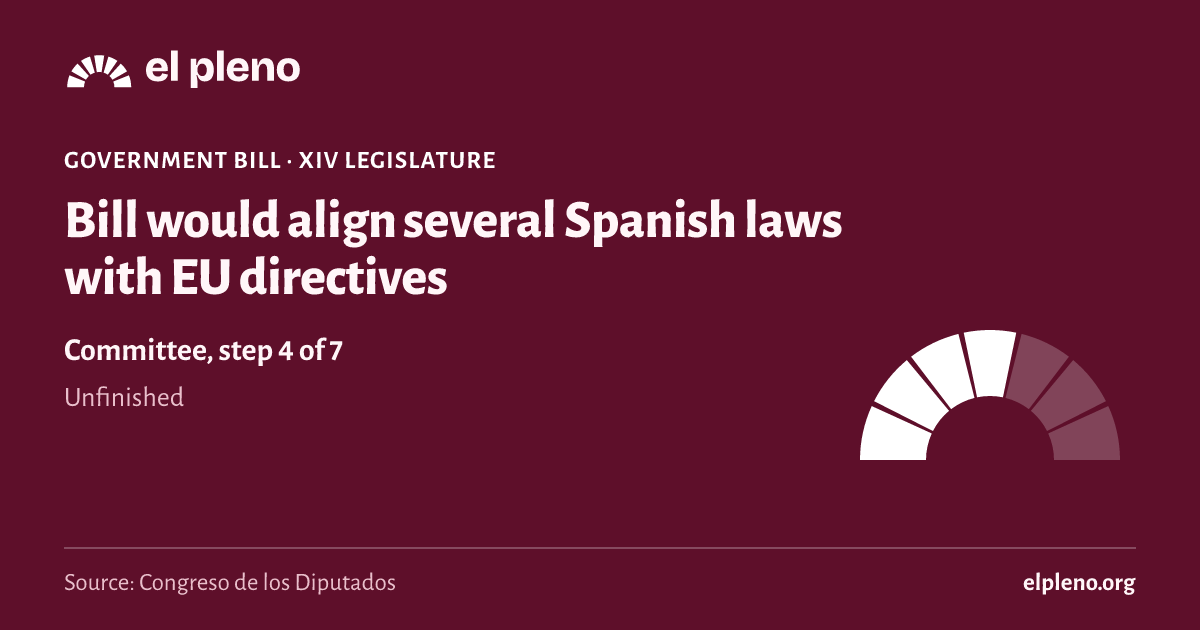
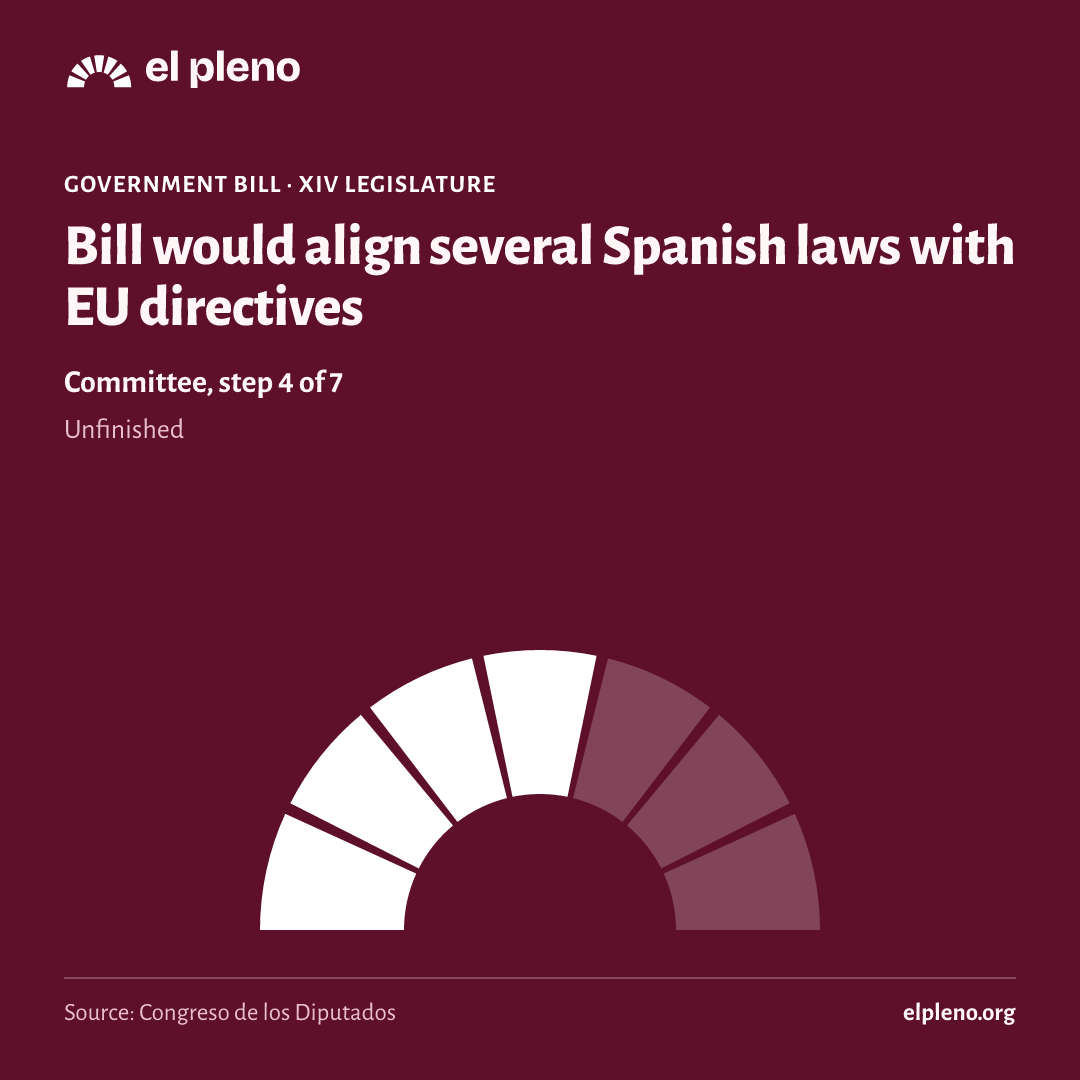
It took 4 of 7 steps. It reached Committee, and today it is unfinished.
- Introduced13 May 2021Someone registers the text in the Congreso.
- Admitted18 May 2021The Bureau of the Congreso accepts it and, for a members’ bill, the plenary decides whether to consider it.
- Amendments21 May 2021Groups propose changes.
- Committee23 September 2021A committee goes through the text in detail.
- Plenarynot reachedAll 350 deputies vote.
- Senatenot reachedThe Senate can pass it, amend it or veto it.
- BOEnot reachedIt is published in the Official State Gazette (BOE) and comes into force.
See the 6 official steps on a timeline
Was there a plenary vote?
We have no plenary vote linked to this law in the Congreso’s data.
What happens next
What happens now?
The legislature ended before it finished. To go on, someone would have to introduce it again in the new Cortes.
It has not been presented again yet.
Sources
Where does all this come from?
- Congreso de los Diputados, file 121/000055
Official title, type, author, dates and stage.
Retrieved 11 November 2026
- The data comes from the open files of the Congreso, the Senate and the BOE, unaltered.
- Each deputy’s province is the one of their seat on the day of the vote.
- We only say “passed” or “rejected” when the majority needed is certain; otherwise we say which side had more votes.