What it is
Direct aid and solvency support for businesses and self-employed hit by COVID-19
It is a government bill. Introduced by the Government. It was introduced on 25 March 2021. Introduced by: Gobierno.
Official title: Government bill on extraordinary measures to support business solvency in response to the COVID-19 pandemic (originating from Royal Decree-Law 5/2021, of March 12).
Source: Congreso de los Diputados, file 121/000052· updated 11 Nov
Automatic summary, not yet reviewed
- The bill would create a Covid Line of direct aid worth 7 billion euros for self-employed people and companies whose sales fell by at least 30% in 2020 compared to 2019 and that belong to the sectors listed in Annex I. The aid would go to paying debts, suppliers and fixed costs.
- The money would be split into two compartments: 5 billion euros for all autonomous communities except the Balearic Islands and the Canary Islands, and 2 billion for those two. The autonomous communities and the cities of Ceuta and Melilla would run the calls, manage and pay out the aid.
- Maximum aid amounts would vary by size and drop in activity: up to 3,000 euros for those taxed under the objective estimate regime, and for everyone else a percentage of the sales drop (40% with 10 or fewer employees, 20% with more), with a minimum of 4,000 and a maximum of 200,000 euros.
- Aid recipients would have to keep operating until June 30, 2022, and could not pay dividends in 2021 and 2022 or raise senior management pay for two years. If they fail to comply, they must return the money.
- A 3-billion-euro line would be created to restructure debt backed by public guarantees: maturities of guaranteed loans could be extended, loans could be converted into participative loans, and, as a last resort, transfers could be made to reduce outstanding debt, always within renegotiation agreements with the banks.
- A voluntary Code of Good Practices would be created for financial institutions, encouraging coordination among creditors. A control committee would oversee compliance, and breaches could be sanctioned.
- A Fund for the recapitalization of companies affected by COVID-19 would be created, with 1 billion euros, managed by COFIDES, to strengthen the solvency of viable mid-sized companies. It would last a maximum of eight years.
- Insolvency moratoriums would be extended until December 31, 2021: insolvent debtors would not have to file for bankruptcy and creditors' involuntary bankruptcy petitions would not be accepted. Also, tax deferrals without late-payment interest would be extended to four months.
Who it affects
- Self-employed people and companies in the sectors listed in Annex I with a sales drop of at least 30% in 2020: They could apply for direct aid to pay debts, suppliers and fixed costs.
- Companies and self-employed people with State-guaranteed loans: They could use debt restructuring measures if they meet the requirements.
- Viable mid-sized companies with solvency problems caused by the pandemic: They could seek support from the new recapitalization fund managed by COFIDES.
- Autonomous communities and the cities of Ceuta and Melilla: They would run the calls, payments and controls for the direct aid.
- People and entities deferring tax debts: They could defer payments for six months with no late-payment interest during the first four months.
Words worth knowing
- Aval público (public guarantee)
- A State guarantee: if the company does not repay the loan, the State answers to the bank.
- Préstamo participativo (participative loan)
- A loan whose interest depends on the company's profits and that, for commercial law purposes, counts almost as equity.
- Concurso de acreedores (creditors' bankruptcy proceeding)
- A court procedure for a company or person that cannot pay its debts.
- CNAE
- National Classification of Economic Activities: codes that identify each company's line of business.
- Estimación objetiva (objective estimate regime)
- A tax regime for self-employed people and small businesses that taxes by standard modules, not actual income.
It summarizes the text as it was introduced. It is written by artificial intelligence and may contain mistakes: the official text is what counts. Read the official text · How we make summaries
Where it stands
How far did it get?
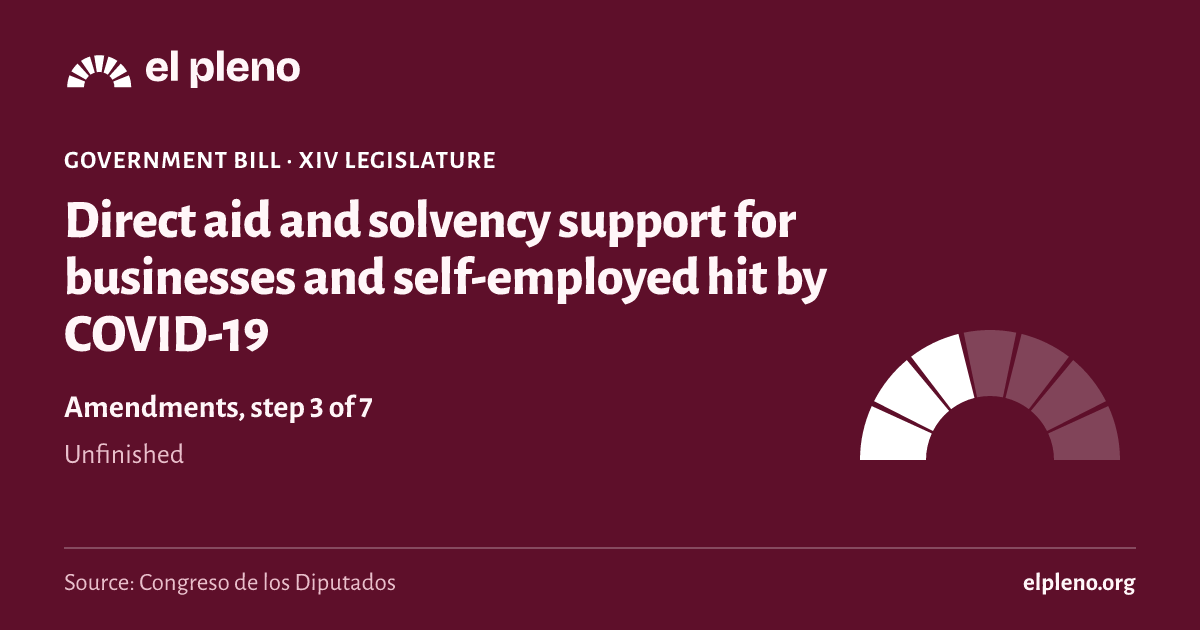
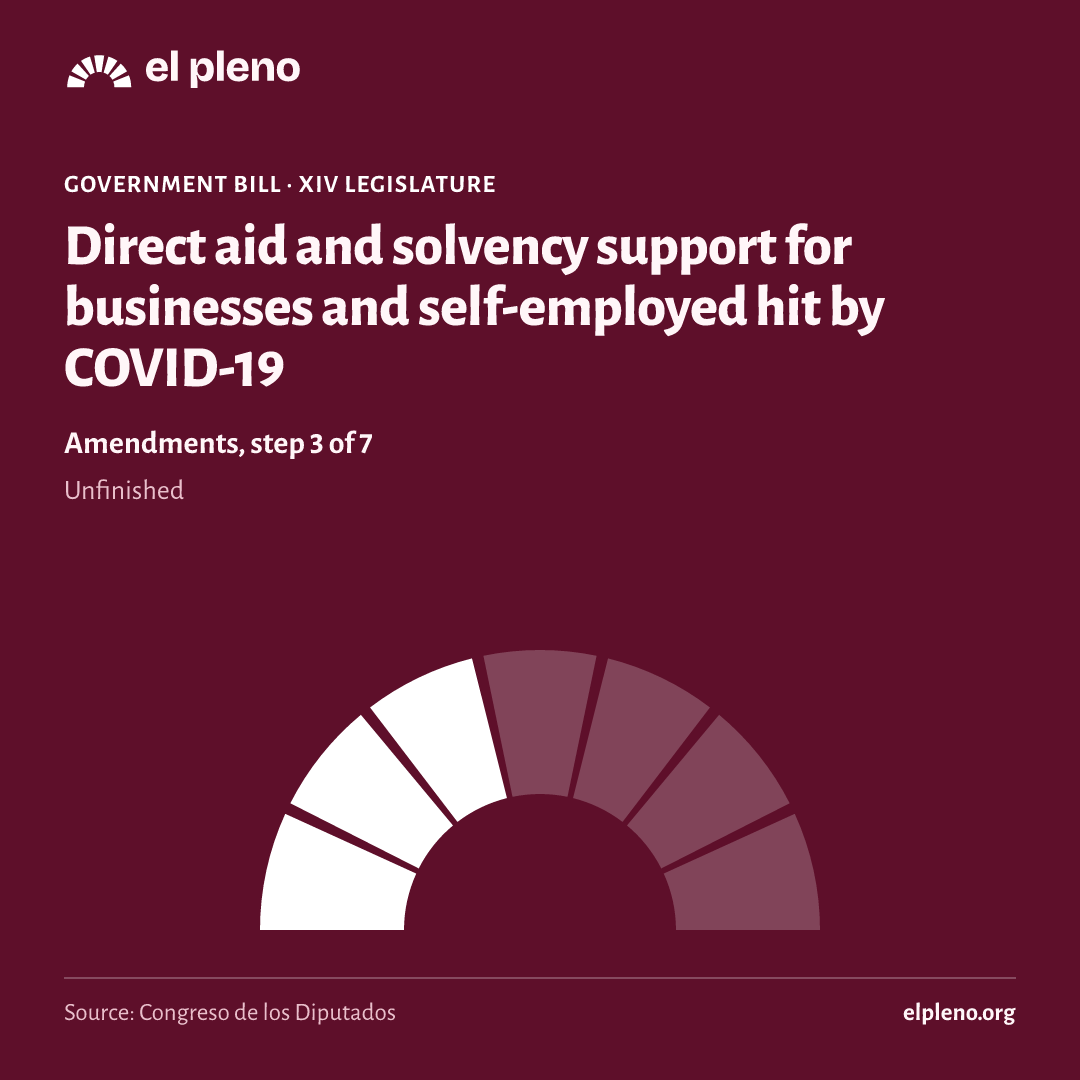
It took 3 of 7 steps. It reached Amendments, and today it is unfinished.
- Introduced25 March 2021Someone registers the text in the Congreso.
- Admitted6 April 2021The Bureau of the Congreso accepts it and, for a members’ bill, the plenary decides whether to consider it.
- Amendments9 April 2021Groups propose changes.
- Committeenot reachedA committee goes through the text in detail.
- Plenarynot reachedAll 350 deputies vote.
- Senatenot reachedThe Senate can pass it, amend it or veto it.
- BOEnot reachedIt is published in the Official State Gazette (BOE) and comes into force.
See the 5 official steps on a timeline
Was there a plenary vote?
We have no plenary vote linked to this law in the Congreso’s data.
What happens next
What happens now?
The legislature ended before it finished. To go on, someone would have to introduce it again in the new Cortes.
It has not been presented again yet.
Sources
Where does all this come from?
- Congreso de los Diputados, file 121/000052
Official title, type, author, dates and stage.
Retrieved 11 November 2026
- The data comes from the open files of the Congreso, the Senate and the BOE, unaltered.
- Each deputy’s province is the one of their seat on the day of the vote.
- We only say “passed” or “rejected” when the majority needed is certain; otherwise we say which side had more votes.