What it is
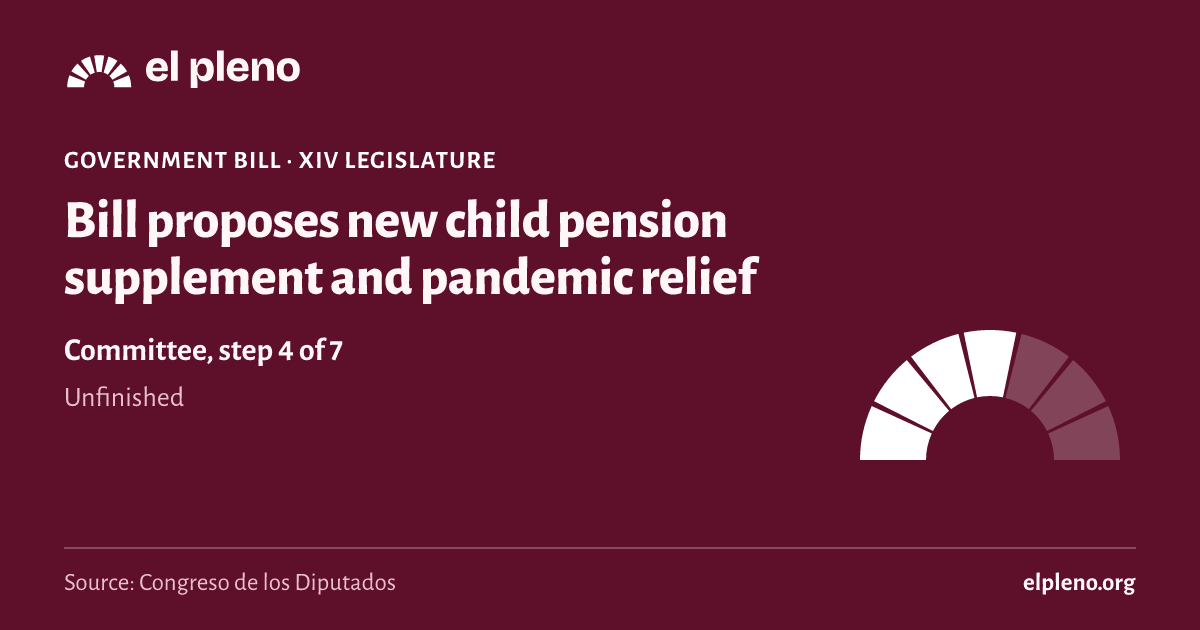
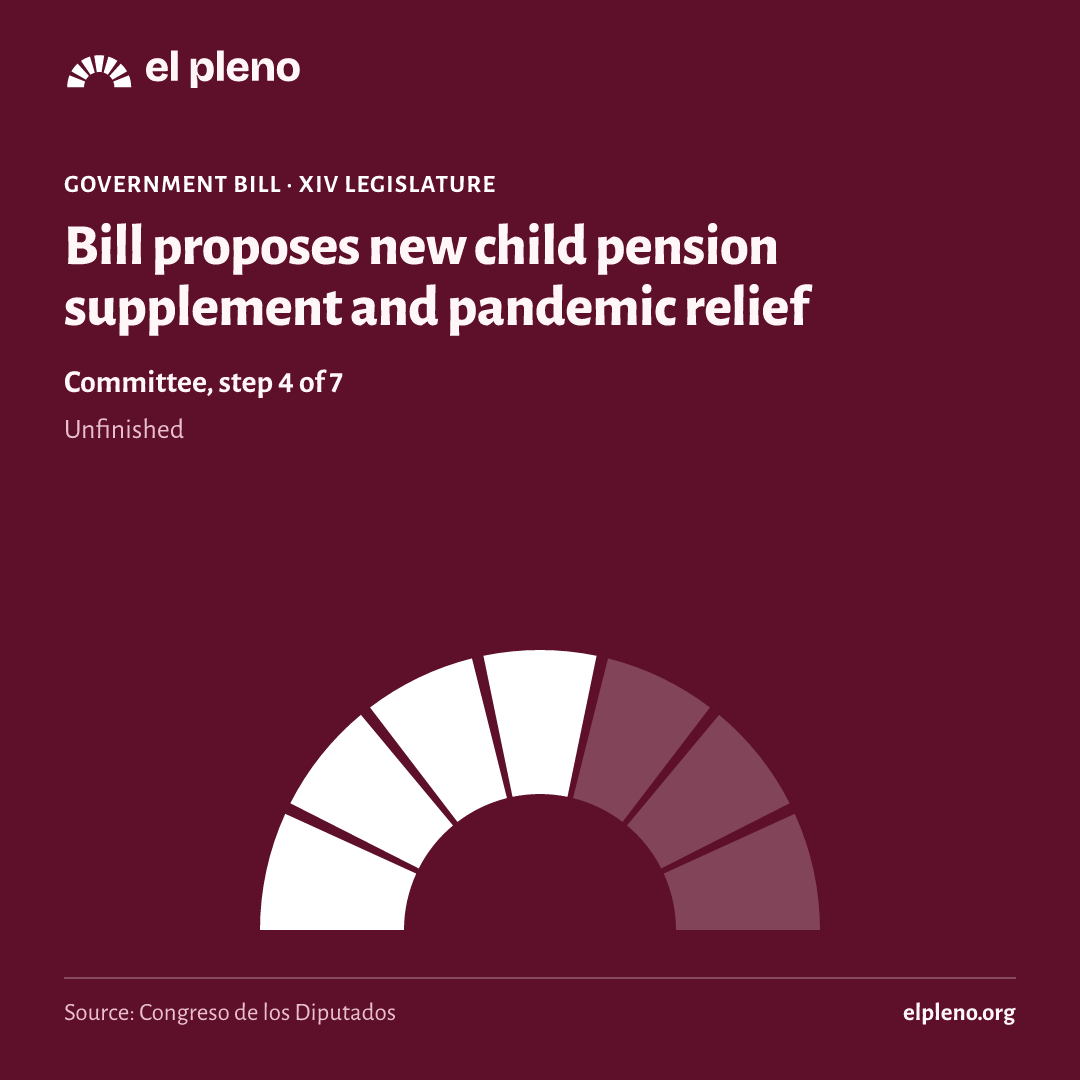
Bill proposes new child pension supplement and pandemic relief
It is a government bill. Introduced by the Government. It was introduced on 18 February 2021. Introduced by: Gobierno.
Official title: Government bill to adopt measures for the reduction of the gender gap and other matters in the fields of Social Security and economics (originating from Royal Decree-Law 3/2021, of February 2).
Source: Congreso de los Diputados, file 121/000049· updated 11 Nov
Automatic summary, not yet reviewed
- The bill would replace the maternity supplement with a supplement to reduce the gender gap in pensions. Women receiving a pension would get it for each child, and men could also get it if they prove their contribution record was harmed by childcare.
- The supplement would be set at 27 euros per month per child for 2021, paid in fourteen installments, and would only remain in force while the gender gap in retirement pensions is above 5%. Those already receiving the maternity supplement would keep it.
- The bill would expand access to the minimum vital income: people living in privately funded residential facilities could receive it, the limit on recipients per home would be removed, and special cases such as registration in collective facilities, substandard housing or homelessness would be regulated.
- It would create the figure of minimum vital income social mediators: third-sector social action organizations that, for five years, could certify certain situations to speed up access to the benefit.
- Retired health professionals who voluntarily return to work during the state of alarm could combine their pension with paid work, and those who catch COVID-19 on the job would receive the same benefits as for an occupational disease.
- The bill would extend until March 30, 2021 the deadline to request payment moratoriums on mortgage and non-mortgage debts, with a maximum cumulative duration of nine months. In addition, the Official Credit Institute could obtain credit ratings from the Bank of Spain for guaranteed companies, under a duty of confidentiality.
Who it affects
- Women pensioners with children, and fathers who prove their career was harmed by childcare: They could receive the new supplement for each child.
- People in situations of vulnerability or social exclusion: They would have more ways to access the minimum vital income.
- Self-employed workers taxed under the objective estimation method: It would be easier for them to prove their income dropped to receive the cessation-of-activity benefit.
- Health and social health care workers: Those rehired after retirement could combine pension and work, and those infected with COVID-19 at work would get occupational disease protection.
- Families and self-employed people with mortgage or non-mortgage loans: They would have more time to request payment moratoriums, with a nine-month cumulative maximum.
Words worth knowing
- Brecha de género (gender gap)
- The difference between men and women; here, the difference between the average pension of each.
- Ingreso mínimo vital (minimum vital income)
- A monthly Social Security payment for people and families with low income.
- Moratoria (moratorium)
- A temporary deferral or suspension of debt payments.
- Estimación objetiva (objective estimation)
- A tax method for some self-employed workers who pay based on set modules, not actual revenue.
- Enfermedad profesional (occupational disease)
- An illness caused by work, which entitles the worker to better Social Security benefits than a common illness.
It summarizes the text as it was introduced. It is written by artificial intelligence and may contain mistakes: the official text is what counts. Read the official text · How we make summaries
Where it stands
How far did it get?
It took 4 of 7 steps. It reached Committee, and today it is unfinished.
- Introduced18 February 2021Someone registers the text in the Congreso.
- Admitted23 February 2021The Bureau of the Congreso accepts it and, for a members’ bill, the plenary decides whether to consider it.
- Amendments26 February 2021Groups propose changes.
- Committee16 March 2021A committee goes through the text in detail.
- Plenarynot reachedAll 350 deputies vote.
- Senatenot reachedThe Senate can pass it, amend it or veto it.
- BOEnot reachedIt is published in the Official State Gazette (BOE) and comes into force.
See the 7 official steps on a timeline
25 March 2021
How did the plenary vote?
Voted on: Vote on the amendment to the whole of the alternative text to the Government bill adopting measures for the reduction of the gender gap and other matters in the fields of Social Security and the economy (originating from Royal Decree-Law 3/2021, of February 2), presented by the Popular Parliamentary Group in the Congress.
Source: Congreso de los Diputados, vote 10 of sitting 88· updated 11 Nov
Each dot is a seat. Tap one, or use the arrow keys, to see who it is.
Your province
How did the deputies from your province vote?
And your senators: the Senate does not link its votes to this law in its open data, so we cannot put them side by side here.
Or see how most of each province voted
- A Coruña More votes against 3 yes · 5 no
- Albacete More votes against 1 yes · 2 no · 1 abst.
- Alicante/Alacant More votes against 3 yes · 6 no · 3 abst.
- Almería Tie 2 yes · 2 no · 2 abst.
- Araba/Álava More votes against 0 yes · 4 no
- Asturias More votes against 2 yes · 4 no · 1 abst.
- Ávila Tie 1 yes · 1 no · 1 abst.
- Badajoz More votes against 2 yes · 3 no · 1 abst.
- Barcelona More votes against 2 yes · 26 no · 4 abst.
- Bizkaia More votes against 1 yes · 7 no
- Burgos Tie 2 yes · 2 no
- Cáceres More votes against 1 yes · 2 no · 1 abst.
- Cádiz More votes against 2 yes · 4 no · 3 abst.
- Cantabria Tie 2 yes · 2 no · 1 abst.
- Castellón/Castelló More votes against 1 yes · 3 no · 1 abst.
- Ceuta Tie 0 yes · 0 no · 1 abst.
- Ciudad Real Tie 2 yes · 2 no · 1 abst.
- Córdoba More votes against 2 yes · 3 no · 1 abst.
- Cuenca More votes against 1 yes · 2 no
- Gipuzkoa More votes against 0 yes · 6 no
- Girona More votes against 0 yes · 6 no
- Granada More votes against 2 yes · 4 no · 1 abst.
- Guadalajara Tie 1 yes · 1 no · 1 abst.
- Huelva More votes against 1 yes · 3 no · 1 abst.
- Huesca More votes against 1 yes · 2 no
- Illes Balears More votes against 2 yes · 3 no · 2 abst.
- Jaén More votes against 1 yes · 3 no · 1 abst.
- La Rioja Tie 2 yes · 2 no
- Las Palmas More votes against 2 yes · 5 no · 1 abst.
- León More votes against 1 yes · 2 no · 1 abst.
- Lleida More votes against 0 yes · 4 no
- Lugo Tie 2 yes · 2 no
- Madrid More votes against 10 yes · 17 no · 10 abst.
- Málaga More votes against 3 yes · 5 no · 3 abst.
- Melilla More votes in favour 1 yes · 0 no
- Murcia More votes against 3 yes · 4 no · 3 abst.
- Navarra More votes against 2 yes · 3 no
- Ourense Tie 2 yes · 2 no
- Palencia More votes in favour 2 yes · 1 no
- Pontevedra More votes against 3 yes · 4 no
- Salamanca More votes in favour 2 yes · 1 no · 1 abst.
- Santa Cruz de Tenerife More votes against 2 yes · 4 no · 1 abst.
- Segovia Tie 1 yes · 1 no · 1 abst.
- Sevilla More votes against 3 yes · 7 no · 2 abst.
- Soria Tie 1 yes · 1 no
- Tarragona More votes against 0 yes · 6 no
- Teruel More votes against 1 yes · 2 no
- Toledo Tie 2 yes · 2 no · 2 abst.
- Valencia/València More votes against 4 yes · 7 no · 4 abst.
- Valladolid Tie 2 yes · 2 no · 1 abst.
- Zamora Tie 1 yes · 1 no · 1 abst.
- Zaragoza More votes against 2 yes · 4 no · 1 abst.
More details: how each group and each province voted
The groups
Who voted in favour and who against?
In favour, most of Popular en el Congreso. Against, most of Euskal Herria Bildu, Republicano, Socialista, Vasco (EAJ-PNV), Mixto, Gcup-ec-gc and GPlu. 5 deputies voted differently from their group.
By province: in 3 most voted in favour; in 34, against.
Coloured by how most of each province’s deputies voted.
- In favour: 3
- Against: 34
- Abstained: 1
- Tie: 14
| Group | Seats | How it voted |
|---|---|---|
| Euskal Herria Bildu | 5 | 5 against |
| Republicano | 13 | 13 against |
| Socialista | 120 | 120 against |
| Vasco (EAJ-PNV) | 6 | 6 against |
| Mixto | 10 | 4 in favour · 6 against |
| Ciudadanos | 9 | 9 abst. |
| Gcup-ec-gc | 35 | 34 against · 1 did not vote |
| GPlu | 12 | 12 against |
| Popular en el Congreso | 88 | 88 in favour |
| VOX | 52 | 1 against · 51 abst. |
What happens next
What happens now?
The legislature ended before it finished. To go on, someone would have to introduce it again in the new Cortes.
It has not been presented again yet.
Sources
Where does all this come from?
- Congreso de los Diputados, file 121/000049
Official title, type, author, dates and stage.
Retrieved 11 November 2026
- Congreso de los Diputados, vote 10 of sitting 88
The count and every seat’s vote.
Retrieved 11 November 2026
- The data comes from the open files of the Congreso, the Senate and the BOE, unaltered.
- Each deputy’s province is the one of their seat on the day of the vote.
- We only say “passed” or “rejected” when the majority needed is certain; otherwise we say which side had more votes.