What it is
Streamlining government to manage EU recovery funds
It is a government bill. Introduced by the Government. It was introduced on 4 January 2021. Introduced by: Gobierno.
Official title: Government bill approving urgent measures for the modernization of the Public Administration and for the execution of the Recovery, Transformation and Resilience Plan (originating from Royal Decree-Law 36/2020, of 30 December).
Source: Congreso de los Diputados, file 121/000043· updated 11 Nov
Automatic summary, not yet reviewed
- The bill would set out management principles for public bodies handling EU funds, including strategic planning, agility, transparency and effective spending control.
- It would create a new form of public-private collaboration, the PERTE Proyecto Estratégico para la Recuperación y Transformación Económica: a large strategic public-private collaboration project with spillover effects on the economy., for large strategic projects that boost the economy, declared by the Council of Ministers.
- It would create the State Register of entities interested in PERTE projects, under the Ministry of Finance, and would allow registration to be required to receive aid linked to those projects.
- It would organize the governance of the Recovery Plan: a Commission chaired by the Prime Minister, a supporting Technical Committee, a Sectoral Conference with the autonomous communities, and social participation forums.
- It would relax budget rules: multi-year spending commitments of up to five years, carryover of unused credit, and early processing of spending files for later years.
- It would speed up public procurement of projects funded by these funds: urgent processing, shorter deadlines, model contract terms and higher thresholds for simplified procedures.
- It would simplify EU-funded grants: some prior authorizations would be removed, grants could be awarded in order of application, and beneficiaries would submit less paperwork.
- It would shorten deadlines for environmental assessment procedures and for environmental permits of industrial facilities, to speed up EU-funded projects.
Who it affects
- Public administrations and their staff: They would follow new management principles and guidelines, prepare strategic plans, and could receive performance-based variable pay.
- Companies and entities wanting to join PERTE projects: They would need to be accredited and registered in the state register to access aid linked to these projects.
- Companies contracting with the public sector: Contracts funded by these funds would be processed urgently with shorter deadlines.
- Entities applying for EU grants: They would face simpler procedures and less documentation to justify.
- Developers of projects with environmental impact: Their environmental assessments would be decided within shorter time limits.
Words worth knowing
- PERTE
- Proyecto Estratégico para la Recuperación y Transformación Económica: a large strategic public-private collaboration project with spillover effects on the economy.
- Mecanismo de Recuperación y Resiliencia
- Recovery and Resilience Facility: an EU fund created to finance the economic recovery of EU countries after the pandemic.
- Función interventora
- Prior control exercised by the State's audit office to check that public spending is legal and correct before payment.
- Convenio administrativo
- Administrative agreement: a collaboration deal signed between public administrations or between them and private entities.
- Evaluación ambiental
- Environmental assessment: a procedure that analyzes the impact of a project or plan on the environment before approval.
It summarizes the text as it was introduced. It is written by artificial intelligence and may contain mistakes: the official text is what counts. Read the official text · How we make summaries
Where it stands
How far did it get?
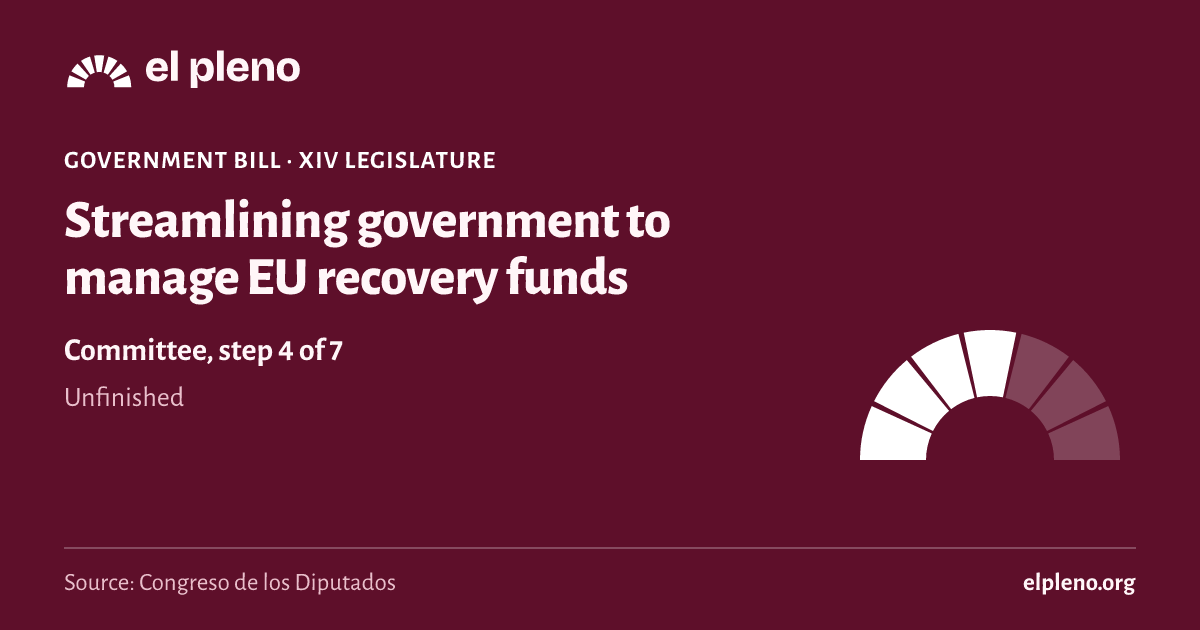
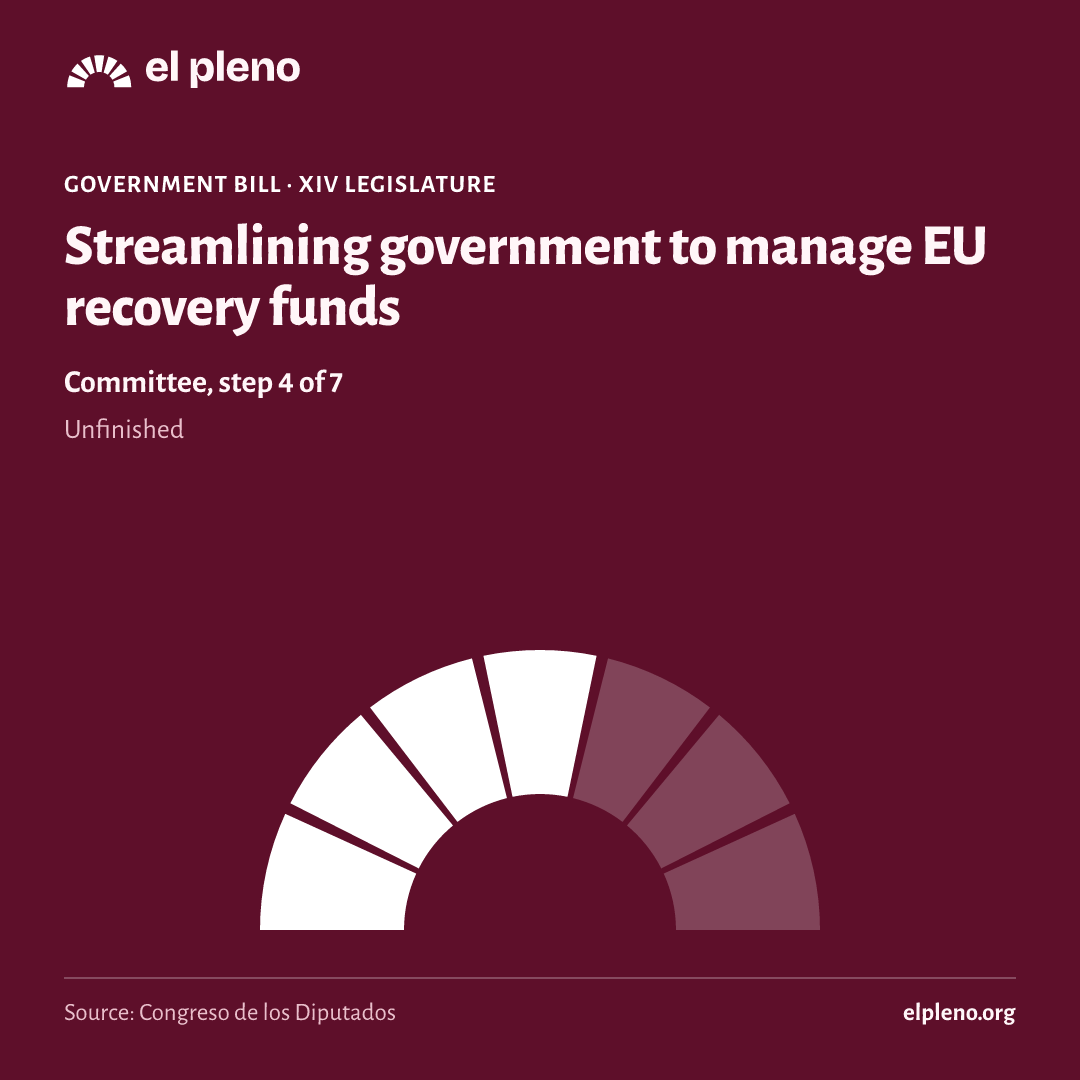
It took 4 of 7 steps. It reached Committee, and today it is unfinished.
- Introduced4 January 2021Someone registers the text in the Congreso.
- Admitted2 February 2021The Bureau of the Congreso accepts it and, for a members’ bill, the plenary decides whether to consider it.
- Amendments5 February 2021Groups propose changes.
- Committee16 February 2021A committee goes through the text in detail.
- Plenarynot reachedAll 350 deputies vote.
- Senatenot reachedThe Senate can pass it, amend it or veto it.
- BOEnot reachedIt is published in the Official State Gazette (BOE) and comes into force.
See the 7 official steps on a timeline
25 February 2021
How did the plenary vote?
Voted on: Vote on the amendment to the whole with alternative text to the Government bill approving urgent measures for the modernization of the Public Administration and for the execution of the Recovery, Transformation and Resilience Plan (Royal Decree-Law 36/2020, of 30 December), submitted by the Ciudadanos Parliamentary Group.
Source: Congreso de los Diputados, vote 7 of sitting 79· updated 11 Nov
Each dot is a seat. Tap one, or use the arrow keys, to see who it is.
Your province
How did the deputies from your province vote?
And your senators: the Senate does not link its votes to this law in its open data, so we cannot put them side by side here.
Or see how most of each province voted
- A Coruña More votes against 3 yes · 5 no
- Albacete More votes against 1 yes · 3 no
- Alicante/Alacant More votes against 4 yes · 8 no
- Almería More votes against 2 yes · 4 no
- Araba/Álava More votes against 0 yes · 4 no
- Asturias More votes against 2 yes · 5 no
- Ávila More votes against 1 yes · 2 no
- Badajoz More votes against 2 yes · 4 no
- Barcelona More votes against 4 yes · 27 no · 1 abst.
- Bizkaia More votes against 1 yes · 7 no
- Burgos Tie 2 yes · 2 no
- Cáceres More votes against 1 yes · 3 no
- Cádiz More votes against 3 yes · 6 no
- Cantabria More votes against 2 yes · 3 no
- Castellón/Castelló More votes against 1 yes · 4 no
- Ceuta More votes against 0 yes · 1 no
- Ciudad Real More votes against 2 yes · 3 no
- Córdoba More votes against 2 yes · 4 no
- Cuenca More votes against 1 yes · 2 no
- Gipuzkoa More votes against 0 yes · 6 no
- Girona More votes against 0 yes · 6 no
- Granada More votes against 2 yes · 5 no
- Guadalajara More votes against 1 yes · 2 no
- Huelva More votes against 1 yes · 4 no
- Huesca More votes against 1 yes · 2 no
- Illes Balears More votes against 2 yes · 6 no
- Jaén More votes against 1 yes · 4 no
- La Rioja Tie 2 yes · 2 no
- Las Palmas More votes against 3 yes · 5 no
- León More votes against 1 yes · 3 no
- Lleida More votes against 0 yes · 4 no
- Lugo Tie 2 yes · 2 no
- Madrid More votes against 13 yes · 24 no
- Málaga More votes against 4 yes · 7 no
- Melilla More votes in favour 1 yes · 0 no
- Murcia More votes against 3 yes · 7 no
- Navarra More votes against 2 yes · 3 no
- Ourense Tie 2 yes · 2 no
- Palencia More votes in favour 2 yes · 1 no
- Pontevedra More votes against 3 yes · 4 no
- Salamanca Tie 2 yes · 2 no
- Santa Cruz de Tenerife More votes against 2 yes · 5 no
- Segovia More votes against 1 yes · 2 no
- Sevilla More votes against 3 yes · 9 no
- Soria Tie 1 yes · 1 no
- Tarragona More votes against 0 yes · 6 no
- Teruel More votes against 1 yes · 2 no
- Toledo More votes against 2 yes · 4 no
- Valencia/València More votes against 5 yes · 10 no
- Valladolid More votes against 2 yes · 3 no
- Zamora More votes against 1 yes · 2 no
- Zaragoza More votes against 2 yes · 5 no
More details: how each group and each province voted
The groups
Who voted in favour and who against?
In favour, most of Ciudadanos and Popular en el Congreso. Against, most of Euskal Herria Bildu, Republicano, Socialista, Vasco (EAJ-PNV), Mixto, Gcup-ec-gc, GPlu and VOX. 5 deputies voted differently from their group.
By province: in 2 most voted in favour; in 44, against.
Coloured by how most of each province’s deputies voted.
- In favour: 2
- Against: 44
- Tie: 6
| Group | Seats | How it voted |
|---|---|---|
| Euskal Herria Bildu | 5 | 5 against |
| Republicano | 13 | 12 against · 1 abst. |
| Socialista | 120 | 120 against |
| Vasco (EAJ-PNV) | 6 | 6 against |
| Mixto | 9 | 4 in favour · 5 against |
| Ciudadanos | 10 | 10 in favour |
| Gcup-ec-gc | 35 | 35 against |
| GPlu | 12 | 12 against |
| Popular en el Congreso | 88 | 88 in favour |
| VOX | 52 | 52 against |
What happens next
What happens now?
The legislature ended before it finished. To go on, someone would have to introduce it again in the new Cortes.
It has not been presented again yet.
Sources
Where does all this come from?
- Congreso de los Diputados, file 121/000043
Official title, type, author, dates and stage.
Retrieved 11 November 2026
- Congreso de los Diputados, vote 7 of sitting 79
The count and every seat’s vote.
Retrieved 11 November 2026
- The data comes from the open files of the Congreso, the Senate and the BOE, unaltered.
- Each deputy’s province is the one of their seat on the day of the vote.
- We only say “passed” or “rejected” when the majority needed is certain; otherwise we say which side had more votes.