What it is
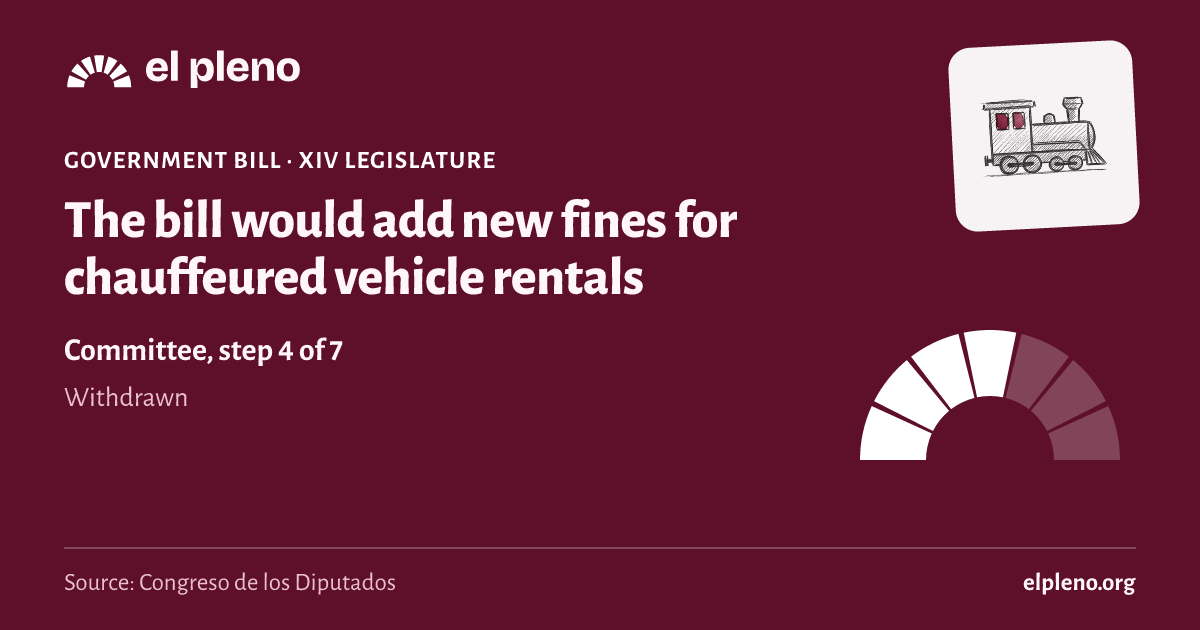
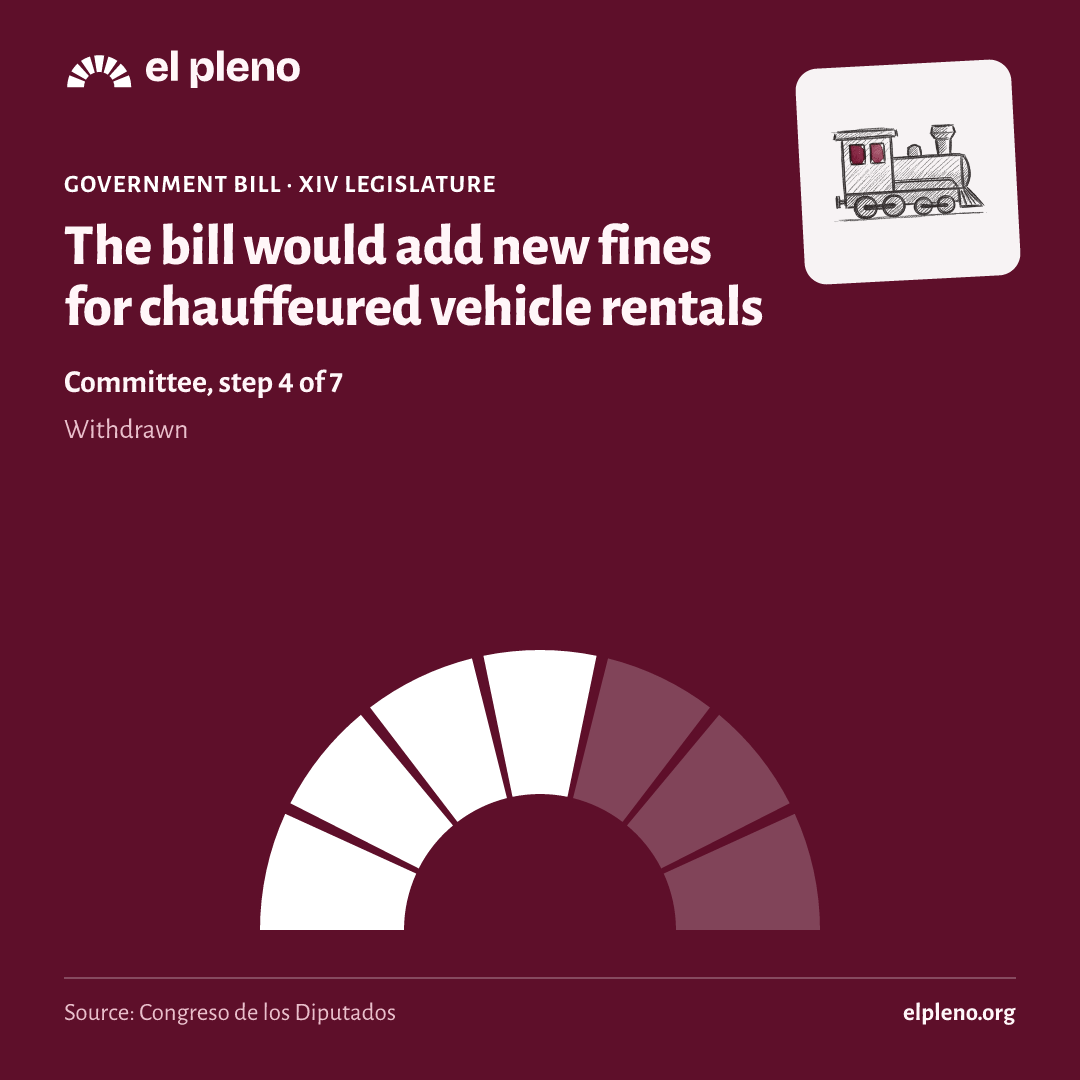
The bill would add new fines for chauffeured vehicle rentals
It is a government bill. Introduced by the Government. It was introduced on 23 December 2020. Introduced by: Gobierno.
Official title: Government bill to amend Law 16/1987, of July 30, on the Regulation of Land Transport, regarding offenses related to the leasing of vehicles with a driver.
Source: Congreso de los Diputados, file 121/000038· updated 11 Nov
Automatic summary, not yet reviewed
- The bill would create three new very serious offenses for chauffeured vehicle rentals: starting a service outside the allowed territory, failing to send the service details electronically in advance to the registry of the Dirección General de Transporte Terrestre, and picking up customers who did not book the service in advance, or breaking the rules on the route, schedules, technical features or vehicle signage.
- It would punish these offenses with fines of €1,001 to €2,000 and, if detected on the road, the vehicle would be immobilized until the fine is paid.
- If the same authorization gets five or more final fines for these offenses within one year, the bill would allow that authorization to be revoked.
- The new offense of not reporting service data would not apply until the communications registry is up and running; until then, the current offense stays in force, with a fine of €401 to €600.
Who it affects
- Chauffeured vehicle rental companies (such as VTC operators): They could face fines of €1,001 to €2,000, vehicle immobilization and revocation of their authorization if they repeat offenses.
- Drivers of these vehicles: They could not pick up customers without a prior booking or operate outside the authorized territory.
- Customers of these services: They could only be picked up if they booked the service in advance.
Words worth knowing
- Arrendamiento de vehículos con conductor
- Transport service where you rent a car with its driver, for example for a specific trip.
- Autorización
- Administrative permit required to provide this kind of transport service.
- Revocación
- Permanent withdrawal of a permit, here the authorization to operate.
- Resolución firme en vía administrativa
- A penalty that can no longer be challenged through the usual channels.
- VTC
- Stands for vehículo de turismo con conductor, a car with driver hired by prior booking.
It summarizes the text as it was introduced. It is written by artificial intelligence and may contain mistakes: the official text is what counts. Read the official text · How we make summaries
Where it stands
How far did it get?
It took 4 of 7 steps. It reached Committee, and today it is withdrawn.
- Introduced23 December 2020Someone registers the text in the Congreso.
- Admitted13 January 2021The Bureau of the Congreso accepts it and, for a members’ bill, the plenary decides whether to consider it.
- Amendments15 January 2021Groups propose changes.
- Committee3 June 2021A committee goes through the text in detail.
- Plenarynot reachedAll 350 deputies vote.
- Senatenot reachedThe Senate can pass it, amend it or veto it.
- BOEnot reachedIt is published in the Official State Gazette (BOE) and comes into force.
See the 6 official steps on a timeline
Was there a plenary vote?
We have no plenary vote linked to this law in the Congreso’s data.
What happens next
What happens now?
Whoever introduced it withdrew it, or it was merged into another one. It goes no further.
Sources
Where does all this come from?
- Congreso de los Diputados, file 121/000038
Official title, type, author, dates and stage.
Retrieved 11 November 2026
- The data comes from the open files of the Congreso, the Senate and the BOE, unaltered.
- Each deputy’s province is the one of their seat on the day of the vote.
- We only say “passed” or “rejected” when the majority needed is certain; otherwise we say which side had more votes.