What it is
COVID-19 economic aid for businesses, self-employed workers and car buyers
It is a government bill. Introduced by the Government. It was introduced on 15 July 2020. Introduced by: Gobierno.
Official title: Government bill on urgent measures to support economic reactivation and employment (originating from Royal Decree-Law 25/2020, of 3 July).
Source: Congreso de los Diputados, file 121/000030· updated 11 Nov
Automatic summary, not yet reviewed
- The bill would create a new State guarantee line of up to €40,000 million so banks can finance investments by companies and self-employed workers. It could be used until December 31, 2020.
- A €10,000 million fund managed by SEPI Sociedad Estatal de Participaciones Industriales, the state-owned company that manages government stakes in companies. would be created to rescue strategic, solvent companies hit by the pandemic. It would only act at the company's request and with Council of Ministers approval.
- Hotels, tourist accommodations and travel agencies in difficulty (income drop of at least 40% between March and May 2020) could request up to twelve months of deferral on the principal of their mortgage loans.
- If the mortgaged property is rented out, the owner receiving the mortgage deferral must pass on to the tenant a deferral of at least 70% of the amount received.
- A €216 million loan line would help tourism companies and self-employed workers digitize their businesses. Loans would be repaid over up to six years, with a three-year grace period, at very low interest.
- The PLAN RENOVE 2020 would give direct grants of between €400 and €4,000 to buy a new or nearly new car while scrapping an old one. The program has €250 million and would run until December 31, 2020 or until funds run out.
- Tourism, retail and hospitality companies keeping permanent seasonal (fijo discontinuo) workers on payroll from July to October 2020 could get a 50% rebate on their Social Security contributions.
- Shareholders' right to leave a company and get their share when no dividends are paid would be suspended until December 31, 2020, so companies can keep their money.
Who it affects
- Companies and self-employed workers needing investment financing: They could have their loans backed by the new State guarantee line.
- Hotels, tourist accommodations and travel agencies: They could request mortgage deferrals of up to twelve months, and their tenants would also get rent relief.
- Tourism companies and self-employed workers in the sector: They could apply for cheap loans to digitize and innovate.
- People and companies buying a new or nearly new car: They could receive direct grants under PLAN RENOVE 2020 if they scrap an old vehicle.
- Permanent seasonal workers in tourism and hospitality: Their employers could get a 50% rebate on Social Security contributions from July to October 2020.
Words worth knowing
- Aval (guarantee)
- A commitment by the State to pay a debt if the borrower cannot.
- Moratoria (deferral)
- An authorized postponement of debt payments.
- SEPI
- Sociedad Estatal de Participaciones Industriales, the state-owned company that manages government stakes in companies.
- Fijo discontinuo (permanent seasonal worker)
- A work contract where the person only works when there is activity, for example during the tourist season.
- Carencia (grace period)
- A period in which only loan interest is paid, not the principal.
It summarizes the text as it was introduced. It is written by artificial intelligence and may contain mistakes: the official text is what counts. Read the official text · How we make summaries
Where it stands
How far did it get?
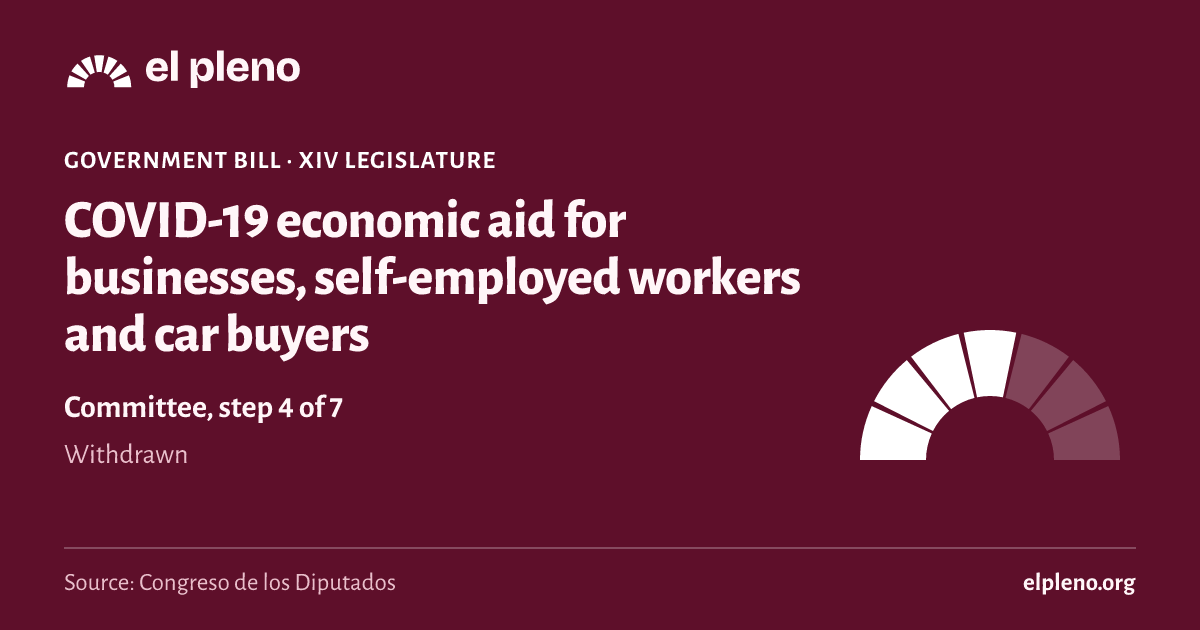
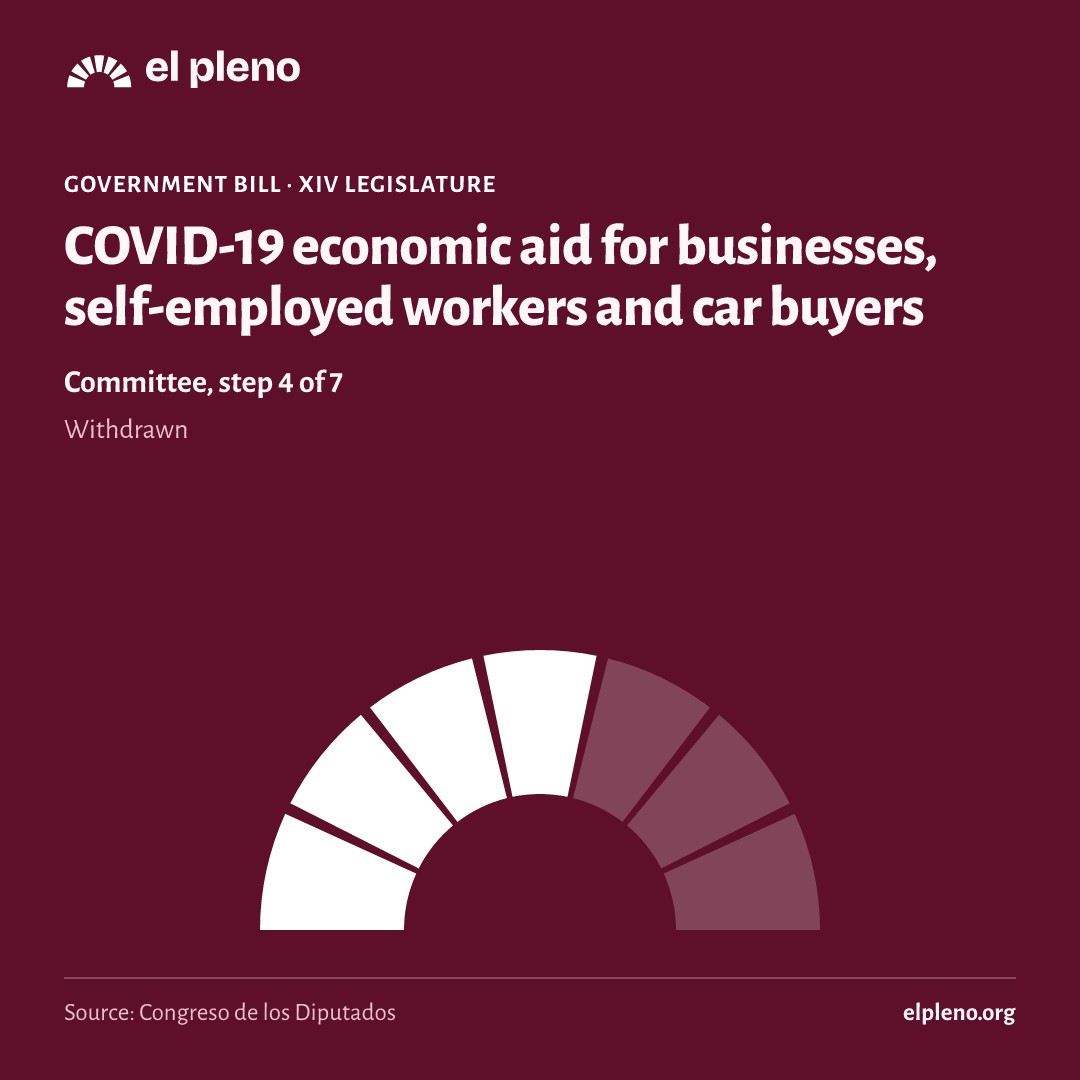
It took 4 of 7 steps. It reached Committee, and today it is withdrawn.
- Introduced15 July 2020Someone registers the text in the Congreso.
- Admitted2 September 2020The Bureau of the Congreso accepts it and, for a members’ bill, the plenary decides whether to consider it.
- Amendments7 September 2020Groups propose changes.
- Committee15 April 2021A committee goes through the text in detail.
- Plenarynot reachedAll 350 deputies vote.
- Senatenot reachedThe Senate can pass it, amend it or veto it.
- BOEnot reachedIt is published in the Official State Gazette (BOE) and comes into force.
See the 6 official steps on a timeline
Was there a plenary vote?
We have no plenary vote linked to this law in the Congreso’s data.
What happens next
What happens now?
Whoever introduced it withdrew it, or it was merged into another one. It goes no further.
Sources
Where does all this come from?
- Congreso de los Diputados, file 121/000030
Official title, type, author, dates and stage.
Retrieved 11 November 2026
- The data comes from the open files of the Congreso, the Senate and the BOE, unaltered.
- Each deputy’s province is the one of their seat on the day of the vote.
- We only say “passed” or “rejected” when the majority needed is certain; otherwise we say which side had more votes.