What it is
Bill would extend COVID aid for farms, banking and jobs
It is a government bill. Introduced by the Government. It was introduced on 10 June 2020. Introduced by: Gobierno.
Official title: Government bill adopting complementary measures in agricultural, scientific, economic, employment, Social Security, and tax matters to mitigate the effects of COVID-19 (originating from Royal Decree-Law 19/2020, of 26 May).
Source: Congreso de los Diputados, file 121/000024· updated 11 Nov
Automatic summary, not yet reviewed
- The bill would extend until September 30, 2020 the extraordinary measures that make temporary hiring in farm work more flexible, to ensure enough workers for summer agricultural tasks.
- It would authorize the creation of a consortium made up of the State and the Regional Government of Andalusia to support Granada's bid to host the IFMIF-DONES fusion science facility.
- Telecom operators would have to let their customers pay in installments or defer for six months the bills issued since the state of alarm began, with no late-payment interest and no collateral required.
- The State would be authorized to guarantee up to €2,252,890,750 in 2020 to the European Commission under the SURE instrument, a European fund against pandemic-driven unemployment.
- It would create a special regime for loan payment holidays that financial institutions grant under sector-wide agreements: they could defer loans without charging fees or requiring new collateral, with simplified paperwork and the option of electronic signature.
- Healthcare and social-health workers who catch COVID-19 during the pandemic would have it recognized as a workplace accident, with the corresponding benefits.
- Foreign young people aged 18 to 21 hired in farm work under the agricultural employment decree could obtain, once that rule ends, a two-year residence and work permit, renewable for another two, valid in any sector.
- Several earlier measures would be adjusted: performing artists would find it easier to claim unemployment benefits, bank foundations would not have to contribute to their reserve fund in 2020, and the interest-free period for deferring tax debts would be extended to four months.
Who it affects
- Farm workers and agricultural companies: They could keep using the extraordinary temporary hiring measures until September 30, 2020.
- Telecom and electronic communications customers: They could pay in installments or defer pandemic bills for six months with no interest or collateral.
- People with loans or credit: Financial institutions could offer them payment deferrals with simplified paperwork and no fees.
- Healthcare and social-health workers: If they catch COVID-19 at work, they would receive benefits as for a workplace accident.
- Foreign young people hired in farm work: They could apply for a two-year residence and work permit once the agricultural employment rule ends.
Words worth knowing
- Moratoria (payment holiday)
- A temporary deferral or suspension of debt payments; nothing has to be paid during that time.
- Aval (guarantee)
- A guarantee by which the State commits to pay if the party that received the money does not.
- ERTE (temporary layoff scheme)
- Expediente de regulación temporal de empleo: a company temporarily suspends or cuts work and contracts, and workers collect unemployment benefits.
- Silencio administrativo estimativo (approval by default)
- If the administration does not answer in time, the application is deemed approved.
- Arrendamiento financiero (leasing)
- A contract that mixes renting an asset with the option to buy it at the end, often used by self-employed workers to finance machinery or vehicles.
It summarizes the text as it was introduced. It is written by artificial intelligence and may contain mistakes: the official text is what counts. Read the official text · How we make summaries
Where it stands
How far did it get?
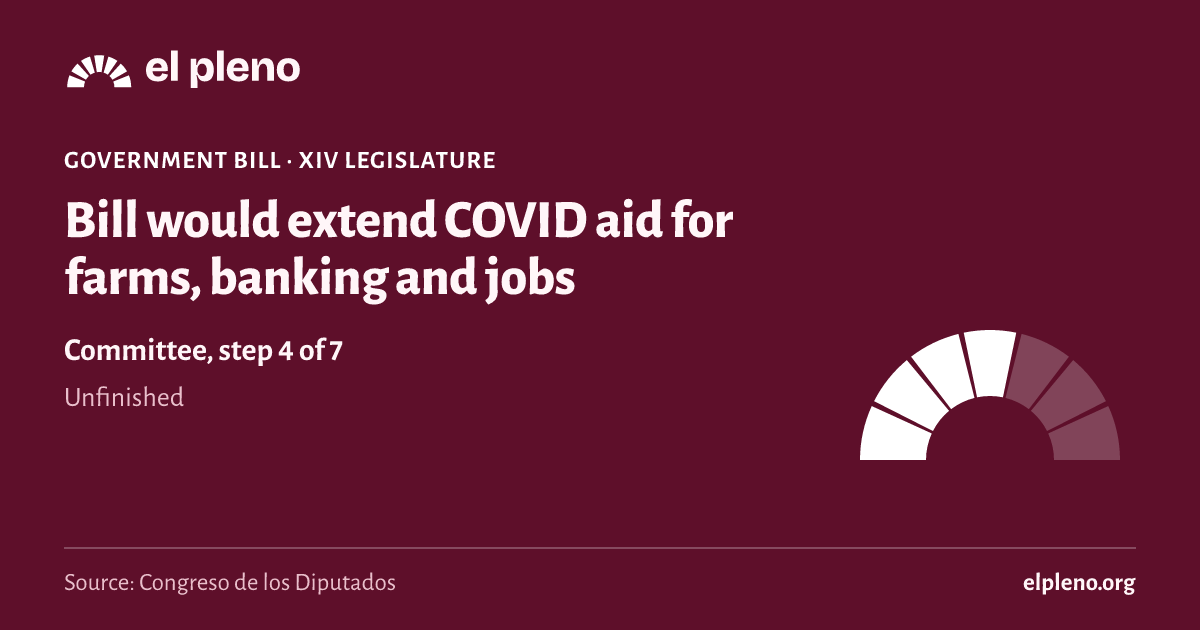
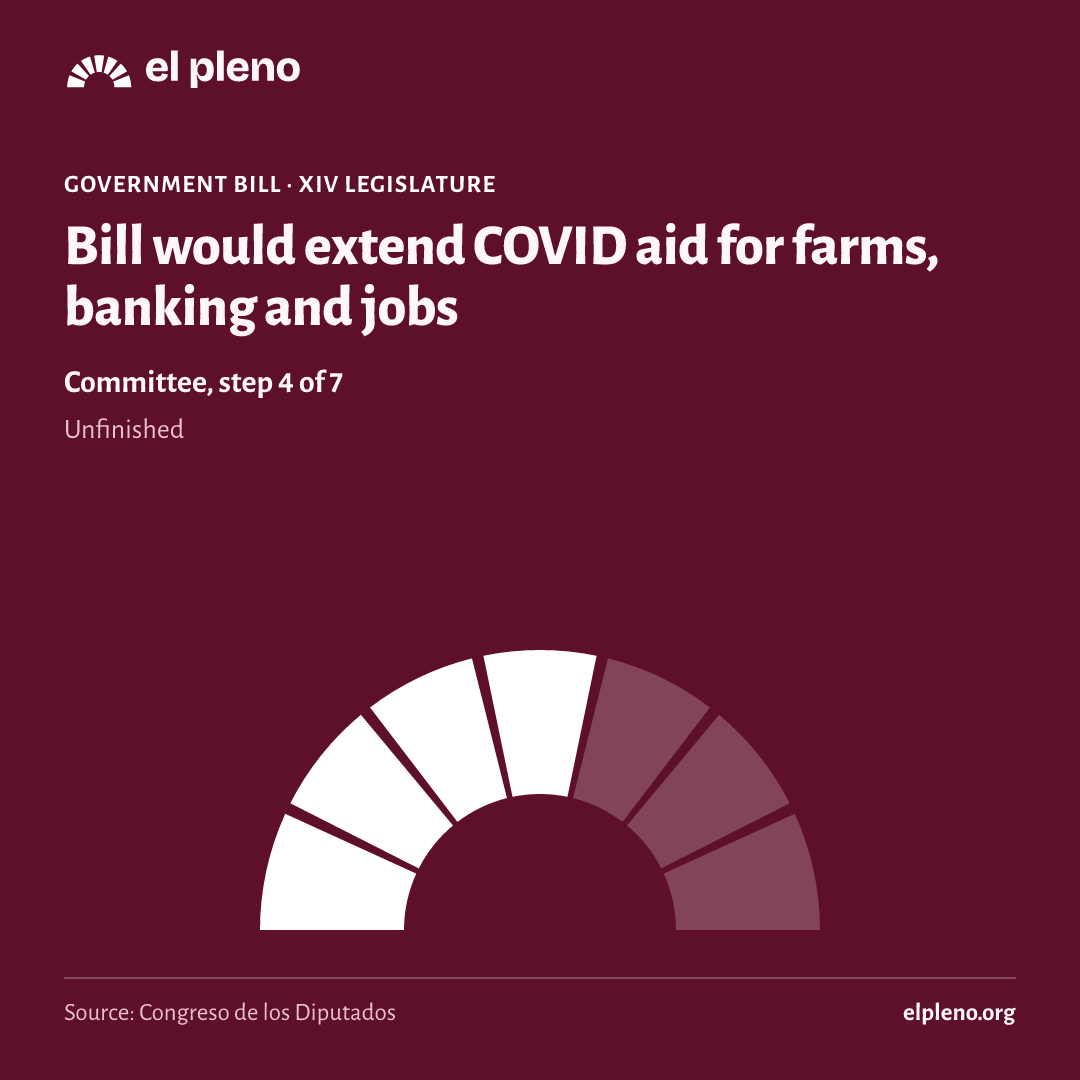
It took 4 of 7 steps. It reached Committee, and today it is unfinished.
- Introduced10 June 2020Someone registers the text in the Congreso.
- Admitted16 June 2020The Bureau of the Congreso accepts it and, for a members’ bill, the plenary decides whether to consider it.
- Amendments19 June 2020Groups propose changes.
- Committee8 October 2020A committee goes through the text in detail.
- Plenarynot reachedAll 350 deputies vote.
- Senatenot reachedThe Senate can pass it, amend it or veto it.
- BOEnot reachedIt is published in the Official State Gazette (BOE) and comes into force.
See the 6 official steps on a timeline
Was there a plenary vote?
We have no plenary vote linked to this law in the Congreso’s data.
What happens next
What happens now?
The legislature ended before it finished. To go on, someone would have to introduce it again in the new Cortes.
It has not been presented again yet.
Sources
Where does all this come from?
- Congreso de los Diputados, file 121/000024
Official title, type, author, dates and stage.
Retrieved 11 November 2026
- The data comes from the open files of the Congreso, the Senate and the BOE, unaltered.
- Each deputy’s province is the one of their seat on the day of the vote.
- We only say “passed” or “rejected” when the majority needed is certain; otherwise we say which side had more votes.