What it is
COVID-19 relief bill: rent, mortgages, self-employed and consumers
It is a government bill. Introduced by the Government. It was introduced on 9 April 2020. Introduced by: Gobierno.
Official title: Government bill adopting complementary urgent measures in the social and economic sphere to address COVID-19 (originating from Royal Decree-Law 11/2020, of 31 March).
Source: Congreso de los Diputados, file 121/000013· updated 11 Nov
Automatic summary, not yet reviewed
- The bill would suspend evictions and removals of households that fall into vulnerability because of COVID-19 and have no housing alternative, for up to six months.
- It would allow an extraordinary extension of up to six months for lease contracts on a primary residence that end while the rule is in force, if the tenant requests it.
- It would create a rent payment moratorium for tenants of primary residences in economic vulnerability. With large landlords and public housing companies it would apply automatically: a 50% rent cut or a payment deferral, capped at four months.
- It would set up a State-backed guarantee line so banks can offer financing to vulnerable tenants, with no costs or interest for the applicant, plus a new rent assistance program of up to €900 per month.
- It would extend the mortgage moratorium to properties used for self-employed business activity and to rented apartments whose owners stop receiving rent, and would also suspend non-mortgage loans for vulnerable individuals.
- It would create an extraordinary subsidy for domestic workers who stop working or see their hours cut because of COVID-19, and an exceptional subsidy for people whose temporary contracts of at least two months end without access to other benefits.
- Companies and the self-employed could request six-month, interest-free moratoriums on Social Security contributions, and defer debts at a reduced 0.5% interest rate.
- Consumers could cancel, without penalty, contracts that cannot be performed because of the state of alarm, and for canceled package trips they could choose between a refund or a voucher valid for one year.
Who it affects
- Tenants of primary residences in vulnerable situations: Could request eviction suspension, contract extension, a rent moratorium or rent assistance if they fall into economic vulnerability due to COVID-19.
- Self-employed people and small businesses: Could suspend mortgages on business properties, defer Social Security payments and debts, and access extraordinary benefits for business closure.
- Domestic workers and temporary contract workers: Could receive an extraordinary subsidy for loss of activity or for the end of a temporary contract.
- Consumers: Could cancel contracts that cannot be performed, with a refund or voucher for package trips, and keep utility service at home.
Words worth knowing
- Moratoria (moratorium)
- A deferral: you are allowed to stop paying a debt for a while and pay it later without penalty.
- Lanzamiento (removal)
- A court-ordered act in which a person is physically removed from a home, for example after an eviction.
- IPREM
- Indicador Público de Renta de Efectos Múltiples: a public income index used to measure whether someone has low income.
- Gran tenedor (large landlord)
- An owner of more than ten urban properties (not counting garages and storage rooms) or more than 1,500 square meters built.
- Bono social (social electricity discount)
- A discount on the electricity bill for consumers with low income or in a vulnerable situation.
It summarizes the text as it was introduced. It is written by artificial intelligence and may contain mistakes: the official text is what counts. Read the official text · How we make summaries
Where it stands
How far did it get?
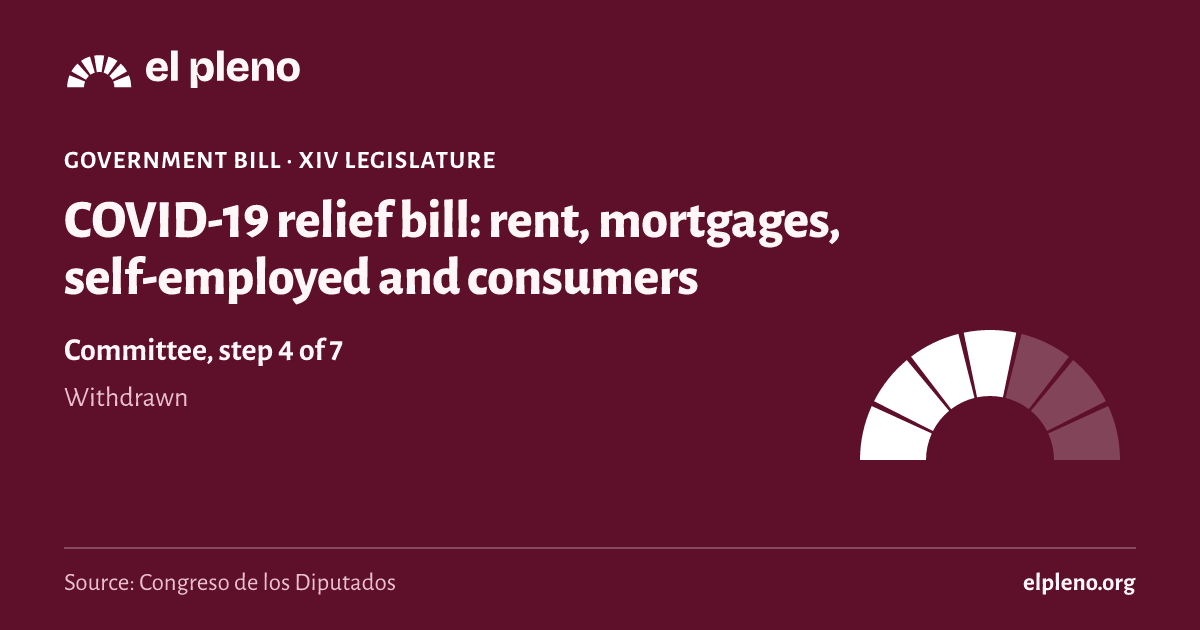
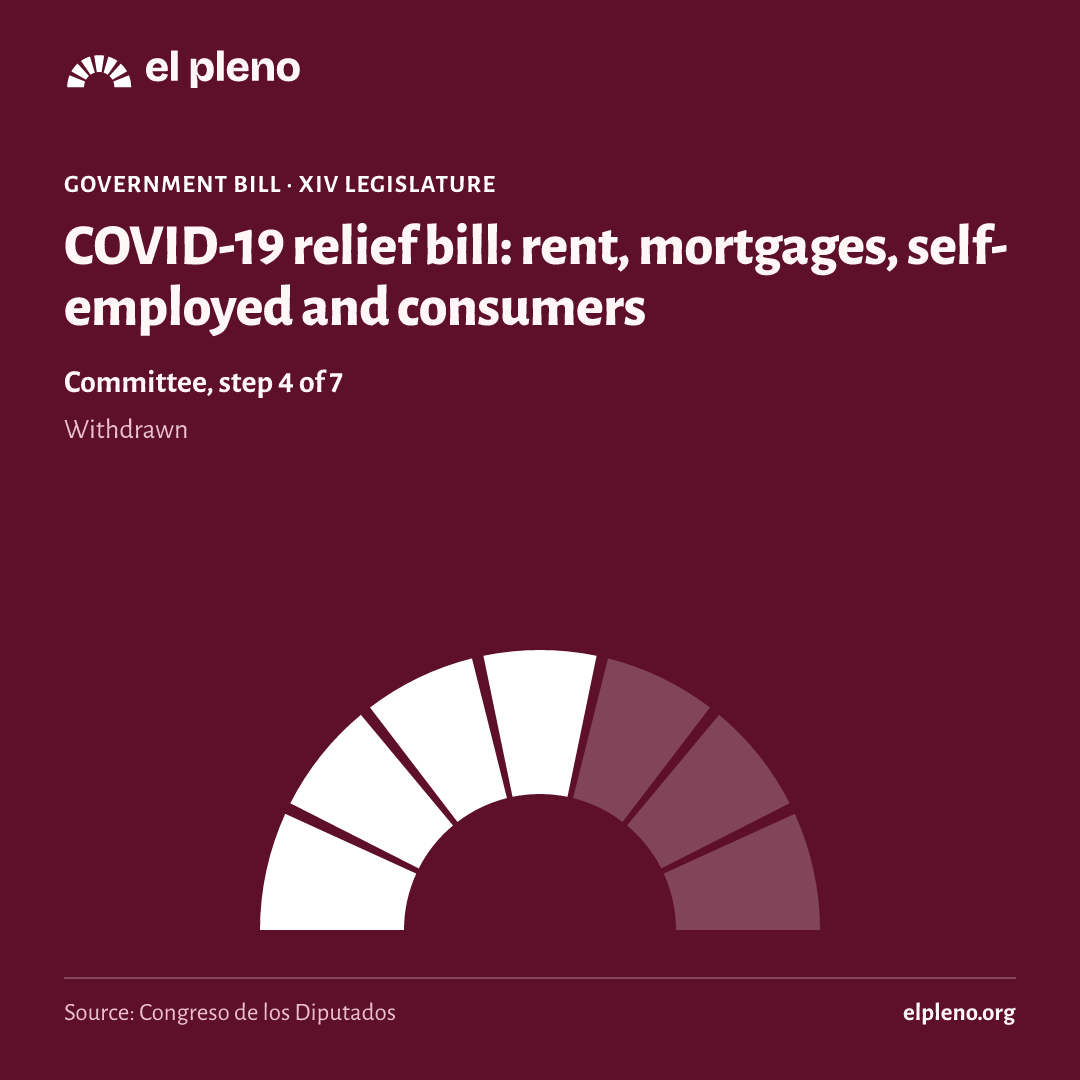
It took 4 of 7 steps. It reached Committee, and today it is withdrawn.
- Introduced9 April 2020Someone registers the text in the Congreso.
- Admitted14 April 2020The Bureau of the Congreso accepts it and, for a members’ bill, the plenary decides whether to consider it.
- Amendments20 April 2020Groups propose changes.
- Committee15 April 2021A committee goes through the text in detail.
- Plenarynot reachedAll 350 deputies vote.
- Senatenot reachedThe Senate can pass it, amend it or veto it.
- BOEnot reachedIt is published in the Official State Gazette (BOE) and comes into force.
See the 6 official steps on a timeline
Was there a plenary vote?
We have no plenary vote linked to this law in the Congreso’s data.
What happens next
What happens now?
Whoever introduced it withdrew it, or it was merged into another one. It goes no further.
Sources
Where does all this come from?
- Congreso de los Diputados, file 121/000013
Official title, type, author, dates and stage.
Retrieved 11 November 2026
- The data comes from the open files of the Congreso, the Senate and the BOE, unaltered.
- Each deputy’s province is the one of their seat on the day of the vote.
- We only say “passed” or “rejected” when the majority needed is certain; otherwise we say which side had more votes.