What it is
Urgent economic and social aid to face COVID-19
It is a government bill. Introduced by the Government. It was introduced on 25 March 2020. Introduced by: Gobierno.
Official title: Government bill on extraordinary urgent measures to address the economic and social impact of COVID-19 (originating from Royal Decree-Law 8/2020, of 17 March).
Source: Congreso de los Diputados, file 121/000010· updated 11 Nov
Automatic summary, not yet reviewed
- The bill would create an Extraordinary Social Fund of 300 million euros for social services in the autonomous communities, Ceuta and Melilla, to pay for home care, telecare, help for homeless people and aid for low-income families.
- It would ban cutting electricity, gas and water supply to vulnerable consumers for one month and would automatically extend the electricity social bonus until September 15, 2020. It would also freeze bottled gas prices for three two-month periods.
- Workers with dependents in their care would have the right to adapt or reduce their working hours for COVID-19 care reasons, with a proportional salary cut, and remote work would take priority over stopping activity.
- It would establish a moratorium on mortgage payments for the primary home for people who lose income due to the crisis and meet economic vulnerability requirements, suspending the debt with no interest during that period.
- It would create an extraordinary benefit for self-employed people whose activity is suspended or whose billing drops by at least 75 percent, set at 70 percent of the regulatory base and lasting one month, extendable until the end of the state of alarm.
- It would make it easier to use temporary layoff plans (ERTEs) due to force majeure from COVID-19, allow unemployment benefits even without enough contributions, and exempt companies from paying 75 percent of their Social Security contribution (100 percent if they have fewer than 50 workers), in exchange for keeping jobs.
- It would approve a State-backed guarantee line of up to 100 billion euros for loans to companies and the self-employed, and would raise the ICO's net debt limit by 10 billion euros to give more liquidity to small businesses and the self-employed.
- It would suspend the liberalization of foreign direct investments in strategic sectors when the investor reaches 10 percent of the capital or takes control, requiring prior government authorization.
Who it affects
- Employees with dependents in their care: They could adapt or reduce their working hours to care for them without losing their job.
- Self-employed people and small businesses: They could apply for a work-stoppage benefit, State guarantees and ICO financing.
- Families with a mortgage and reduced income: They could request a moratorium to stop paying the mortgage on their primary home for a while.
- Vulnerable consumers: Their electricity, gas or water cannot be cut off during the month after the rule takes effect.
- Companies with temporary layoffs (ERTEs): Their workers would receive unemployment benefits even without enough contributions, and the company would pay less to Social Security.
Words worth knowing
- ERTE
- Temporary layoff plan (expediente de regulación temporal de empleo): the company temporarily suspends contracts or reduces working hours.
- Moratoria
- Moratorium: a waiting period to pay a debt, here the mortgage, with no interest charged during that time.
- Bono social
- Social bonus: a discount on the electricity bill for low-income or vulnerable households.
- IPREM
- Public Indicator of Multiple Effects Income (Indicador Público de Renta de Efectos Múltiples): a yearly reference used to measure whether income is low.
- Inversión extranjera directa
- Foreign direct investment: the purchase of a stake in a Spanish company by an investor from outside the European Union.
It summarizes the text as it was introduced. It is written by artificial intelligence and may contain mistakes: the official text is what counts. Read the official text · How we make summaries
Where it stands
How far did it get?
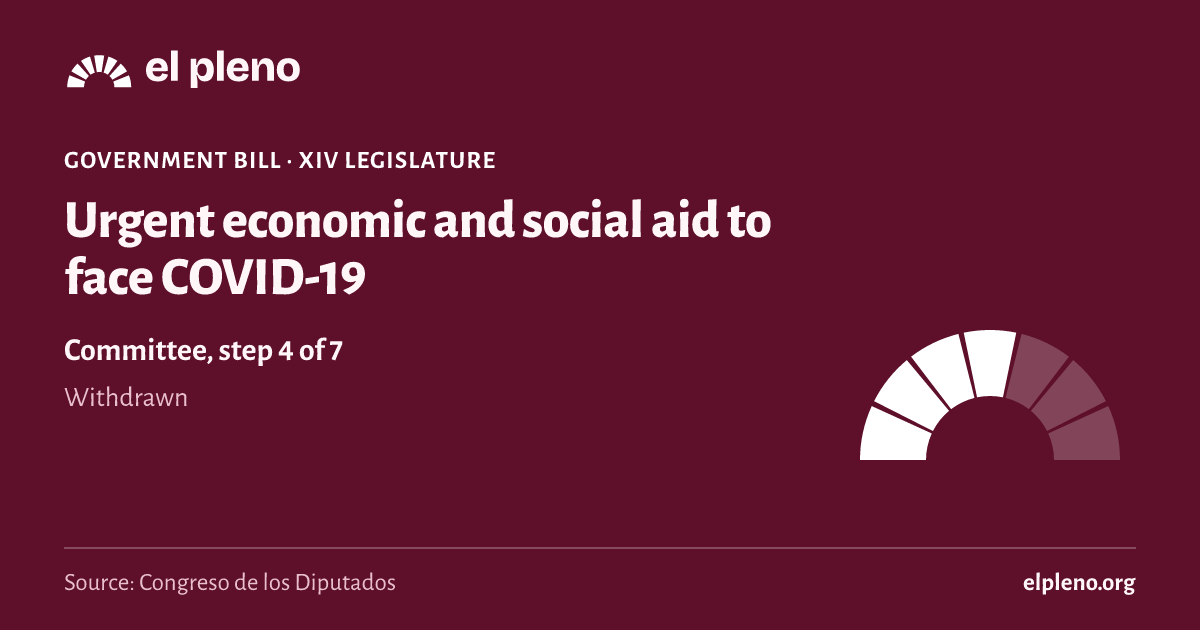
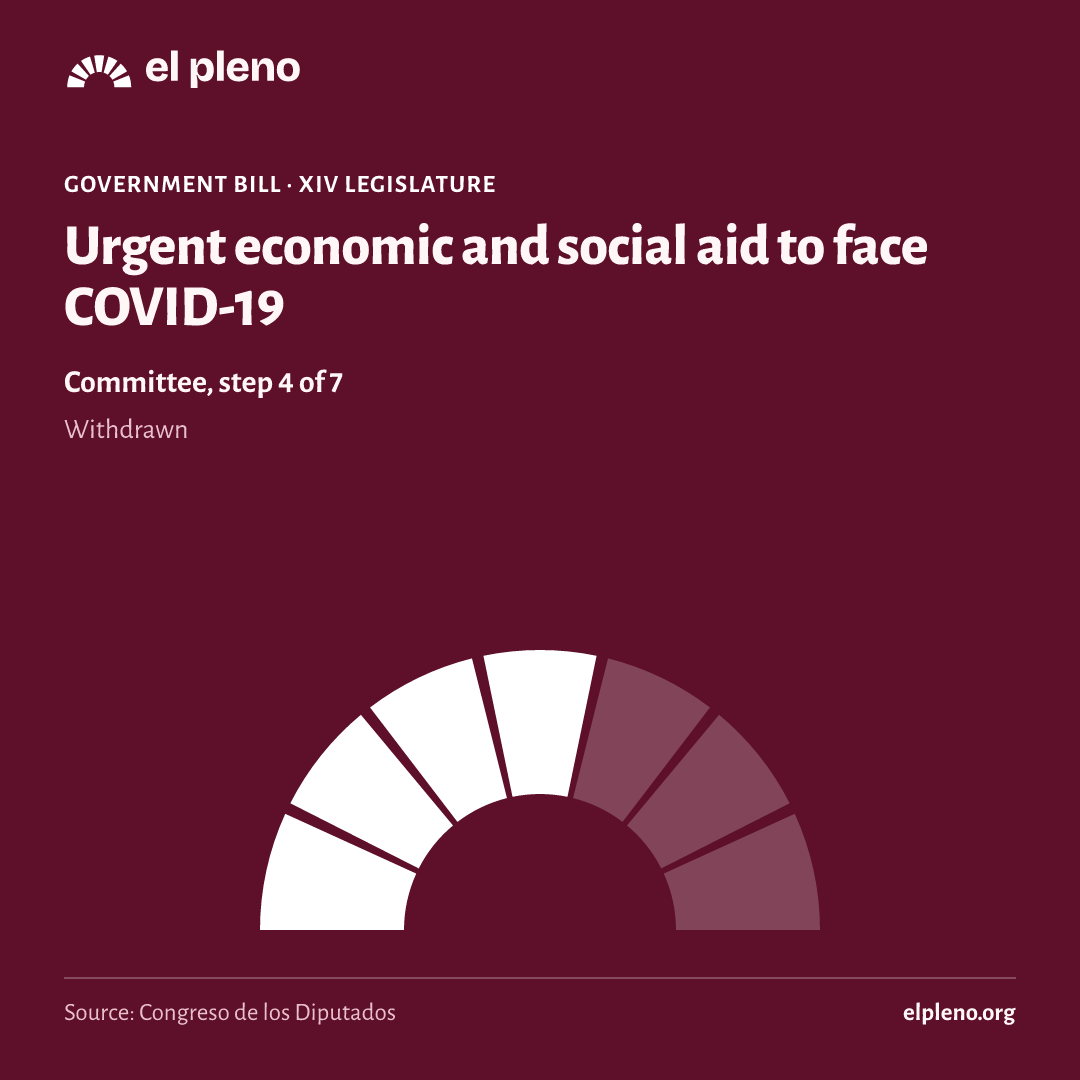
It took 4 of 7 steps. It reached Committee, and today it is withdrawn.
- Introduced25 March 2020Someone registers the text in the Congreso.
- Admitted30 March 2020The Bureau of the Congreso accepts it and, for a members’ bill, the plenary decides whether to consider it.
- Amendments6 April 2020Groups propose changes.
- Committee15 April 2021A committee goes through the text in detail.
- Plenarynot reachedAll 350 deputies vote.
- Senatenot reachedThe Senate can pass it, amend it or veto it.
- BOEnot reachedIt is published in the Official State Gazette (BOE) and comes into force.
See the 6 official steps on a timeline
Was there a plenary vote?
We have no plenary vote linked to this law in the Congreso’s data.
What happens next
What happens now?
Whoever introduced it withdrew it, or it was merged into another one. It goes no further.
Sources
Where does all this come from?
- Congreso de los Diputados, file 121/000010
Official title, type, author, dates and stage.
Retrieved 11 November 2026
- The data comes from the open files of the Congreso, the Senate and the BOE, unaltered.
- Each deputy’s province is the one of their seat on the day of the vote.
- We only say “passed” or “rejected” when the majority needed is certain; otherwise we say which side had more votes.