What it is
Bill to fully repay people who bought preferred shares
It is a members’ bill. Introduced by parliamentary groups, the Senate, regional governments or citizens. It was introduced on 21 May 2019. Introduced by: Comunidad Autónoma de Galicia - Parlamento.
Official title: Private member's bill reforming Law 9/2012, of November 14, on the restructuring and resolution of credit institutions, to guarantee the full return of the nominal value of preferred shares and other hybrid instruments of capital and subordinated debt to savers and small investors without financial experience (corresponds to file number 125/000006/0000 of the XII Legislature).
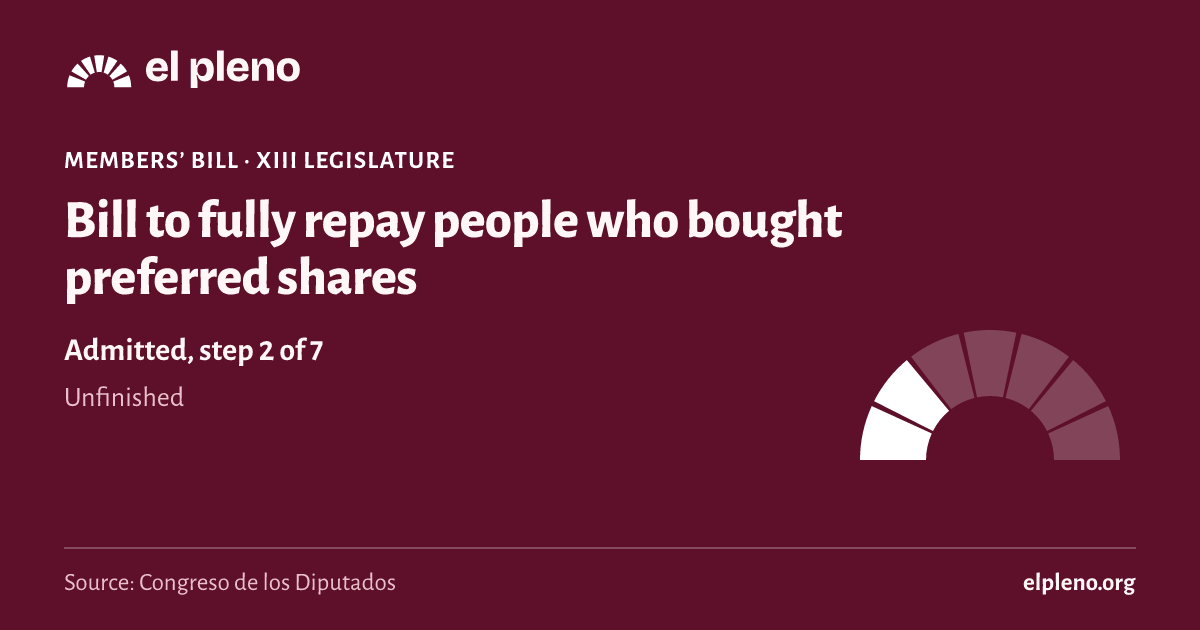
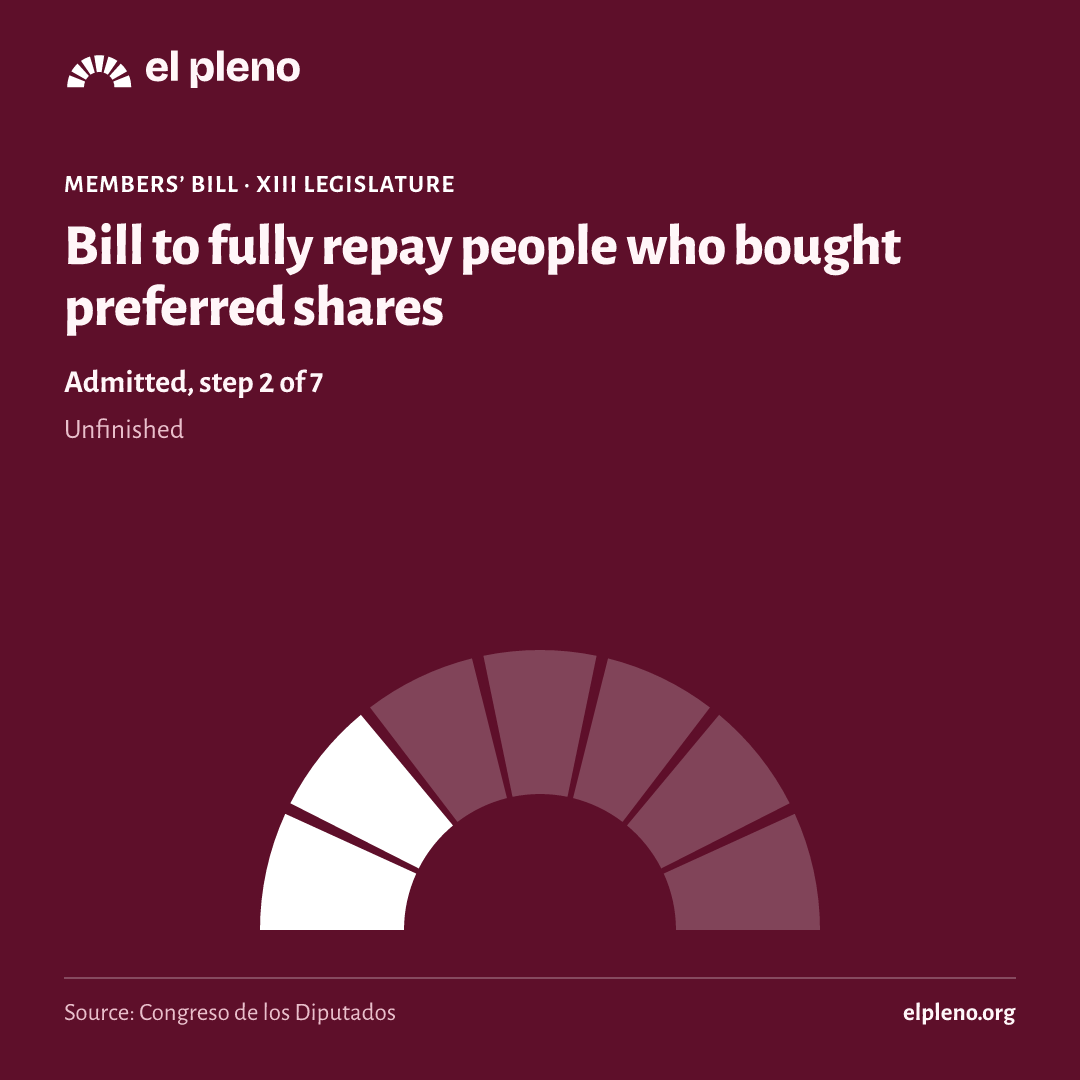
Source: Congreso de los Diputados, file 125/000001· updated 11 Nov
Automatic summary, not yet reviewed
- The bill adds a new provision to Law 9/2012 that would prevent management actions from applying to small savers holding hybrid instruments and would give them the right to recover everything they invested with no losses. In general, a saver is anyone who is a retail client, that is, someone who is not a professional with the experience and knowledge to make their own investment decisions.
- Credit institutions would have to hire an independent third party to review all existing contracts and identify which holders qualify as savers.
- From the law's entry into force, ongoing management actions would be suspended until it is decided who qualifies as a saver, which could be done through arbitration. Those who already swapped their instruments or converted them into shares, and even those who no longer hold them, could also recover what they invested if their saver status is confirmed.
- Savers holding preferred shares or subordinated debt who also have a mortgage with the same institution for their main home and cannot pay the installments could not face foreclosure until the full amount they invested is returned or they regain their ability to pay.
Who it affects
- Small savers and investors without financial experience who bought preferred shares or other hybrid instruments.: They could recover all the money they invested with no losses.
- People who already swapped their preferred shares for shares, converted them, or no longer hold them.: They could recover what they invested if arbitration confirms they are savers.
- Savers with preferred shares or subordinated debt and a mortgage on their main home at the same institution.: They could not be foreclosed on until their money is returned or they regain their ability to pay.
- Credit institutions.: They would have to commission an independent third party to review all contracts and identify savers.
Words worth knowing
- Participaciones preferentes (preferred shares)
- An investment product that is neither a share nor a deposit, very complex and very risky.
- Instrumentos híbridos de capital o deuda subordinada (hybrid capital or subordinated debt instruments)
- Financial products that mix features of shares and loans; if there are losses, their holders are among the last to be paid.
- Acciones de gestión (management actions)
- Measures to reduce losses at a bank, such as swapping or converting these products, which can make the investor lose part of their money.
- Cliente minorista (retail client)
- A client who is not a finance professional, so no experience or knowledge to invest is assumed.
- Arbitraje (arbitration)
- A process in which an independent third party decides or resolves a dispute without going to court.
It summarizes the text as it was introduced. It is written by artificial intelligence and may contain mistakes: the official text is what counts. Read the official text · How we make summaries
Where it stands
How far did it get?
It took 2 of 7 steps. It reached Admitted, and today it is unfinished.
- Introduced21 May 2019Someone registers the text in the Congreso.
- Admitted5 June 2019The Bureau of the Congreso accepts it and, for a members’ bill, the plenary decides whether to consider it.
- Amendmentsnot reachedGroups propose changes.
- Committeenot reachedA committee goes through the text in detail.
- Plenarynot reachedAll 350 deputies vote.
- Senatenot reachedThe Senate can pass it, amend it or veto it.
- BOEnot reachedIt is published in the Official State Gazette (BOE) and comes into force.
See the 2 official steps on a timeline
Was there a plenary vote?
We have no plenary vote linked to this law in the Congreso’s data.
What happens next
What happens now?
The legislature ended before it finished. To go on, someone would have to introduce it again in the new Cortes.
It has not been presented again yet.
Sources
Where does all this come from?
- Congreso de los Diputados, file 125/000001
Official title, type, author, dates and stage.
Retrieved 11 November 2026
- The data comes from the open files of the Congreso, the Senate and the BOE, unaltered.
- Each deputy’s province is the one of their seat on the day of the vote.
- We only say “passed” or “rejected” when the majority needed is certain; otherwise we say which side had more votes.