What it is
Bill to legalize euthanasia and medically assisted suicide
Admitted step 2 of 7 · UnfinishedIt is a members’ bill. Introduced by parliamentary groups, the Senate, regional governments or citizens. It was introduced on 12 July 2019. Introduced by: Grupo Parlamentario Confederal de Unidas Podemos-En Comú Podem-Galicia en Común.
Official title: Private member's Organic bill on euthanasia.
Source: Congreso de los Diputados, file 122/000030· updated 11 Nov
Automatic summary, not yet reviewed
- The bill would regulate the right of people to request medical help to end their life, and what it proposes would also apply to medically assisted suicide.
- Anyone over 18 (or an emancipated minor) who is terminally ill or suffers unbearably could request it, in writing at least twice, 15 days apart. It would also be allowed if the person left an advance directive and can no longer decide.
- The request would be made in writing, signed before the responsible physician and kept in the medical record, and the person could withdraw it at any time.
- Death by euthanasia would be considered equivalent to a natural death for all purposes, including life insurance.
- The responsible physician would have to inform the patient, verify the request is voluntary, get a second consulting physician, and report each case to the Evaluation Commission within 4 business days, or report denied requests.
- The service would be added to the basic coverage of the National Health System, evaluation commissions would be created in each Autonomous Community, and the Penal Code would be amended so that cooperating in or causing death in these cases is not punishable. Directly involved health workers could object on grounds of conscience, but without blocking access for those who request it.
Who it affects
- People with a terminal illness or unbearable suffering: They could request euthanasia or medically assisted suicide if they meet the requirements.
- Physicians and nursing staff: They would have specific duties and could object on grounds of conscience.
- Public health services: They would have to guarantee access to the service and include it in their coverage.
- Evaluation commissions: They would check compliance with the law and keep the records of each case.
Words worth knowing
- Eutanasia (euthanasia)
- A physician's action to cause a rapid, painless death at the request of a person with a serious illness.
- Suicidio médicamente asistido (medically assisted suicide)
- The person ends their own life using means provided by a physician, who stays with them through the process.
- Fase terminal (terminal phase)
- An advanced, irreversible stage of an illness, with a life expectancy of weeks or months.
- Objeción de conciencia (conscientious objection)
- An individual right to refuse to do something that goes against one's own moral beliefs.
- Documento de instrucciones previas (advance directive)
- A document in which a person states in advance how they want to be cared for if they later cannot decide.
It summarizes the text as it was introduced. It is written by artificial intelligence and may contain mistakes: the official text is what counts. Read the official text · How we make summaries
Where it stands
How far did it get?
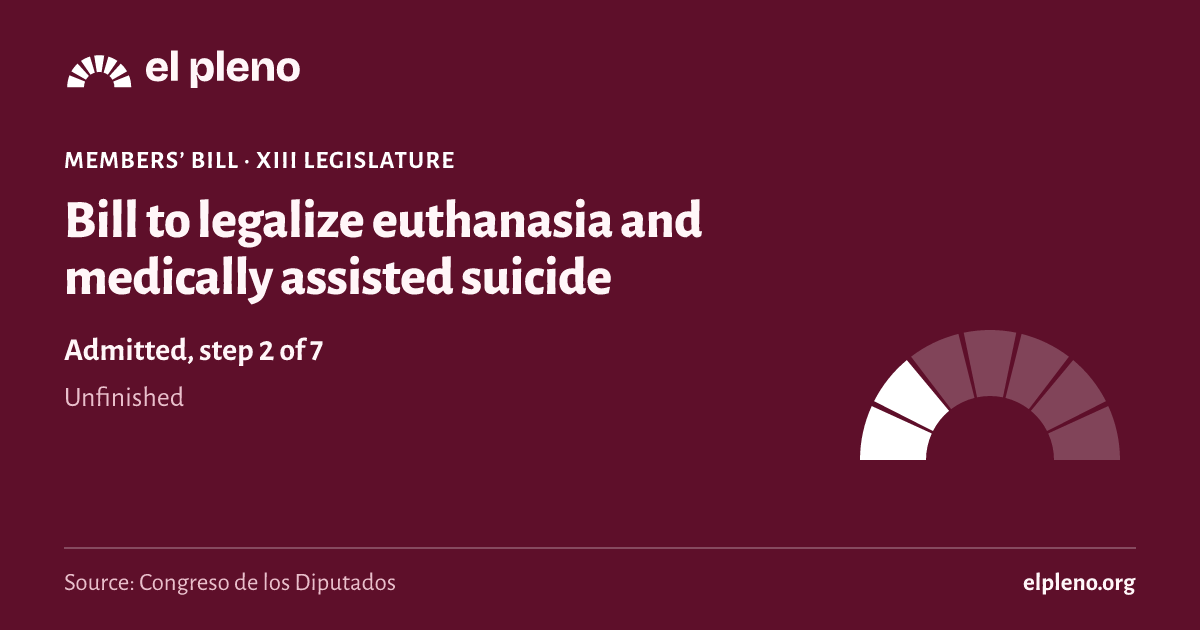
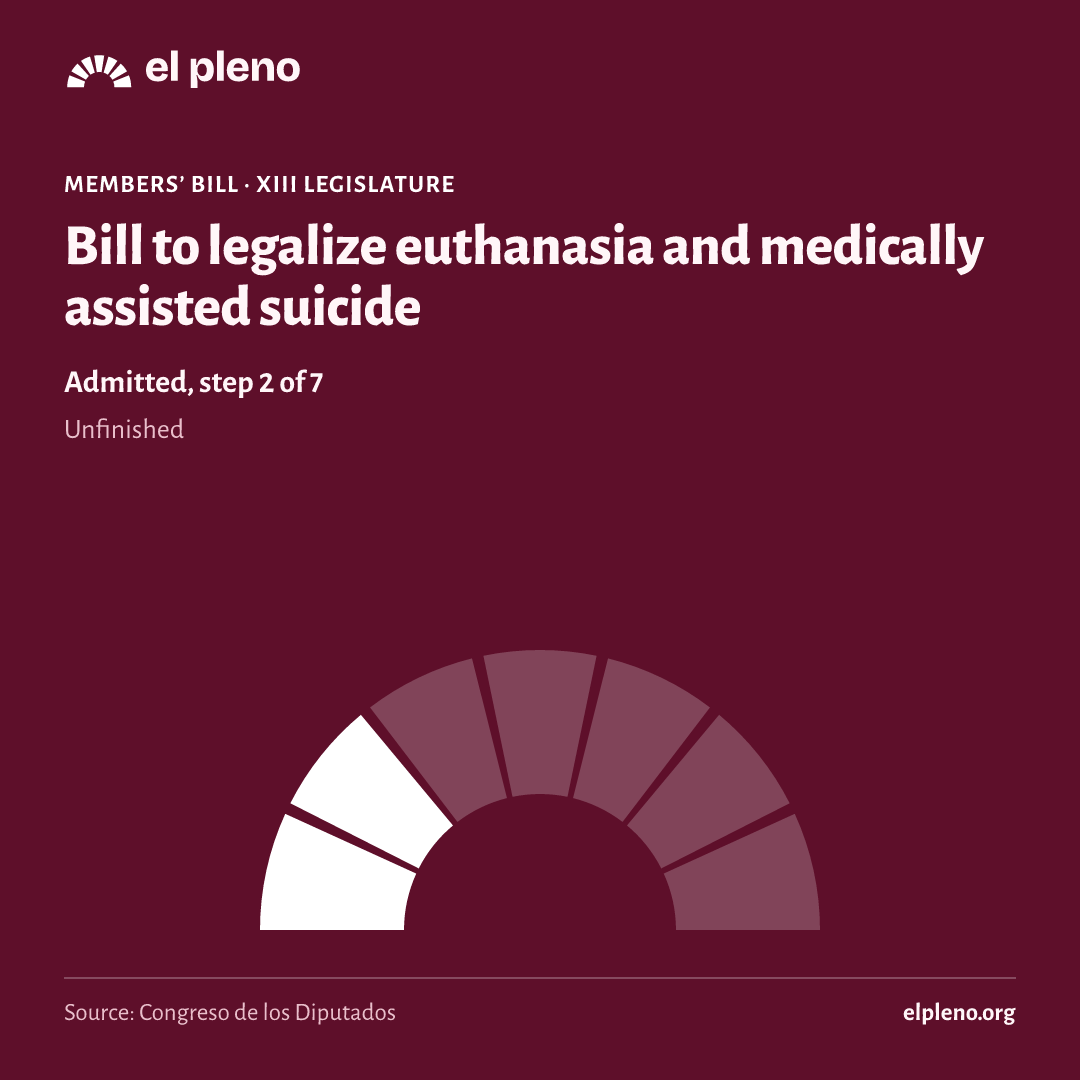
It took 2 of 7 steps. It reached Admitted, and today it is unfinished.
- Introduced12 July 2019Someone registers the text in the Congreso.
- Admitted16 July 2019The Bureau of the Congreso accepts it and, for a members’ bill, the plenary decides whether to consider it.
- Amendmentsnot reachedGroups propose changes.
- Committeenot reachedA committee goes through the text in detail.
- Plenarynot reachedAll 350 deputies vote.
- Senatenot reachedThe Senate can pass it, amend it or veto it.
- BOEnot reachedIt is published in the Official State Gazette (BOE) and comes into force.
See the 5 official steps on a timeline
Was there a plenary vote?
We have no plenary vote linked to this law in the Congreso’s data.
What happens next
What happens now?
The legislature ended before it finished. To go on, someone would have to introduce it again in the new Cortes.
It has not been presented again yet.
Sources
Where does all this come from?
- Congreso de los Diputados, file 122/000030
Official title, type, author, dates and stage.
Retrieved 11 November 2026
- The data comes from the open files of the Congreso, the Senate and the BOE, unaltered.
- Each deputy’s province is the one of their seat on the day of the vote.
- We only say “passed” or “rejected” when the majority needed is certain; otherwise we say which side had more votes.