What it is
Bill to void part of the 1977 Amnesty Law
It is a members’ bill. Introduced by parliamentary groups, the Senate, regional governments or citizens. It was introduced on 5 July 2019. Introduced by: Grupo Parlamentario Confederal de Unidas Podemos-En Comú Podem-Galicia en Común.
Official title: Private member's bill for the declaration of nullity of certain provisions of Law 46/1977, of October 15, on Amnesty.
Source: Congreso de los Diputados, file 122/000022· updated 11 Nov
Automatic summary, not yet reviewed
- The bill would declare void sections e) and f) of Article 2 of the 1977 Amnesty Law, which cover crimes by authorities and public order officers. According to the text, international law bans amnesty for crimes against humanity, war crimes and genocide.
- It would declare void sections e) and f) of Article 2 of the Amnesty Law for violating international law on prosecuting crimes against humanity.
- It would declare, by full legal right, the nullity of sentences handed down by Francoist courts that imposed punishments violating human rights, and would annul all their legal consequences.
- The Government would have to support claims for crimes committed during the Franco dictatorship, since crimes against humanity do not expire. It would also be empowered to issue the necessary rules, and the law would take effect the day after publication in the Official State Gazette.
Who it affects
- Victims of the Franco regime and their families: They could seek investigation, prosecution and reparation, which is currently blocked in the courts by the Amnesty Law.
- Former officials and public order officers of that era: They would lose amnesty for the crimes covered by sections e) and f) of Article 2.
- The Government: It would have to support claims for dictatorship-era crimes and issue the rules needed to apply the law.
Words worth knowing
- Nulidad (nullity)
- Declaring that a rule or court ruling has no legal effect, as if it had never existed.
- Lesa humanidad (crimes against humanity)
- Very serious crimes committed systematically against the civilian population, such as mass murder or torture.
- Imprescriptible (not subject to a statute of limitations)
- That can be prosecuted at any time, because no deadline applies.
- Proposición de ley (bill)
- A draft law introduced by members of the Congress of Deputies (Congreso de los Diputados). It is not an approved law yet.
It summarizes the text as it was introduced. It is written by artificial intelligence and may contain mistakes: the official text is what counts. Read the official text · How we make summaries
Where it stands
How far did it get?
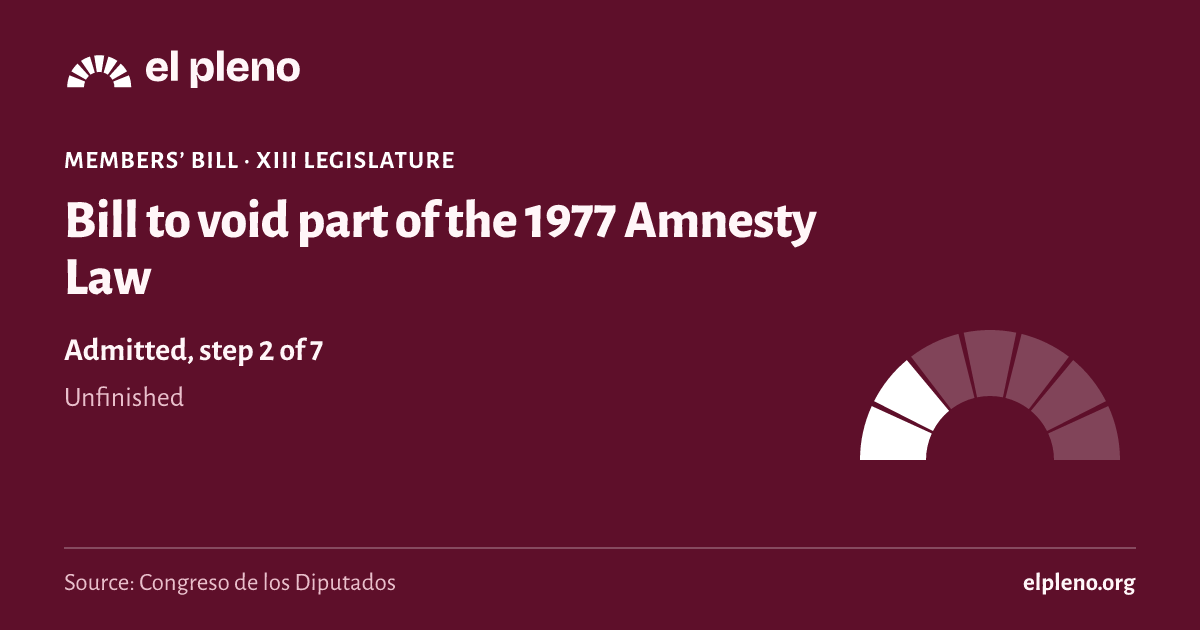
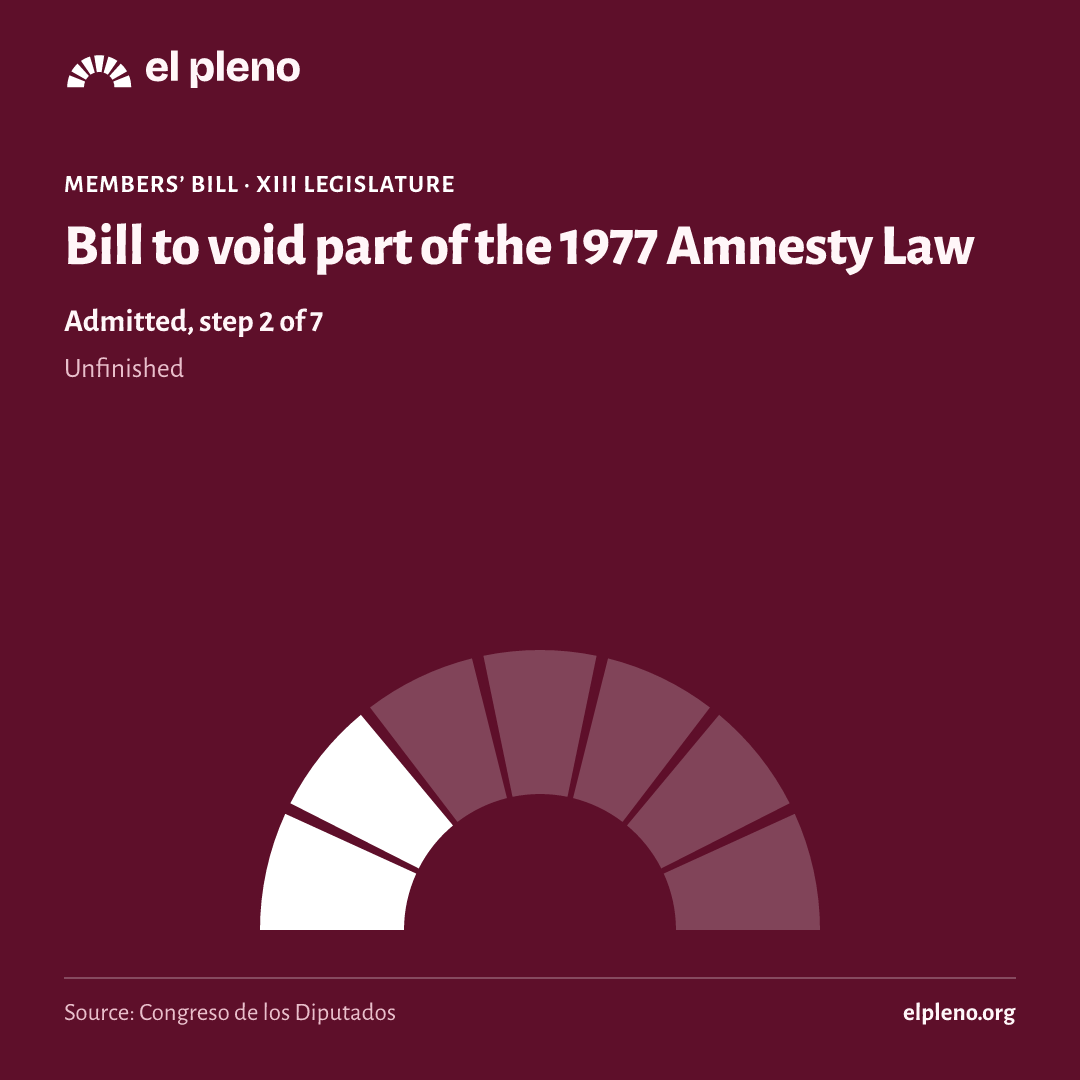
It took 2 of 7 steps. It reached Admitted, and today it is unfinished.
- Introduced5 July 2019Someone registers the text in the Congreso.
- Admitted11 July 2019The Bureau of the Congreso accepts it and, for a members’ bill, the plenary decides whether to consider it.
- Amendmentsnot reachedGroups propose changes.
- Committeenot reachedA committee goes through the text in detail.
- Plenarynot reachedAll 350 deputies vote.
- Senatenot reachedThe Senate can pass it, amend it or veto it.
- BOEnot reachedIt is published in the Official State Gazette (BOE) and comes into force.
See the 5 official steps on a timeline
Was there a plenary vote?
We have no plenary vote linked to this law in the Congreso’s data.
What happens next
What happens now?
The legislature ended before it finished. To go on, someone would have to introduce it again in the new Cortes.
It has not been presented again yet.
Sources
Where does all this come from?
- Congreso de los Diputados, file 122/000022
Official title, type, author, dates and stage.
Retrieved 11 November 2026
- The data comes from the open files of the Congreso, the Senate and the BOE, unaltered.
- Each deputy’s province is the one of their seat on the day of the vote.
- We only say “passed” or “rejected” when the majority needed is certain; otherwise we say which side had more votes.