What it is
Emergency tourism aid after the Thomas Cook collapse
It is a government bill. Introduced by the Government. It was introduced on 22 October 2019. Introduced by: Gobierno.
Official title: Government bill adopting urgent measures to mitigate the effects of the opening of insolvency proceedings of the Thomas Cook business group (originating from Royal Decree-Law 12/2019, of October 11).
Source: Congreso de los Diputados, file 121/000001· updated 11 Nov
Automatic summary, not yet reviewed
- The bill would exceptionally extend a 50% rebate on companies' Social Security contributions for workers on fixed discontinuous contracts in tourism, commerce and hospitality. It would apply in October and December 2019 and February and March 2020, only for workplaces in the Balearic Islands and the Canary Islands.
- It would have the State Public Employment Service and the regional governments coordinate unemployment protection and active employment policies to respond to affected workers as soon as possible.
- It would create a financing line of up to €200 million, approved by the Government's Delegate Commission for Economic Affairs, to meet the financial needs of those affected by the Thomas Cook insolvency.
- It would grant direct subsidies to the Canary Islands (€15 million) and the Balearic Islands (€8 million) to recover lost connectivity, diversify and improve the destinations. Each subsidy would be set up through an agreement and could be paid in a single advance payment.
- It would rename the FOMIT fund as the State Financial Fund for Tourism Competitiveness (FOCIT), which would make loans to tourism companies' projects, especially digitalization, innovation and service modernization. The Government would have three months to develop the rules.
- It would have the State Secretary for Tourism inform companies seeking to recover debts from Thomas Cook group companies in insolvency proceedings, and allocate €1,485,000 to SEGITTUR to strengthen the smart tourist destinations strategy.
Who it affects
- Tourism, commerce and hospitality companies in the Balearic and Canary Islands: They could apply an extra Social Security rebate for four months.
- Workers on fixed discontinuous contracts in those sectors: Their working period is extended with rebates, and their unemployment protection is coordinated.
- Tourism companies affected by the Thomas Cook insolvency: They could access a financing line of up to €200 million and FOCIT loans.
- Governments of the Canary Islands and the Balearic Islands: They would receive direct subsidies of €15 million and €8 million, respectively.
Words worth knowing
- Contrato fijo discontinuo (fixed discontinuous contract)
- A work contract for tasks done only at certain times of year, such as the tourist season.
- Bonificación (rebate)
- A discount the company saves on its Social Security contributions for its workers.
- Insolvencia (insolvency)
- A situation where a company cannot pay its debts and goes to a court procedure called concurso de acreedores (creditors' proceeding).
- Turoperador (tour operator)
- A company that organizes full travel packages, including flights and hotels, and sells them to tourists.
It summarizes the text as it was introduced. It is written by artificial intelligence and may contain mistakes: the official text is what counts. Read the official text · How we make summaries
Where it stands
How far did it get?
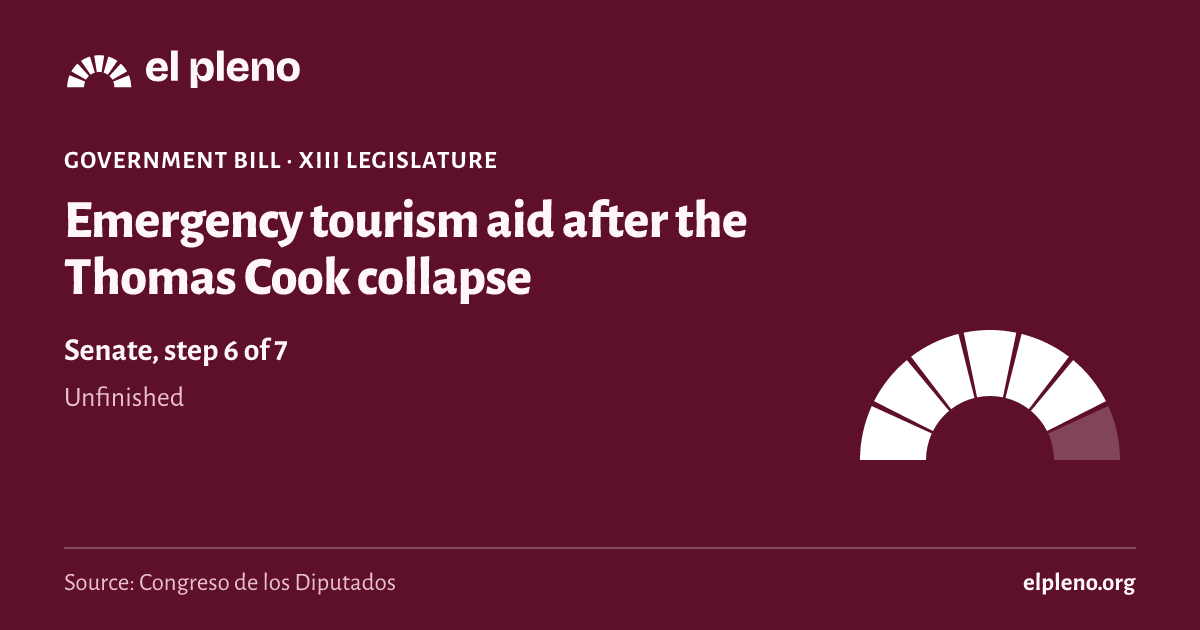
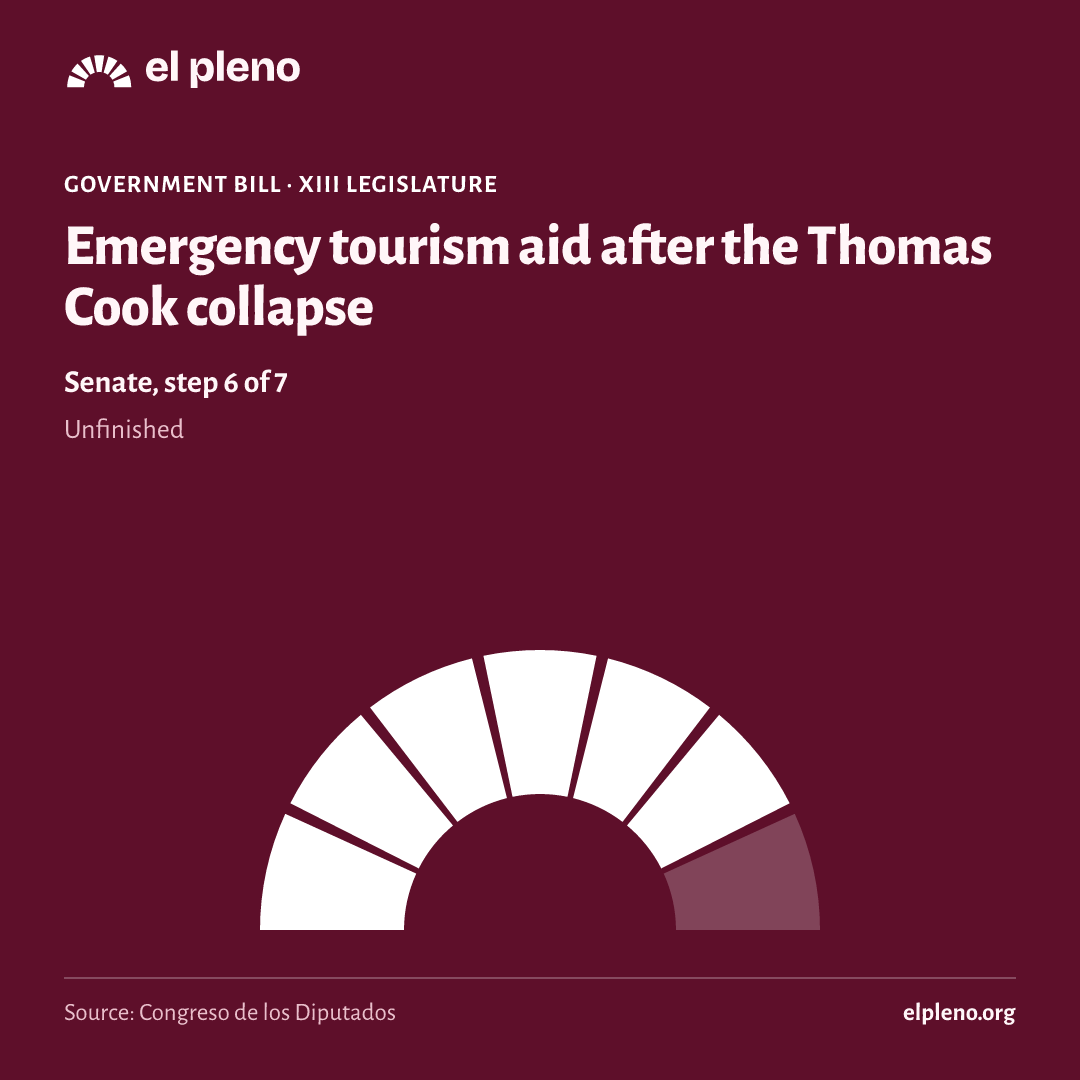
It took 6 of 7 steps. It reached Senate, and today it is unfinished.
- Introduced22 October 2019Someone registers the text in the Congreso.
- Admitted4 November 2019The Bureau of the Congreso accepts it and, for a members’ bill, the plenary decides whether to consider it.
- Amendments5 November 2019Groups propose changes.
- Committeeno dateA committee goes through the text in detail.
- Plenaryno dateAll 350 deputies vote.
- Senate27 November 2019The Senate can pass it, amend it or veto it.
- BOEnot reachedIt is published in the Official State Gazette (BOE) and comes into force.
See the 7 official steps on a timeline
Was there a plenary vote?
We have no plenary vote linked to this law in the Congreso’s data.
What happens next
What happens now?
The legislature ended before it finished. To go on, someone would have to introduce it again in the new Cortes.
It has not been presented again yet.
The same initiative in the other chamber:
Sources
Where does all this come from?
- Congreso de los Diputados, file 121/000001
Official title, type, author, dates and stage.
Retrieved 11 November 2026
- The data comes from the open files of the Congreso, the Senate and the BOE, unaltered.
- Each deputy’s province is the one of their seat on the day of the vote.
- We only say “passed” or “rejected” when the majority needed is certain; otherwise we say which side had more votes.