What it is
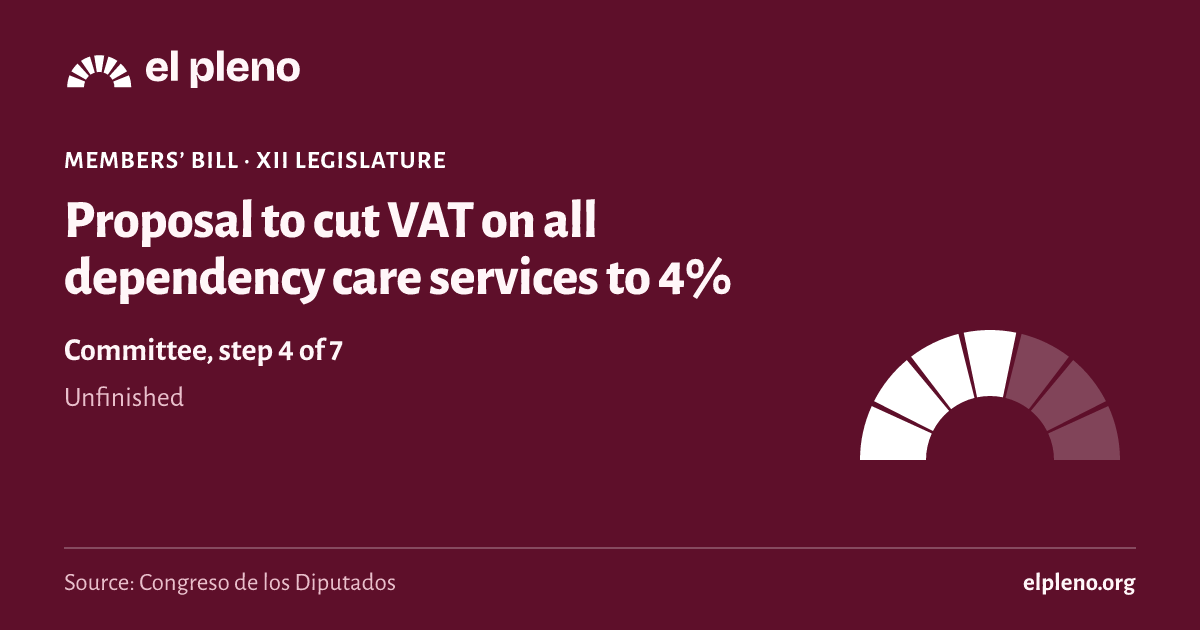
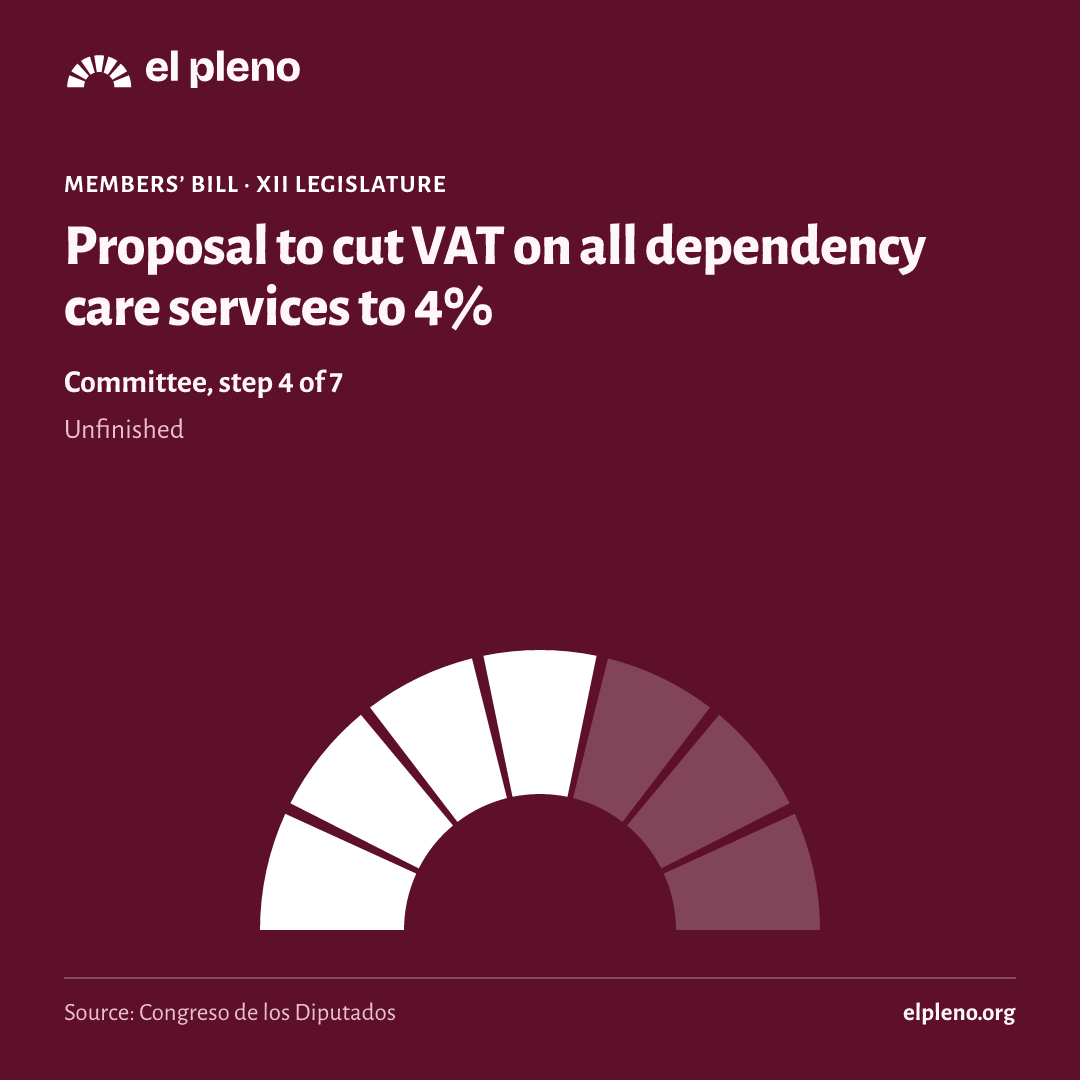
Proposal to cut VAT on all dependency care services to 4%
Committee step 4 of 7 · UnfinishedIt is a members’ bill. Introduced by parliamentary groups, the Senate, regional governments or citizens. It was introduced on 12 November 2018. Introduced by: Senado.
Official title: Private member's bill to amend Law 37/1992, of 28 December, on Value Added Tax, to apply the 4% VAT rate to the provision of all non-exempt dependency care services.
Source: Congreso de los Diputados, file 124/000011· updated 11 Nov
Automatic summary, not yet reviewed
- The bill's statement of reasons explains that many dependency care services are VAT exempt when provided by a public entity or a social establishment, but taxed at 4% or 10% when provided by other entities. This makes many families pay more for basic services.
- The sponsors propose a single 4% VAT rate for all dependency care services, regardless of how they are funded, because many people on waiting lists hire private services.
- The bill would amend the VAT Law so that the 4% rate applies to telecare, home help, day and night center, and residential care services, with no conditions on their funding. It would not affect services that are already VAT exempt.
- The law would enter into force on January 1 of the year after its publication in the Boletín Oficial del Estado (official gazette).
Who it affects
- Dependent people and their families: Would pay 4% VAT instead of 10% on dependency care services hired on the private market.
- Companies and entities providing dependency care services: Would have to apply the 4% rate to all non-exempt dependency care services, with no funding conditions.
- Public administrations and the tax agency: Would have to adapt tax administration to the new rule.
Words worth knowing
- IVA
- Impuesto sobre el Valor Añadido, Spain's Value Added Tax (VAT), paid when buying goods or services.
- Tipo superreducido
- The lowest VAT rate, in this case 4%.
- Servicios exentos
- Services that are not subject to VAT.
- Plaza concertada
- A place in a private care home or center paid for through an agreement with a public administration.
- Proposición de ley
- A bill, a legislative proposal still going through Parliament, not yet approved.
It summarizes the text as it was introduced. It is written by artificial intelligence and may contain mistakes: the official text is what counts. Read the official text · How we make summaries
Where it stands
How far did it get?
It took 4 of 7 steps. It reached Committee, and today it is unfinished.
- Introduced12 November 2018Someone registers the text in the Congreso.
- Admitted20 November 2018The Bureau of the Congreso accepts it and, for a members’ bill, the plenary decides whether to consider it.
- Amendments23 November 2018Groups propose changes.
- Committee27 February 2019A committee goes through the text in detail.
- Plenarynot reachedAll 350 deputies vote.
- Senatenot reachedThe Senate can pass it, amend it or veto it.
- BOEnot reachedIt is published in the Official State Gazette (BOE) and comes into force.
See the 6 official steps on a timeline
Was there a plenary vote?
We have no plenary vote linked to this law in the Congreso’s data.
What happens next
What happens now?
The legislature ended before it finished. To go on, someone would have to introduce it again in the new Cortes.
It was presented again:
- XIV Legislature, Congreso de los Diputados· Unfinished Bill to cut VAT on dependency care services to 4%
- XIV Legislature, Senate Private member's bill to amend Law 37/1992, of 28 December, on Value Added Tax, to apply the 4% VAT rate to the provision of all non-exempt dependency care services.
- XV Legislature, Congreso de los Diputados· Unfinished Bill proposes 4% VAT for all dependency care services
- XV Legislature, Senate Private member's bill amending Law 37/1992, of December 28, on Value Added Tax, to apply the 4 % VAT rate to the provision of all non-exempt dependency care services.
The same initiative in the other chamber:
Sources
Where does all this come from?
- Congreso de los Diputados, file 124/000011
Official title, type, author, dates and stage.
Retrieved 11 November 2026
- The data comes from the open files of the Congreso, the Senate and the BOE, unaltered.
- Each deputy’s province is the one of their seat on the day of the vote.
- We only say “passed” or “rejected” when the majority needed is certain; otherwise we say which side had more votes.