What it is
Bill would set common rules for forest rangers in Spain
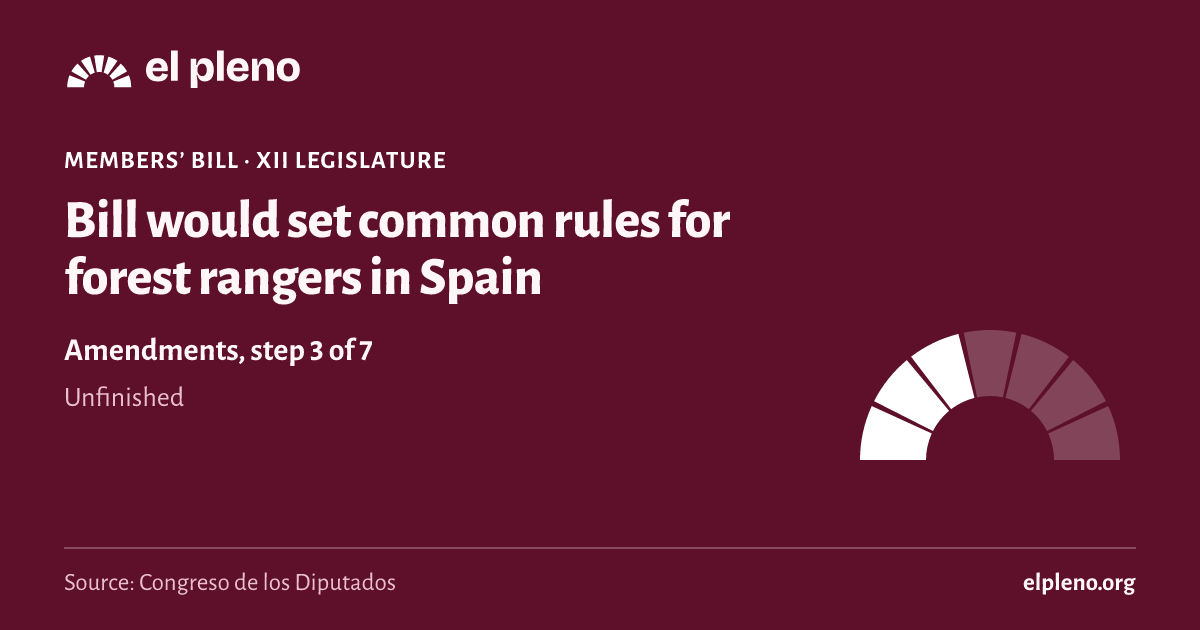
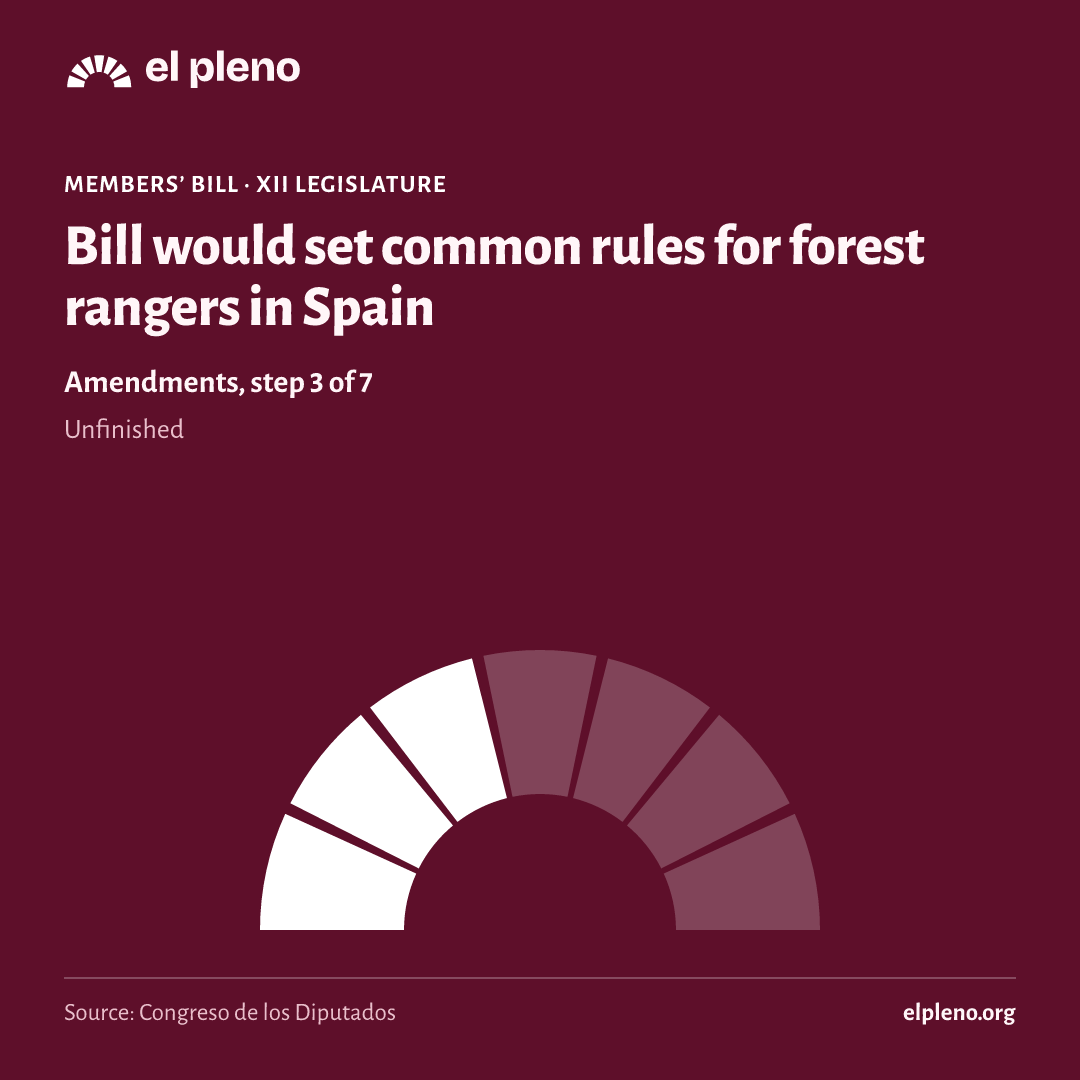
Amendments step 3 of 7 · UnfinishedIt is a members’ bill. Introduced by parliamentary groups, the Senate, regional governments or citizens. It was introduced on 11 October 2018. Introduced by: Senado.
Official title: Private member's bill for a basic law on forest agents.
Source: Congreso de los Diputados, file 124/000008· updated 11 Nov
Automatic summary, not yet reviewed
- The bill would establish a common basic legal framework for all forest and environmental ranger corps in Spain, without changing their attachment to each administration. It would also set "Agente Forestal y Medioambiental" as the generic name, though each territory may keep names such as Guardas or Agentes Rurales.
- Rangers would be civil servants, authority agents and special administrative police, and would act as judicial police assisting judges and the Public Prosecutor. Their basic duties would be environmental policing, technical support for managing the natural environment, and help in emergencies such as forest fires or searches for missing people.
- The text lists powers such as asking people to identify themselves, entering places subject to inspection while respecting the inviolability of the home, taking samples and carrying out checks, always respecting proportionality. Their reports and citations would carry a presumption of truth, after confirmation if challenged.
- Rangers would work in coordination with the Security Forces, without subordination, and would carry personal defense equipment when they see a risk to their life or physical integrity. They would also use official priority vehicles, and a State Commission for Cooperation would be created within the Ministry of the Interior.
- Entry into these corps would be through competitive examinations, with a selection course, a training period and physical fitness tests. The administration would guarantee their legal defense, and specific occupational health and safety plans would be developed.
- The Forestry Law and the Criminal Procedure Law would be amended, and the government would adapt the Weapons Regulation so that the ranger's professional card could serve as a class A weapons license. The law would take effect three months after publication, except budget-related measures, which would wait until 2020.
Who it affects
- Forest and environmental rangers across Spain: They would get a common basic legal framework, with powers, defense equipment and job safety protections set by law.
- Spain's Autonomous Communities and local entities: They would have to adapt their rules on these corps within one year, while keeping control of their own corps.
- The Security Forces: They would cooperate reciprocally and in a coordinated way with forest rangers within their respective powers.
- Anyone using the natural environment or committing environmental offenses: They could be identified, inspected or cited by forest rangers in the course of their duties.
Words worth knowing
- Agente de la autoridad (authority agent)
- A public official whose orders and reports have full legal force against citizens.
- Policía judicial (judicial police)
- The role of helping judges, courts and prosecutors investigate crimes.
- Presunción de certeza (presumption of truth)
- What appears in the ranger's report is considered true, unless proven otherwise after it is confirmed.
- Vehículo prioritario (priority vehicle)
- An official vehicle with lights and markings that may have priority in traffic.
- Ley básica (basic law)
- A state law setting minimum common rules for the whole country, while each Autonomous Community may later add its own rules.
It summarizes the text as it was introduced. It is written by artificial intelligence and may contain mistakes: the official text is what counts. Read the official text · How we make summaries
Where it stands
How far did it get?
It took 3 of 7 steps. It reached Amendments, and today it is unfinished.
- Introduced11 October 2018Someone registers the text in the Congreso.
- Admitted16 October 2018The Bureau of the Congreso accepts it and, for a members’ bill, the plenary decides whether to consider it.
- Amendments19 October 2018Groups propose changes.
- Committeenot reachedA committee goes through the text in detail.
- Plenarynot reachedAll 350 deputies vote.
- Senatenot reachedThe Senate can pass it, amend it or veto it.
- BOEnot reachedIt is published in the Official State Gazette (BOE) and comes into force.
See the 5 official steps on a timeline
Was there a plenary vote?
We have no plenary vote linked to this law in the Congreso’s data.
What happens next
What happens now?
The legislature ended before it finished. To go on, someone would have to introduce it again in the new Cortes.
It has not been presented again yet.
Sources
Where does all this come from?
- Congreso de los Diputados, file 124/000008
Official title, type, author, dates and stage.
Retrieved 11 November 2026
- The data comes from the open files of the Congreso, the Senate and the BOE, unaltered.
- Each deputy’s province is the one of their seat on the day of the vote.
- We only say “passed” or “rejected” when the majority needed is certain; otherwise we say which side had more votes.