What it is
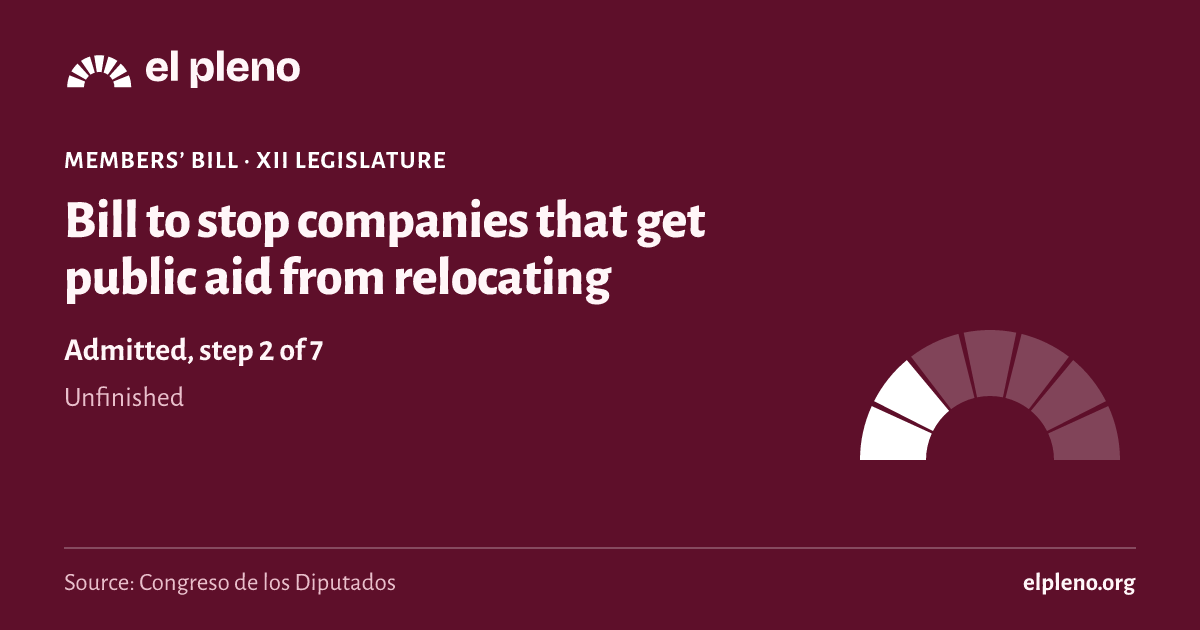
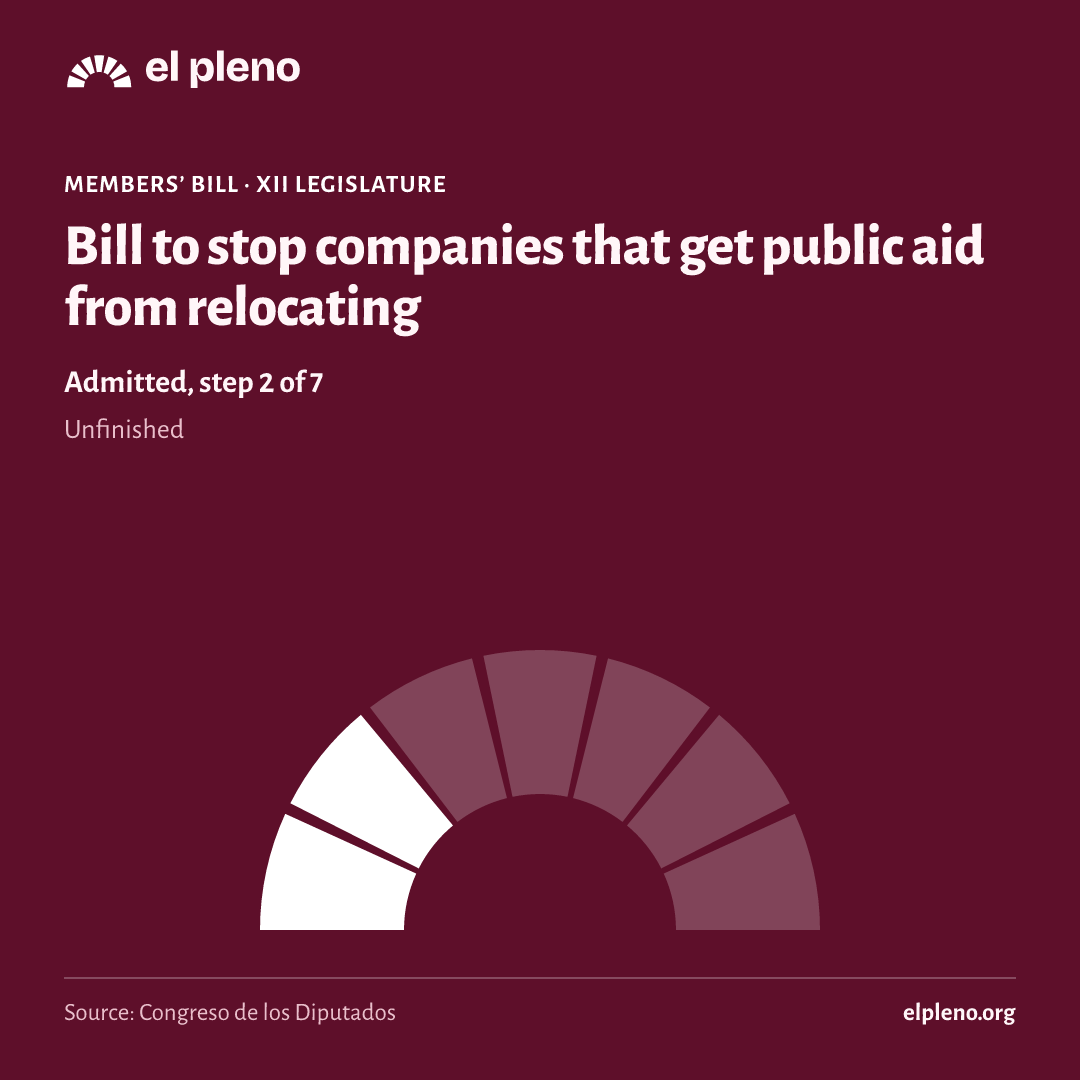
Bill to stop companies that get public aid from relocating
It is a members’ bill. Introduced by parliamentary groups, the Senate, regional governments or citizens. It was introduced on 20 February 2019. Introduced by: Grupo Parlamentario Confederal de Unidos Podemos-En Comú Podem-En Marea.
Official title: Private member's bill on measures against the relocation of industrial activities.
Source: Congreso de los Diputados, file 122/000326· updated 11 Nov
Automatic summary, not yet reviewed
- The bill would define relocation as moving an industry or productive activity to a State outside the European Union and the European Economic Area, even if the move is made by a linked company or one in the same group.
- It would require companies receiving grants for industrial investments, internationalization, competitiveness, digitalization or keeping activity going to repay the money if they relocate within 10 years of the grant.
- It would classify relocation within those 10 years as a very serious offense, with a fine of two to three times the amount received and accessory penalties of up to ten years, such as losing the right to grants or being barred from public contracts.
- It would not penalize relocation if it happens from the fifth year after the grant was awarded and the money has been repaid without prior demand.
- In the electricity sector, it would require anyone who relocates within 10 years of receiving the interruptibility service to repay all amounts plus interest, and would classify relocation as a very serious offense with fines and accessory penalties.
- It would apply these rules to grants already awarded before the law takes effect, as long as ten years have not passed since the award, and would take effect the same day it is published in the official state gazette.
Who it affects
- Companies receiving public grants for industrial investments, internationalization, competitiveness, digitalization or keeping activity going.: They would have to repay the money and could be sanctioned if they relocate within 10 years.
- Electricity consumers with the interruptibility service.: They would have to repay amounts plus interest if they relocate within 10 years.
- Public administrations that award grants.: They could demand repayment and impose penalties; the Government and the Autonomous Communities would have to adapt their rules within six months.
- Companies in the electricity sector.: They could face disqualification, suspension of permits or a ban on public contracts for very serious offenses.
Words worth knowing
- Deslocalización (relocation)
- Moving a factory or productive activity to another country, in this bill outside the European Union and the European Economic Area.
- Reintegro (repayment)
- Returning the grant money to the public administration, plus late-payment interest.
- Intereses de demora (late-payment interest)
- An extra amount paid for delaying repayment of the money.
- Servicio de interrumpibilidad (interruptibility service)
- An electricity aid scheme where the consumer allows power cuts at certain times in exchange for compensation.
- Infracción muy grave (very serious offense)
- The most serious type of violation under the law, carrying the harshest penalties.
It summarizes the text as it was introduced. It is written by artificial intelligence and may contain mistakes: the official text is what counts. Read the official text · How we make summaries
Where it stands
How far did it get?
It took 2 of 7 steps. It reached Admitted, and today it is unfinished.
- Introduced20 February 2019Someone registers the text in the Congreso.
- Admitted26 February 2019The Bureau of the Congreso accepts it and, for a members’ bill, the plenary decides whether to consider it.
- Amendmentsnot reachedGroups propose changes.
- Committeenot reachedA committee goes through the text in detail.
- Plenarynot reachedAll 350 deputies vote.
- Senatenot reachedThe Senate can pass it, amend it or veto it.
- BOEnot reachedIt is published in the Official State Gazette (BOE) and comes into force.
See the 5 official steps on a timeline
Was there a plenary vote?
We have no plenary vote linked to this law in the Congreso’s data.
What happens next
What happens now?
The legislature ended before it finished. To go on, someone would have to introduce it again in the new Cortes.
It has not been presented again yet.
Sources
Where does all this come from?
- Congreso de los Diputados, file 122/000326
Official title, type, author, dates and stage.
Retrieved 11 November 2026
- The data comes from the open files of the Congreso, the Senate and the BOE, unaltered.
- Each deputy’s province is the one of their seat on the day of the vote.
- We only say “passed” or “rejected” when the majority needed is certain; otherwise we say which side had more votes.