What it is
Bill proposes repealing rule letting parties collect political opinions
It is a members’ bill. Introduced by parliamentary groups, the Senate, regional governments or citizens. It was introduced on 18 February 2019. Introduced by: Grupo Parlamentario Mixto.
Official title: Private member's bill for an Organic Law repealing Article 58 bis of Organic Law 5/1985, of June 19, on the General Electoral Regime, relating to the collection of personal data by political parties.
Source: Congreso de los Diputados, file 122/000323· updated 11 Nov
Automatic summary, not yet reviewed
- The bill would repeal Article 58 bis of the General Electoral Regime organic law A law on fundamental rights, the electoral system or other matters the Constitution reserves. It needs an absolute majority in the Congreso: 176 votes.. That article allows political parties to collect data about people's political opinions during election campaigns.
- According to the explanatory statement, Article 58 bis lets parties use data taken from websites and other public sources to run election campaign propaganda without asking for consent. It also allows them to build lists and databases that classify people by their opinions.
- The explanatory statement argues that the article goes beyond what the European data protection regulation allows, since political opinions are a special category of data whose processing is banned except for exceptions. It also cites the Cambridge Analytica scandal as an example of the risks of these practices.
Who it affects
- Citizens in general: They would no longer face targeted election propaganda based on political opinions collected without their consent.
- Political parties, coalitions and electoral groups: They would lose the ability to collect and use political opinion data from public sources during campaigns.
Words worth knowing
- Derogar
- To repeal, that is, to remove a law or part of it so it no longer applies.
- Proposición de Ley Orgánica
- A bill on fundamental rights introduced by a parliamentary group; here it is not an approved law yet.
- LOREG
- Ley Orgánica del Régimen Electoral General, the Spanish law that regulates elections.
- Categoría especial de datos
- Special category of data: highly sensitive information, such as political opinions or health, whose processing is banned except for exceptions.
- organic law
- A law on fundamental rights, the electoral system or other matters the Constitution reserves. It needs an absolute majority in the Congreso: 176 votes.
It summarizes the text as it was introduced. It is written by artificial intelligence and may contain mistakes: the official text is what counts. Read the official text · How we make summaries
Where it stands
How far did it get?
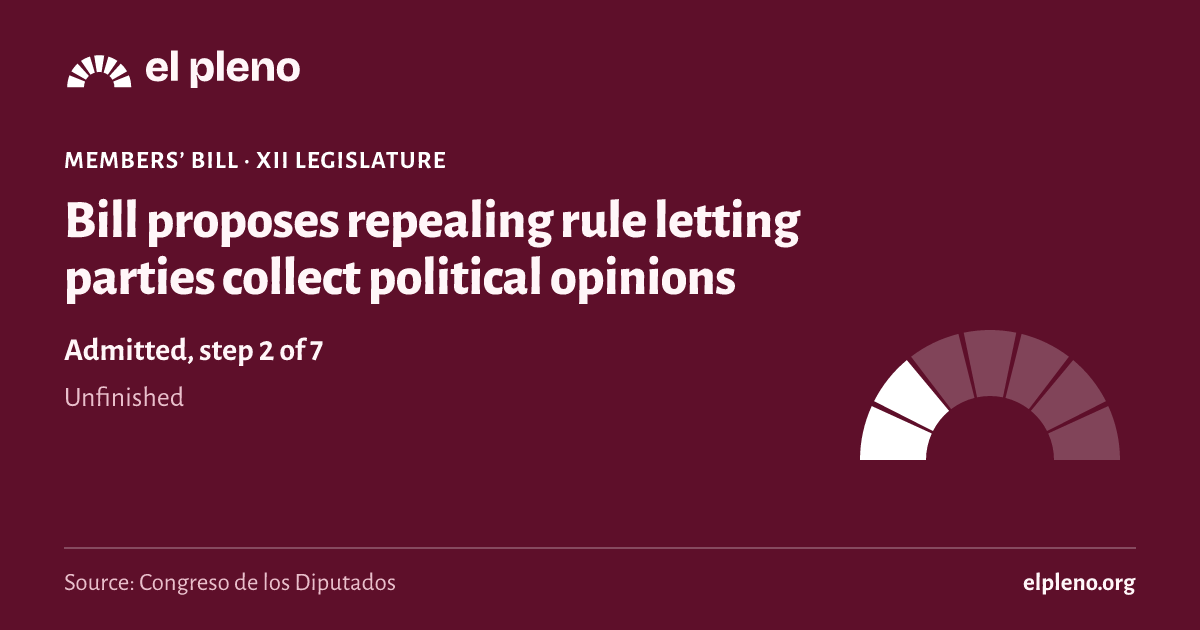
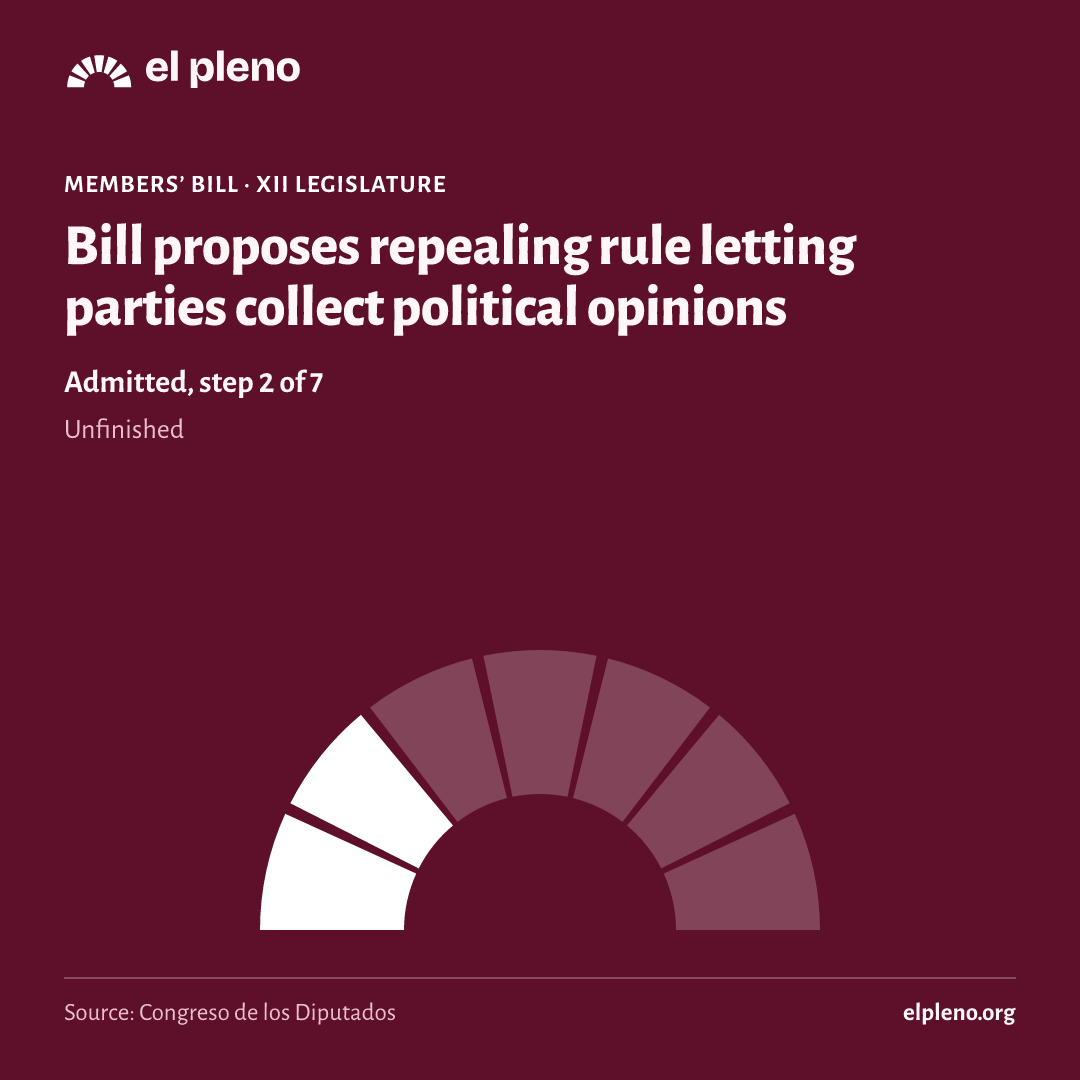
It took 2 of 7 steps. It reached Admitted, and today it is unfinished.
- Introduced18 February 2019Someone registers the text in the Congreso.
- Admitted26 February 2019The Bureau of the Congreso accepts it and, for a members’ bill, the plenary decides whether to consider it.
- Amendmentsnot reachedGroups propose changes.
- Committeenot reachedA committee goes through the text in detail.
- Plenarynot reachedAll 350 deputies vote.
- Senatenot reachedThe Senate can pass it, amend it or veto it.
- BOEnot reachedIt is published in the Official State Gazette (BOE) and comes into force.
See the 5 official steps on a timeline
Was there a plenary vote?
We have no plenary vote linked to this law in the Congreso’s data.
What happens next
What happens now?
The legislature ended before it finished. To go on, someone would have to introduce it again in the new Cortes.
It has not been presented again yet.
Sources
Where does all this come from?
- Congreso de los Diputados, file 122/000323
Official title, type, author, dates and stage.
Retrieved 11 November 2026
- The data comes from the open files of the Congreso, the Senate and the BOE, unaltered.
- Each deputy’s province is the one of their seat on the day of the vote.
- We only say “passed” or “rejected” when the majority needed is certain; otherwise we say which side had more votes.