What it is
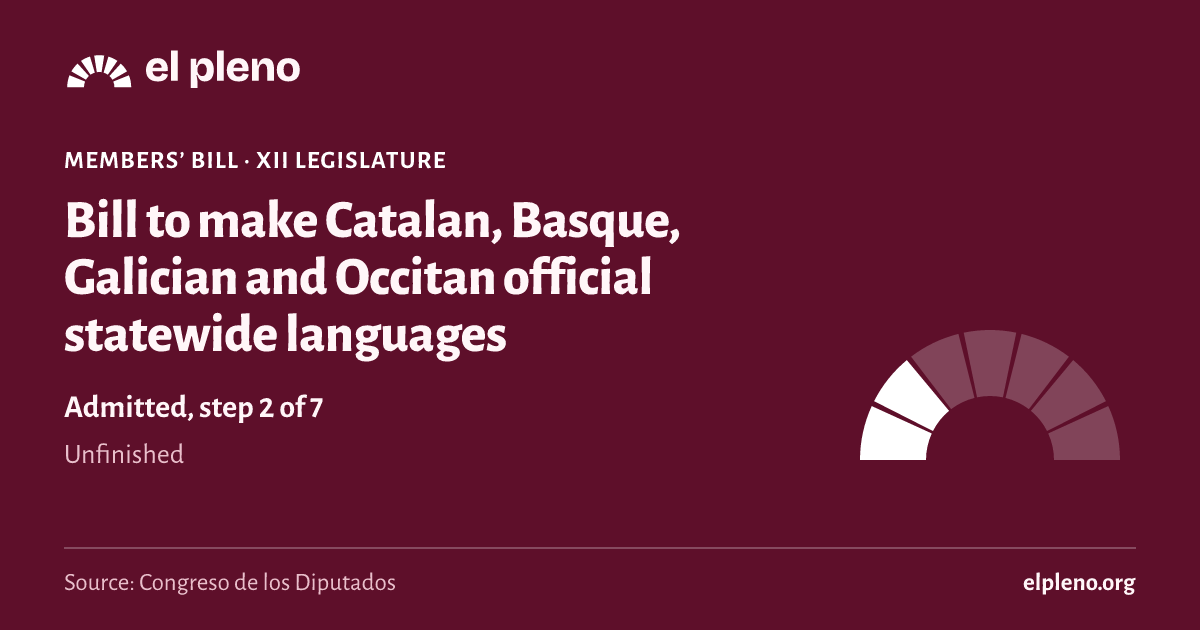
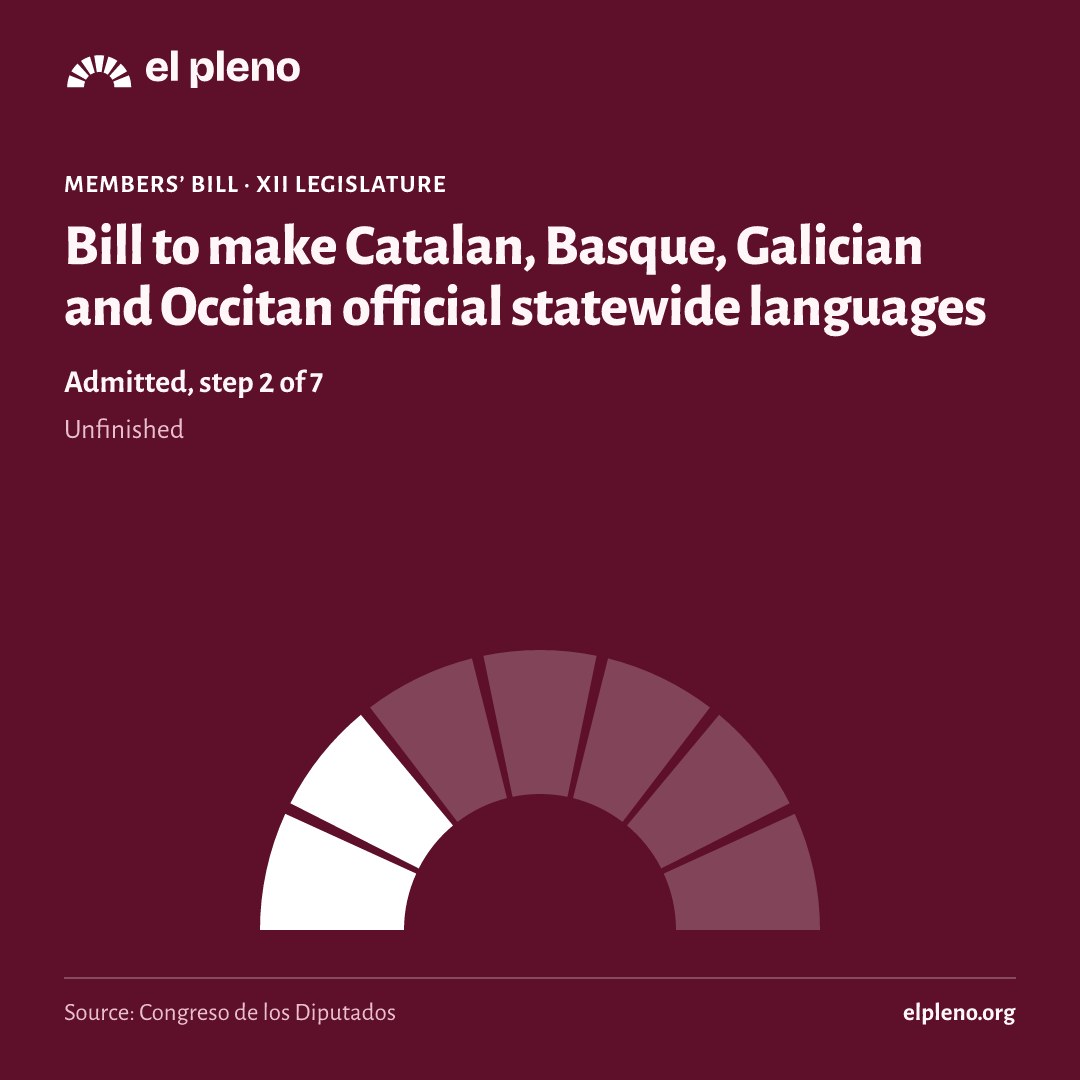
Bill to make Catalan, Basque, Galician and Occitan official statewide languages
It is a members’ bill. Introduced by parliamentary groups, the Senate, regional governments or citizens. It was introduced on 14 November 2018. Introduced by: Grupo Parlamentario de Esquerra Republicana.
Official title: Private member's organic bill for the protection, promotion, and declaration of official status of Spanish languages other than Castilian.
Source: Congreso de los Diputados, file 122/000307· updated 11 Nov
Automatic summary, not yet reviewed
- The bill would declare Catalan (called Valencian in the Valencian Community), Basque, Galician and Occitan (Aranese in the Aran Valley) official languages of the State, alongside Spanish, as long as they are official in at least one autonomous community. It would also require the State to seek their recognition in the European Union and international bodies.
- Any person or company could deal with the State's central services and common bodies in whichever official language they choose, and receive a reply in that same language. They could also get official documents such as the national ID card, passport or driver's license in the chosen language.
- The Government would appoint a Commissioner to make sure the law is followed, and the Administration would need staff with language training and translation services paid for by the State budget. State laws and regulations and basic European rules would have to be available in all official languages.
- The same language rights would apply in the courts, the Public Prosecutor's Office, notaries and public registries. Judges, prosecutors and court clerks would use the territory's own official language, and a minimum level of that language would be required to apply for vacant positions.
- The bill includes promotion measures: at least half of the programming of statewide radio and TV stations would have to air in languages other than Spanish, food labeling would be in all official languages, and the languages' presence in film, digital platforms, software and phone services would be boosted.
- This is a bill introduced by Esquerra Republicana in the Congress of Deputies (Congreso de los Diputados) in November 2018 and admitted for processing, not an approved law. It would take effect three months after publication in the official gazette, except for measures with budget costs.
Who it affects
- Anyone who speaks Catalan, Basque, Galician or Occitan: Could use their language before the State, the courts and registries, and get replies in it.
- State civil servants: Would need to prove knowledge of the official language to fill positions in territories with their own language.
- Businesses: Would have to label food in all official languages and offer goods and services preferably in each community's own language.
- Statewide radio and TV stations: Would have to air at least half their programming in official languages other than Spanish.
- Judges, prosecutors and notaries: Would use the territory's official language and could not require translation from people using it.
Words worth knowing
- Proposición de ley
- A text through which a parliamentary group proposes a new law. It is not a law until passed by the Congress and, in this case, as an organic law.
- Ley orgánica (organic law)
- A law that needs an absolute majority in the Congress and is reserved for major matters, such as fundamental rights.
- Comunidad autónoma (autonomous community)
- Each of the territories with their own government that make up Spain, such as Catalonia or Galicia.
- Dominio lingüístico (linguistic domain)
- The territory where a given language is habitually spoken.
- Concurso de plazas
- The system for choosing which civil servants fill a vacant post, based on their merits.
It summarizes the text as it was introduced. It is written by artificial intelligence and may contain mistakes: the official text is what counts. Read the official text · How we make summaries
Where it stands
How far did it get?
It took 2 of 7 steps. It reached Admitted, and today it is unfinished.
- Introduced14 November 2018Someone registers the text in the Congreso.
- Admitted20 November 2018The Bureau of the Congreso accepts it and, for a members’ bill, the plenary decides whether to consider it.
- Amendmentsnot reachedGroups propose changes.
- Committeenot reachedA committee goes through the text in detail.
- Plenarynot reachedAll 350 deputies vote.
- Senatenot reachedThe Senate can pass it, amend it or veto it.
- BOEnot reachedIt is published in the Official State Gazette (BOE) and comes into force.
See the 5 official steps on a timeline
Was there a plenary vote?
We have no plenary vote linked to this law in the Congreso’s data.
What happens next
What happens now?
The legislature ended before it finished. To go on, someone would have to introduce it again in the new Cortes.
It has not been presented again yet.
Sources
Where does all this come from?
- Congreso de los Diputados, file 122/000307
Official title, type, author, dates and stage.
Retrieved 11 November 2026
- The data comes from the open files of the Congreso, the Senate and the BOE, unaltered.
- Each deputy’s province is the one of their seat on the day of the vote.
- We only say “passed” or “rejected” when the majority needed is certain; otherwise we say which side had more votes.