What it is
Proposal to share working time and care more fairly
It is a members’ bill. Introduced by parliamentary groups, the Senate, regional governments or citizens. It was introduced on 6 November 2018. Introduced by: Grupo Parlamentario Confederal de Unidos Podemos-En Comú Podem-En Marea.
Official title: Private member's bill on shared working time.
Source: Congreso de los Diputados, file 122/000299· updated 11 Nov
Automatic summary, not yet reviewed
- The bill would make unfavorable treatment of workers for exercising work-life balance and shared responsibility rights a form of sex discrimination.
- It would reform part-time work: contracts would have to state start and end times, supplementary hours would be abolished, and employers could not unilaterally add hours or switch workers between full-time and part-time.
- The leave for breastfeeding and caring for children under twelve months would become an individual, duplicable right: each parent could take it, even for the same child, and it could be accumulated into full days off.
- It would create a right to reduce working hours, or to change shifts or schedules, for reasons of training, career prospects, family or disability, subject to certain seniority requirements.
- All employees' working time would have to be recorded daily, with start and end times, and kept available to the Labor Inspectorate; failing to keep the record would be a serious offense.
- Workers would gain the right to have employers consider adapting their schedules for work-life balance, and employers would have to justify any refusal in writing within fifteen days.
- In Social Security, the bill would count time registered with the system, not just hours actually worked, toward pensions and unemployment benefits, abolishing the part-time coefficient, and would replace the maternity top-up with a child care top-up available to mothers or fathers.
- It would strengthen dismissal protection for pregnant workers and people on care leave, abolish dismissal for absenteeism, and create a special, fast-track court procedure to claim work-life balance rights.
Who it affects
- Workers, especially those caring for children or dependents: They would gain more rights to adapt their schedules, reduce working time and protection against dismissal.
- Part-time workers: They would have the same rights as full-time workers and more control over their hours and contributions.
- Employers: They would have to record working time, justify refusals of schedule adaptations and could be fined for violations.
- Public employees: The Public Employees' Basic Statute would include similar work-life balance and reduced hours rights.
- Pensioners and unemployed people: The rules for calculating pensions and benefits would change to reduce the gender gap.
Words worth knowing
- Conciliación y corresponsabilidad
- Work-life balance and shared responsibility: combining work with family life and splitting care tasks between men and women.
- Horas complementarias
- Extra hours an employer could require a part-time worker to work under the agreed terms; the bill would abolish them.
- Coeficiente de parcialidad
- A rule that reduced the counted contributions of part-time workers; the bill would eliminate it.
- Base reguladora
- The amount taken from contribution bases used to calculate how much a pension or benefit pays.
- Excedencia
- A leave status where a worker temporarily stops working with full or partial job reservation.
It summarizes the text as it was introduced. It is written by artificial intelligence and may contain mistakes: the official text is what counts. Read the official text · How we make summaries
Where it stands
How far did it get?
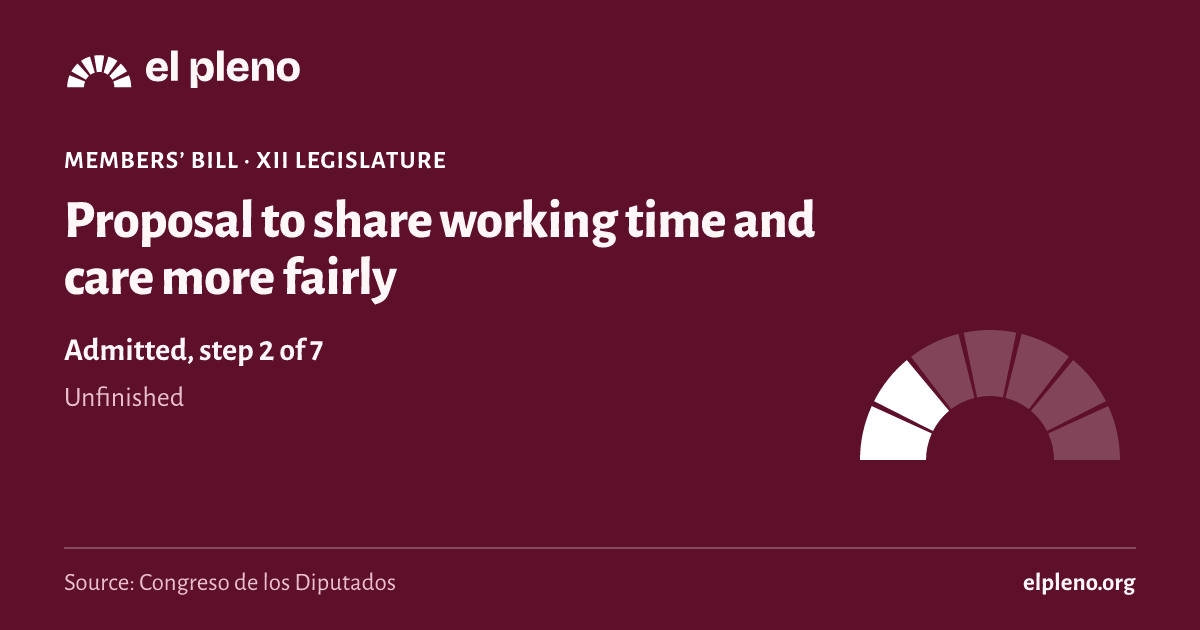
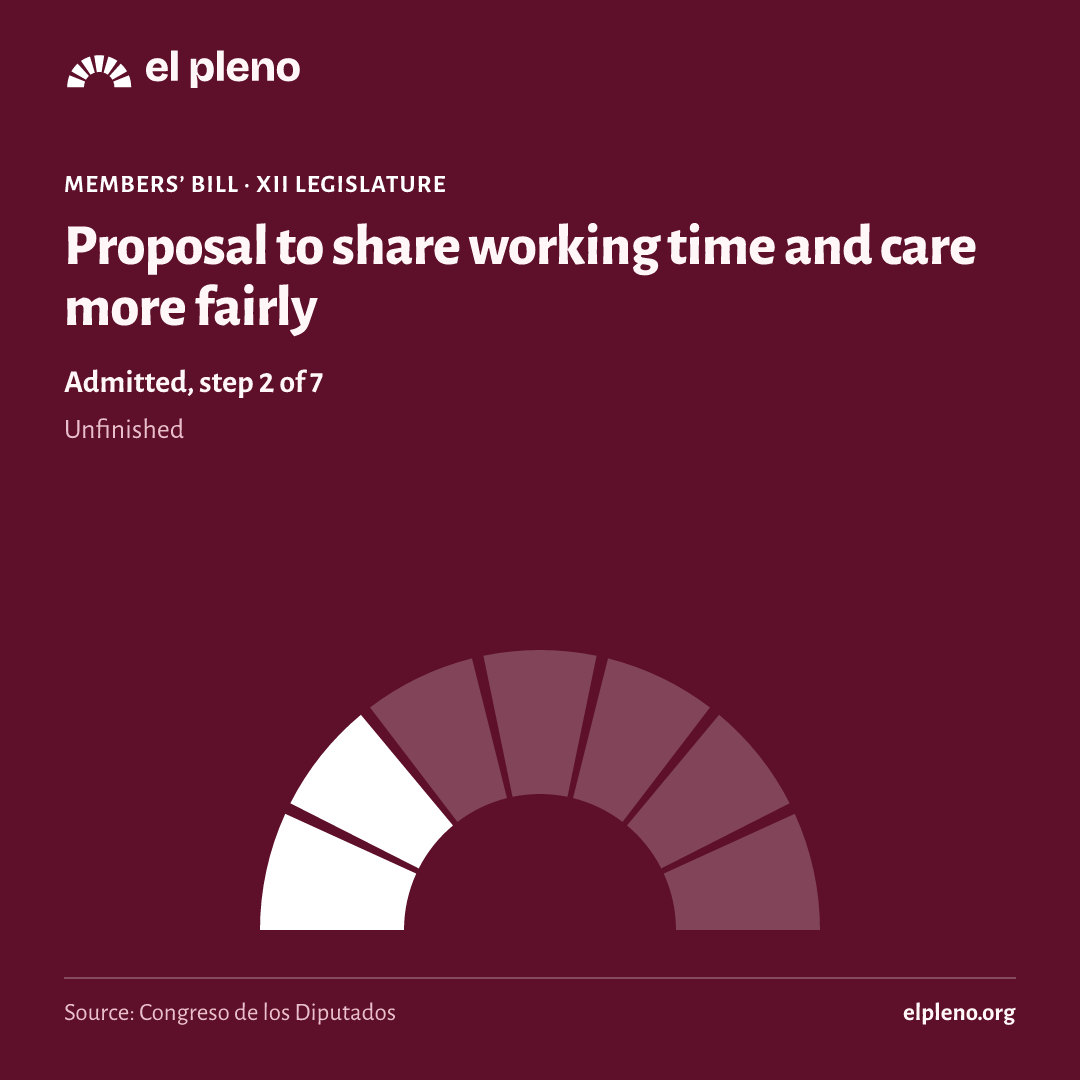
It took 2 of 7 steps. It reached Admitted, and today it is unfinished.
- Introduced6 November 2018Someone registers the text in the Congreso.
- Admitted13 November 2018The Bureau of the Congreso accepts it and, for a members’ bill, the plenary decides whether to consider it.
- Amendmentsnot reachedGroups propose changes.
- Committeenot reachedA committee goes through the text in detail.
- Plenarynot reachedAll 350 deputies vote.
- Senatenot reachedThe Senate can pass it, amend it or veto it.
- BOEnot reachedIt is published in the Official State Gazette (BOE) and comes into force.
See the 6 official steps on a timeline
Was there a plenary vote?
We have no plenary vote linked to this law in the Congreso’s data.
What happens next
What happens now?
The legislature ended before it finished. To go on, someone would have to introduce it again in the new Cortes.
It has not been presented again yet.
Sources
Where does all this come from?
- Congreso de los Diputados, file 122/000299
Official title, type, author, dates and stage.
Retrieved 11 November 2026
- The data comes from the open files of the Congreso, the Senate and the BOE, unaltered.
- Each deputy’s province is the one of their seat on the day of the vote.
- We only say “passed” or “rejected” when the majority needed is certain; otherwise we say which side had more votes.