What it is
Bill would give town councils back the say on new gas stations
It is a members’ bill. Introduced by parliamentary groups, the Senate, regional governments or citizens. It was introduced on 5 November 2018. Introduced by: Grupo Parlamentario Confederal de Unidos Podemos-En Comú Podem-En Marea.
Official title: Private member's bill regarding the recovery of municipal autonomy for the establishment of retail fuel supply facilities on land designated for commercial or industrial use.
Source: Congreso de los Diputados, file 122/000297· updated 11 Nov
Automatic summary, not yet reviewed
- The bill would give town councils back the power to approve or reject gas stations on land zoned for commercial or industrial use. Under current law they cannot refuse these installations, which the text says has led to gas stations piling up along city roads.
- The bill would amend Law 11/2013 to delete the paragraph declaring gas stations compatible with commercial and industrial land without any specific zoning. It would also delete the provision barring councils from refusing these installations for lack of specifically zoned land.
- Even so, the proposed text keeps some limits: urban planning rules could not regulate technical aspects of the installations or require a specific technology, and the process to open a gas station would have to be resolved within a maximum of eight months.
- Any rules that conflict with the law would be repealed, the Government could issue the rules needed to apply it, and the law would take effect the day after its publication in the Official State Gazette (Boletín Oficial del Estado).
Who it affects
- Town councils (ayuntamientos): They would regain the power to approve or deny gas stations on commercial or industrial land.
- Residents and neighborhood groups: Their complaints about the buildup of gas stations near residential areas could be addressed.
- Fuel sector companies: They could still open service stations, but under municipal planning control and a single procedure with an eight-month deadline.
Words worth knowing
- Autonomía municipal
- The ability of each town council to decide for itself on matters within its municipality, here on urban planning.
- Suelo calificado con uso comercial o industrial
- Land that urban plans designate for commercial or industrial activities, such as shopping centers or industrial parks.
- Competencias urbanísticas
- A town council's powers to organize and control land use and buildings within its municipality.
- Proposición de ley
- A bill introduced by members of the Congress of Deputies. It is not a law until the whole legislative process is completed.
It summarizes the text as it was introduced. It is written by artificial intelligence and may contain mistakes: the official text is what counts. Read the official text · How we make summaries
Where it stands
How far did it get?
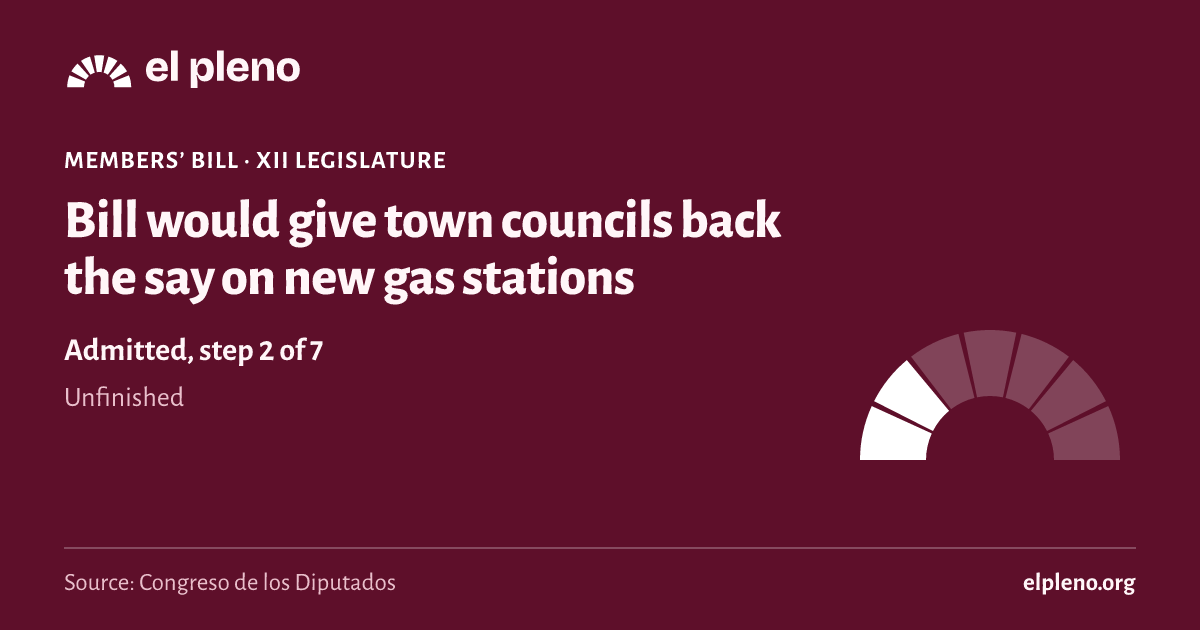
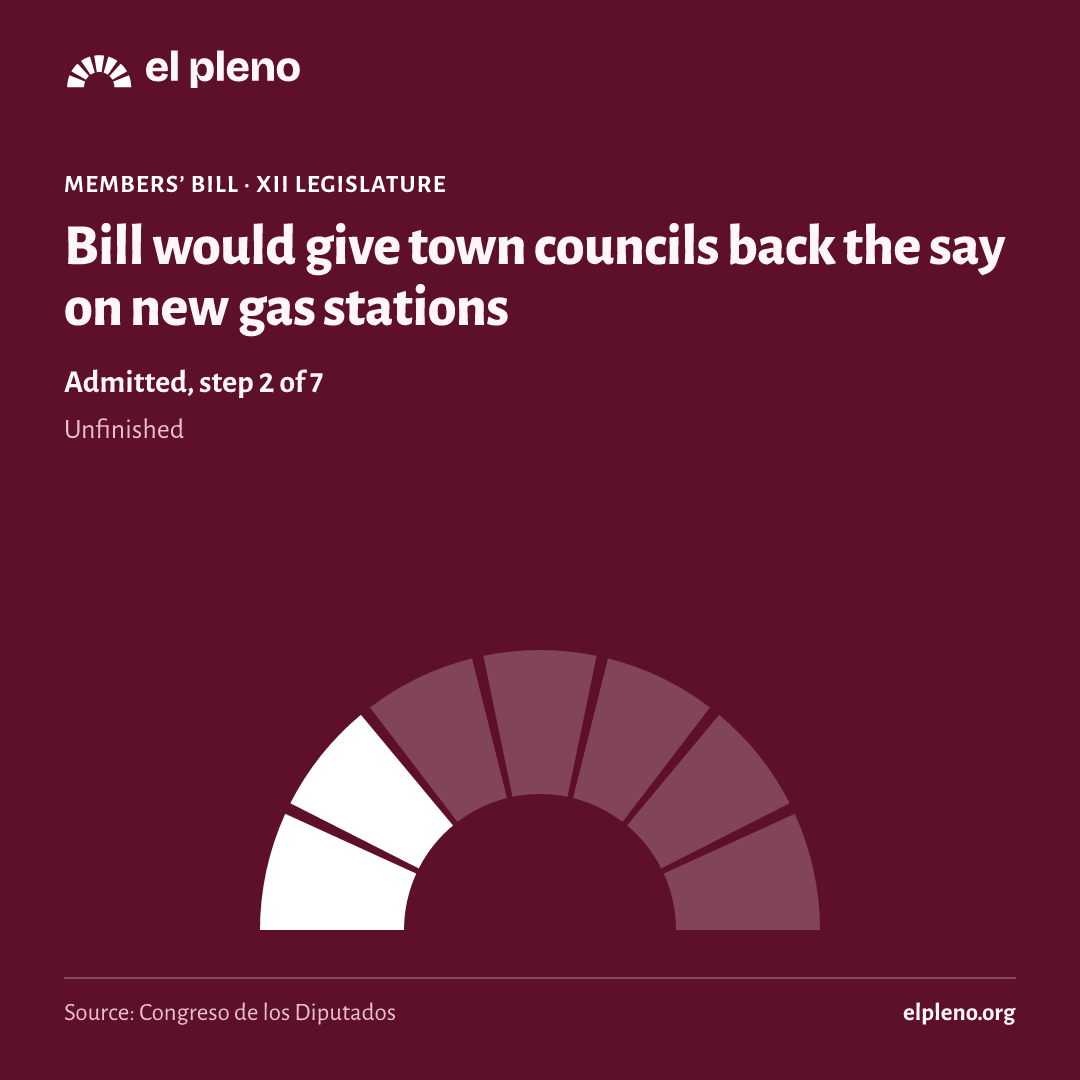
It took 2 of 7 steps. It reached Admitted, and today it is unfinished.
- Introduced5 November 2018Someone registers the text in the Congreso.
- Admitted13 November 2018The Bureau of the Congreso accepts it and, for a members’ bill, the plenary decides whether to consider it.
- Amendmentsnot reachedGroups propose changes.
- Committeenot reachedA committee goes through the text in detail.
- Plenarynot reachedAll 350 deputies vote.
- Senatenot reachedThe Senate can pass it, amend it or veto it.
- BOEnot reachedIt is published in the Official State Gazette (BOE) and comes into force.
See the 6 official steps on a timeline
Was there a plenary vote?
We have no plenary vote linked to this law in the Congreso’s data.
What happens next
What happens now?
The legislature ended before it finished. To go on, someone would have to introduce it again in the new Cortes.
It has not been presented again yet.
Sources
Where does all this come from?
- Congreso de los Diputados, file 122/000297
Official title, type, author, dates and stage.
Retrieved 11 November 2026
- The data comes from the open files of the Congreso, the Senate and the BOE, unaltered.
- Each deputy’s province is the one of their seat on the day of the vote.
- We only say “passed” or “rejected” when the majority needed is certain; otherwise we say which side had more votes.