What it is
Bill would tighten state control over Spain's foreign action
It is a members’ bill. Introduced by parliamentary groups, the Senate, regional governments or citizens. It was introduced on 11 October 2018. Introduced by: Grupo Parlamentario Popular en el Congreso.
Official title: Private member's bill to amend Law 2/2014, of 25 March, on the External Action and Service of the State.
Source: Congreso de los Diputados, file 122/000284· updated 11 Nov
Automatic summary, not yet reviewed
- The bill would amend eleven articles of Law 2/2014 on State Foreign Action and add a new one, 12 bis, while repealing several additional provisions that had already served their purpose.
- Foreign activities of the Autonomous Communities, Autonomous Cities and local government entities could not harm the image of Spain as a social and democratic state governed by the rule of law, its institutions, the Constitution or constitutional values.
- Autonomous Communities and Cities would have to notify the central government before opening foreign promotion offices. If the Ministry of Foreign Affairs issues two unfavorable reports, the office could not be created. A new article would also let the State demand the closure of offices that invade State powers, and ask courts for an immediate halt to their activity.
- Autonomous Communities would have to give the State more information about their foreign activities and about the public entities that depend on them, to improve coordination.
- Foreign action on justice would always include defending judicial independence and the Spanish justice system, and foreign action on home affairs would include promoting the image of the State's law enforcement agencies.
- The Foreign Action Strategy would be approved by the Council of Ministers with a four-year term, sent to the Cortes Generales before approval, and the Minister of Foreign Affairs would appear at least once a year in each chamber to report on its implementation. Promoting Spain's image would take into account defense of the Constitution and the unity of Spain.
Who it affects
- Autonomous Communities and Autonomous Cities: They would have to notify the government before opening offices abroad, provide more information about their activities, and could be forced to close offices that invade State powers.
- Local government entities: Their foreign activities would have to follow the law's principles and the central government's foreign policy guidelines.
- The Government and the Ministry of Foreign Affairs: Their power to coordinate, report on and, where needed, force the closure of regional offices abroad would be strengthened.
- Public sector entities linked to public administrations: They would have to report on their foreign activities and act according to the government's guidelines.
Words worth knowing
- Acción Exterior del Estado (State Foreign Action)
- The set of activities that the Spanish State and other public administrations carry out abroad.
- Requerimiento entre administraciones (inter-administration demand)
- A formal request from one public administration to another to correct or stop an action.
- Jurisdicción contencioso-administrativa (administrative law courts)
- The courts that resolve disputes involving public administrations.
- Medida cautelar (interim measure)
- An urgent court order to prevent harm while the dispute is being resolved, such as immediately halting an activity.
It summarizes the text as it was introduced. It is written by artificial intelligence and may contain mistakes: the official text is what counts. Read the official text · How we make summaries
Where it stands
How far did it get?
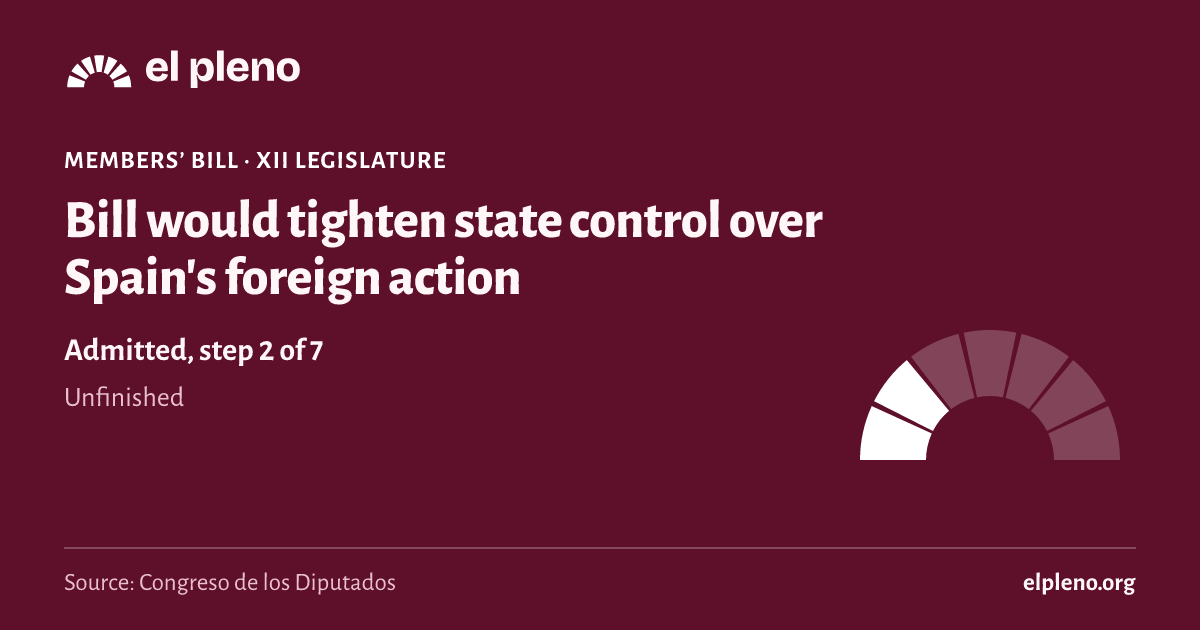
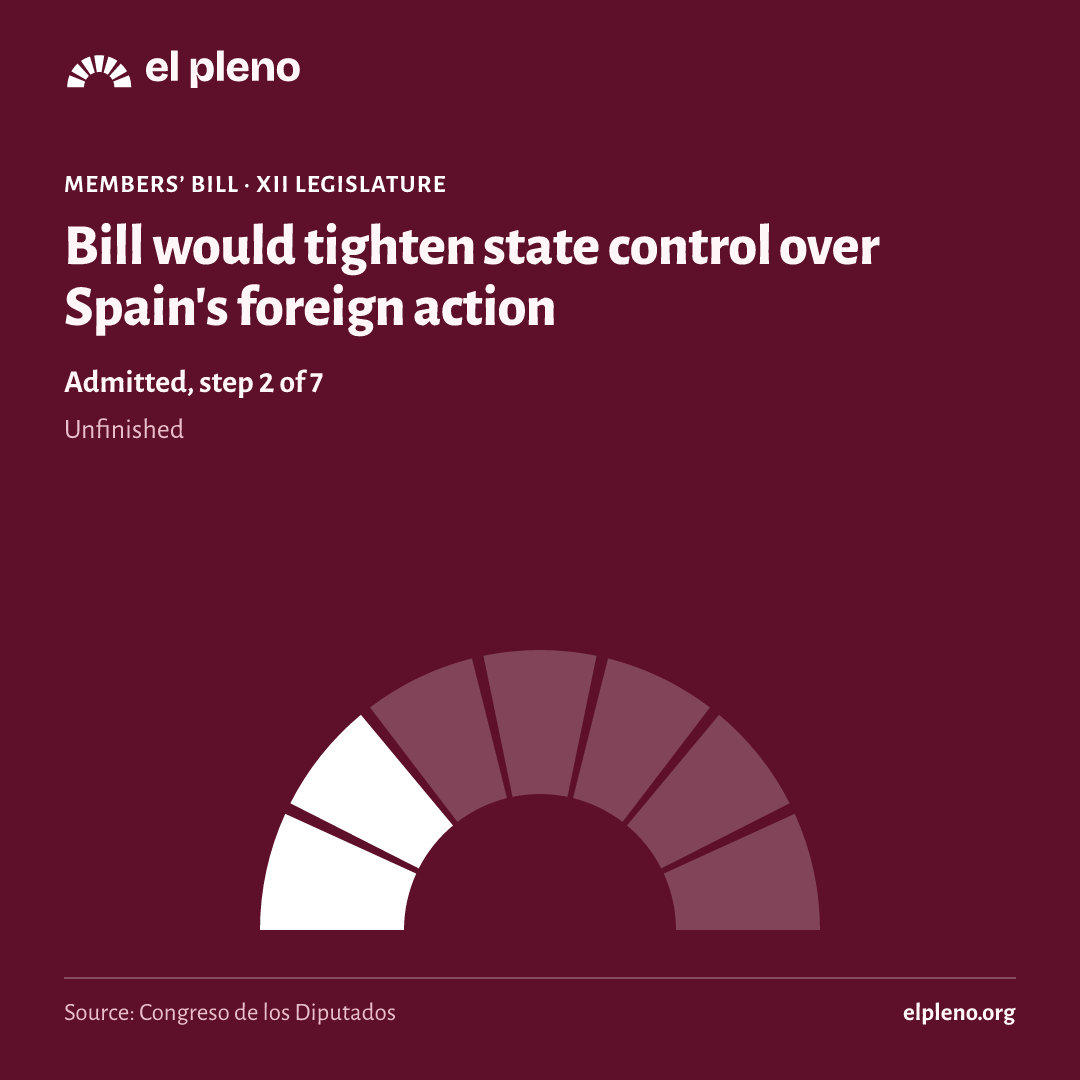
It took 2 of 7 steps. It reached Admitted, and today it is unfinished.
- Introduced11 October 2018Someone registers the text in the Congreso.
- Admitted16 October 2018The Bureau of the Congreso accepts it and, for a members’ bill, the plenary decides whether to consider it.
- Amendmentsnot reachedGroups propose changes.
- Committeenot reachedA committee goes through the text in detail.
- Plenarynot reachedAll 350 deputies vote.
- Senatenot reachedThe Senate can pass it, amend it or veto it.
- BOEnot reachedIt is published in the Official State Gazette (BOE) and comes into force.
See the 6 official steps on a timeline
Was there a plenary vote?
We have no plenary vote linked to this law in the Congreso’s data.
What happens next
What happens now?
The legislature ended before it finished. To go on, someone would have to introduce it again in the new Cortes.
It has not been presented again yet.
Sources
Where does all this come from?
- Congreso de los Diputados, file 122/000284
Official title, type, author, dates and stage.
Retrieved 11 November 2026
- The data comes from the open files of the Congreso, the Senate and the BOE, unaltered.
- Each deputy’s province is the one of their seat on the day of the vote.
- We only say “passed” or “rejected” when the majority needed is certain; otherwise we say which side had more votes.