What it is
Bill to limit the fallout when a planning plan is struck down
It is a members’ bill. Introduced by parliamentary groups, the Senate, regional governments or citizens. It was introduced on 5 October 2018. Introduced by: Grupo Parlamentario Popular en el Congreso.
Official title: Private member's bill on administrative and procedural measures to reinforce legal security in the field of territorial and urban planning.
Source: Congreso de los Diputados, file 122/000280· updated 11 Nov
Automatic summary, not yet reviewed
- The bill would distinguish between the rules of a planning instrument and its other decisions. The rules would be general administrative provisions and the rest administrative acts, so that annulment would have different consequences depending on the case.
- It would make non-normative decisions voidable rather than null, with full nullity for skipping the procedure only in very serious cases, such as skipping the environmental assessment or public information stage.
- It would preserve final and consented acts issued under an annulled plan, and proceedings not affected by the defect, to avoid the cascade effect of annulment.
- It would restrict the public action in planning matters to non-profit organizations with at least two years of activity, and ban receiving money in exchange for withdrawing a lawsuit.
- It would set a four-year limit, counted from publication, for indirectly challenging the rules of planning instruments, and allow that challenge to rely only on material defects, never formal ones.
- If a court annuls a plan for a formal defect, it would set a one-year deadline, extendable by six months, for the administration to fix it, keeping the annulled plan provisionally in force in the meantime.
Who it affects
- City councils and public administrations: They would get clearer rules to fix defects in their plans and avoid cascade annulments.
- Developers and property owners: Their licenses and final acts would be preserved if the plan is later annulled, and a method would be set to value compensation in expropriations.
- Non-profit organizations: They would be the only ones able to bring the public action in planning matters, if they meet certain requirements.
- Citizens in general: They would keep their rights to information and participation, but with stricter limits for challenging plans.
Words worth knowing
- Nulidad de pleno derecho (full nullity)
- The act is considered invalid from the start and cannot be corrected.
- Anulabilidad (voidability)
- The act has a defect that can be fixed or validated without fully annulling it.
- Acción pública (public action)
- The ability of anyone to go to court to report planning violations, even if not personally affected.
- Impugnación indirecta (indirect challenge)
- Challenging a rule as applied in a specific act, instead of attacking the rule directly.
- Reviviscencia (revival)
- When an old plan becomes effective again after the current one is annulled.
It summarizes the text as it was introduced. It is written by artificial intelligence and may contain mistakes: the official text is what counts. Read the official text · How we make summaries
Where it stands
How far did it get?
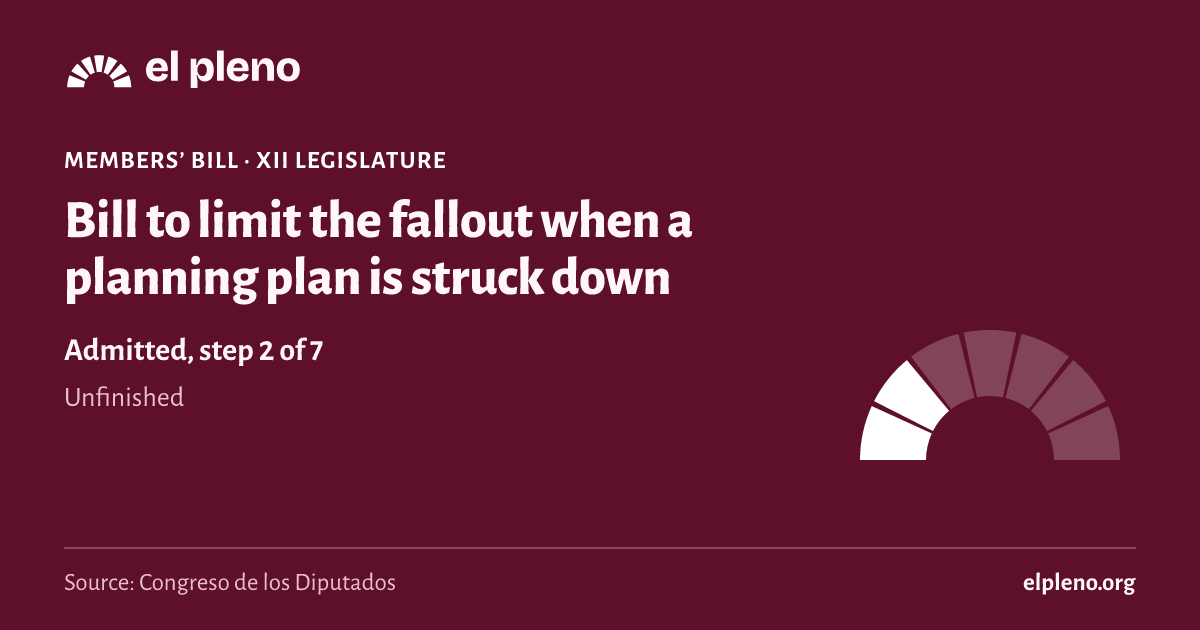
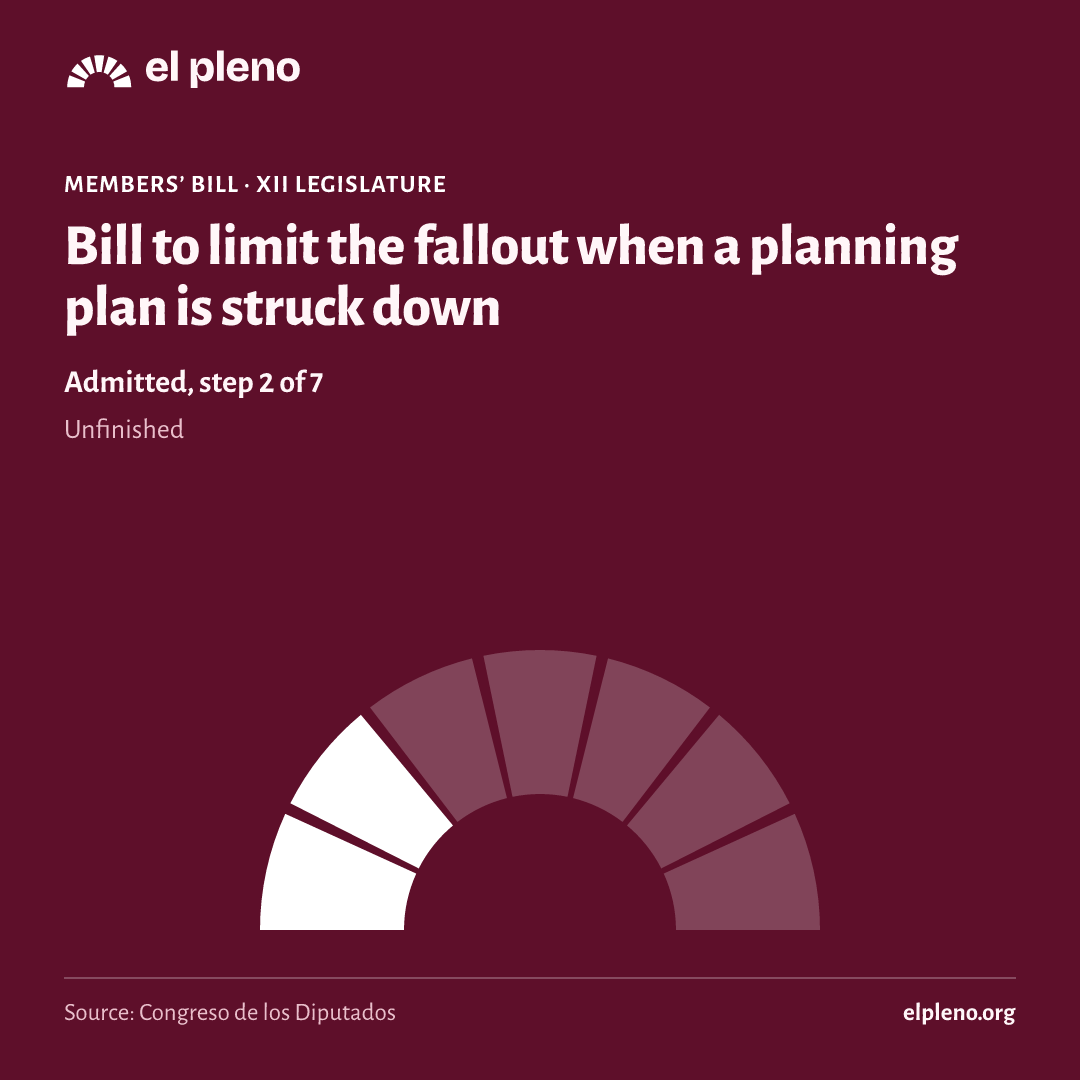
It took 2 of 7 steps. It reached Admitted, and today it is unfinished.
- Introduced5 October 2018Someone registers the text in the Congreso.
- Admitted9 October 2018The Bureau of the Congreso accepts it and, for a members’ bill, the plenary decides whether to consider it.
- Amendmentsnot reachedGroups propose changes.
- Committeenot reachedA committee goes through the text in detail.
- Plenarynot reachedAll 350 deputies vote.
- Senatenot reachedThe Senate can pass it, amend it or veto it.
- BOEnot reachedIt is published in the Official State Gazette (BOE) and comes into force.
See the 6 official steps on a timeline
Was there a plenary vote?
We have no plenary vote linked to this law in the Congreso’s data.
What happens next
What happens now?
The legislature ended before it finished. To go on, someone would have to introduce it again in the new Cortes.
It has not been presented again yet.
Sources
Where does all this come from?
- Congreso de los Diputados, file 122/000280
Official title, type, author, dates and stage.
Retrieved 11 November 2026
- The data comes from the open files of the Congreso, the Senate and the BOE, unaltered.
- Each deputy’s province is the one of their seat on the day of the vote.
- We only say “passed” or “rejected” when the majority needed is certain; otherwise we say which side had more votes.