What it is
Bill to compensate Franco-era victims and recover democratic memory
It is a members’ bill. Introduced by parliamentary groups, the Senate, regional governments or citizens. It was introduced on 2 October 2018. Introduced by: Grupo Parlamentario Confederal de Unidos Podemos-En Comú Podem-En Marea.
Official title: Private member's comprehensive bill on democratic memory and the recognition and reparation of victims of Francoism and the Transition.
Source: Congreso de los Diputados, file 122/000278· updated 11 Nov
Automatic summary, not yet reviewed
- The bill would formally condemn the military coup of July 18, 1936 and the Franco dictatorship, and recognize as victims those who suffered repression from then and at least until 1983.
- It would declare illegal and null all summary courts-martial and their sentences issued for political reasons since July 17, 1936, and provide nullity certificates and compensation for those convicted.
- It would create a public census of victims and missing persons and a map of mass graves, and require courts to investigate the location, exhumation and identification of the disappeared on their own initiative.
- It would push for judicial investigations of stolen children up to December 31, 1999, treating it as a continuing crime, and guarantee access to public and church archives related to missing persons.
- It would recognize financial compensation, such as €80,000 for beneficiaries of those killed or left disabled by repression until October 15, 1977, and require the State to return confiscated property.
- It would order the removal of symbols and public tributes glorifying the coup and the dictatorship, revoke noble titles granted to its collaborators, and repurpose the Valley of the Fallen, which would be renamed Valle de Cuelgamuros.
- It would declare null paragraphs e) and f) of Article 2 of the 1977 Amnesty Law, on the grounds that crimes against humanity cannot be amnestied, and amend Article 510 of the Criminal Code to include Franco-era crimes.
- It would set a sanction regime with fines from €50 to €50,000 depending on severity, and provide for a Victims' Office and a special prosecutor's office for forced disappearances and stolen children.
Words worth knowing
- Consejo de guerra sumarísimo (summary court-martial)
- A fast military trial with no guarantees used by the Franco regime to judge opponents.
- Desaparición forzada (forced disappearance)
- Deprivation of liberty by state agents or with their support, followed by refusal to disclose the person's whereabouts.
- Lesa humanidad (crimes against humanity)
- Widespread or systematic grave crimes against civilians, such as murder or torture, which never expire.
- Bien de Interés Cultural
- The highest protection category for Spanish historical heritage.
- Denunciar un tratado (to denounce a treaty)
- Official notice by which a State stops being bound by an international agreement.
It summarizes the text as it was introduced. It is written by artificial intelligence and may contain mistakes: the official text is what counts. Read the official text · How we make summaries
Where it stands
How far did it get?
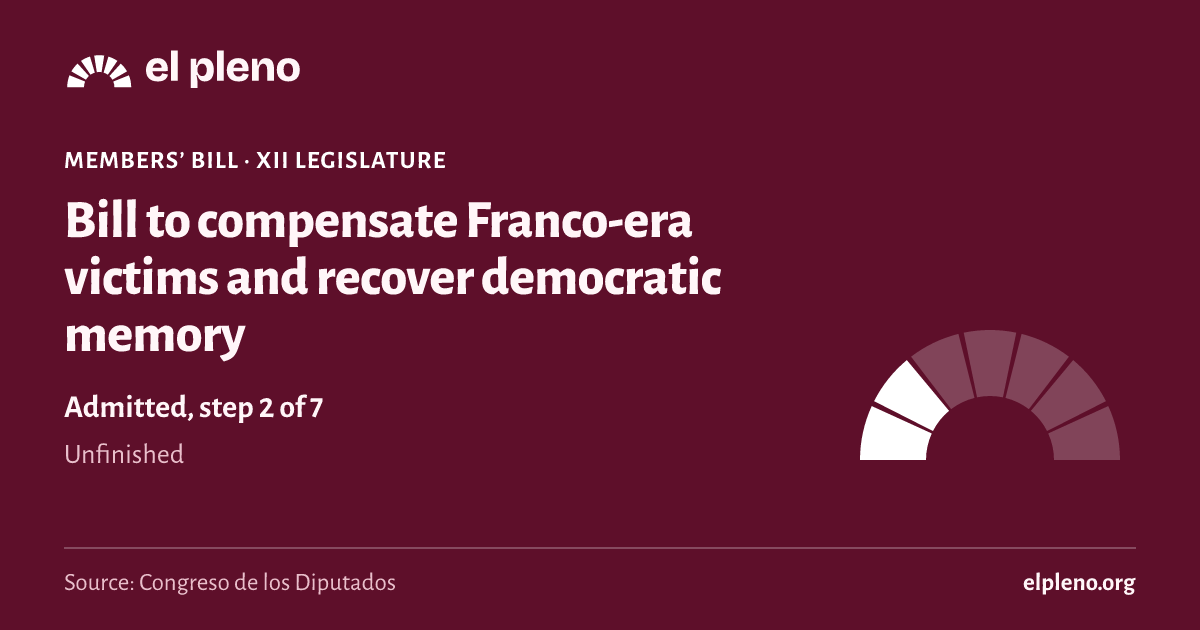
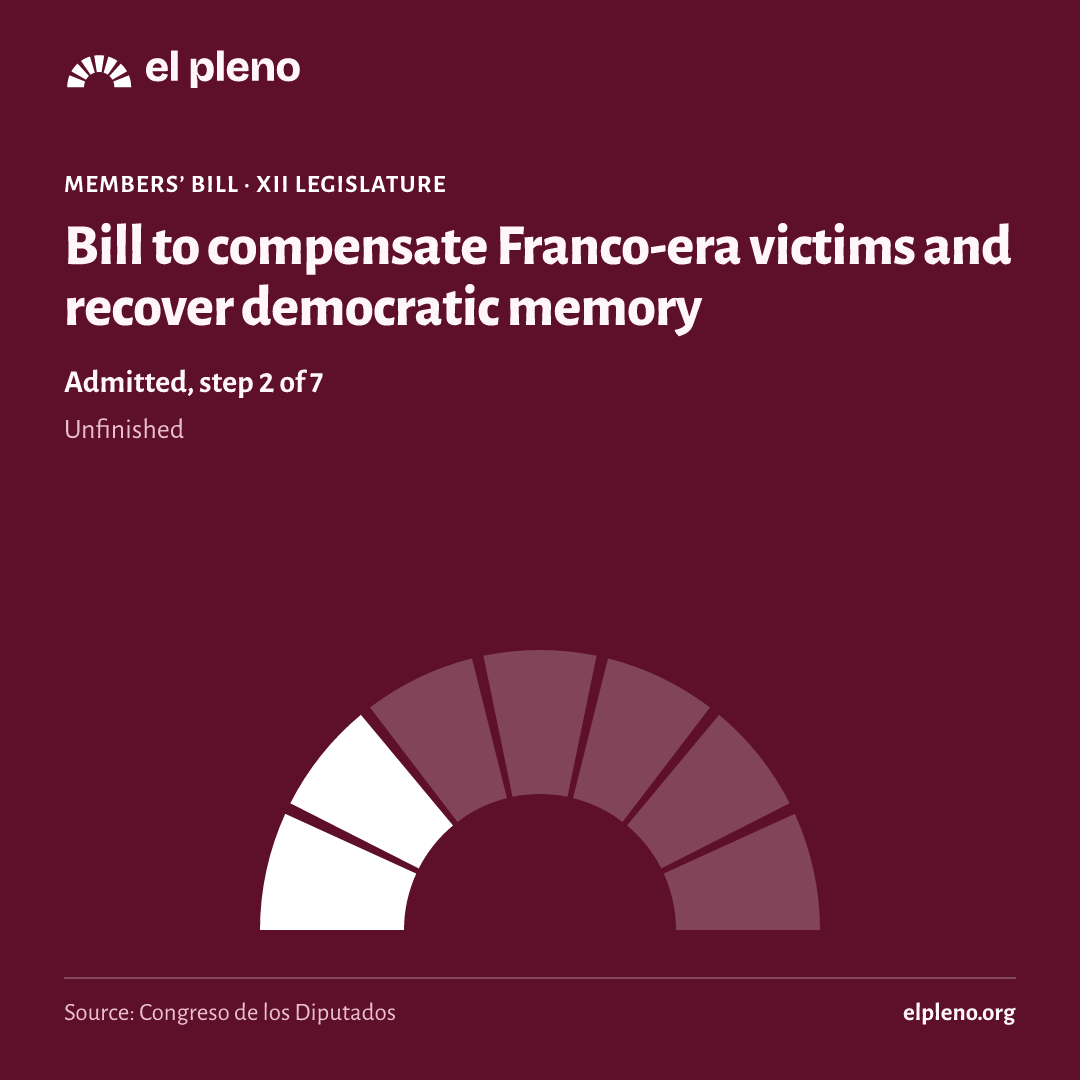
It took 2 of 7 steps. It reached Admitted, and today it is unfinished.
- Introduced2 October 2018Someone registers the text in the Congreso.
- Admitted9 October 2018The Bureau of the Congreso accepts it and, for a members’ bill, the plenary decides whether to consider it.
- Amendmentsnot reachedGroups propose changes.
- Committeenot reachedA committee goes through the text in detail.
- Plenarynot reachedAll 350 deputies vote.
- Senatenot reachedThe Senate can pass it, amend it or veto it.
- BOEnot reachedIt is published in the Official State Gazette (BOE) and comes into force.
See the 6 official steps on a timeline
Was there a plenary vote?
We have no plenary vote linked to this law in the Congreso’s data.
What happens next
What happens now?
The legislature ended before it finished. To go on, someone would have to introduce it again in the new Cortes.
It has not been presented again yet.
Sources
Where does all this come from?
- Congreso de los Diputados, file 122/000278
Official title, type, author, dates and stage.
Retrieved 11 November 2026
- The data comes from the open files of the Congreso, the Senate and the BOE, unaltered.
- Each deputy’s province is the one of their seat on the day of the vote.
- We only say “passed” or “rejected” when the majority needed is certain; otherwise we say which side had more votes.