What it is
Bill would make shared custody the preferred option in divorces
It is a members’ bill. Introduced by parliamentary groups, the Senate, regional governments or citizens. It was introduced on 27 September 2018. Introduced by: Grupo Parlamentario Ciudadanos.
Official title: Private member's bill to promote shared custody of minors in cases of breakdown of cohabitation of the parents.
Source: Congreso de los Diputados, file 122/000277· updated 11 Nov
Automatic summary, not yet reviewed
- The proposal explains that shared custody is not yet the preferred arrangement and that there are large differences between Autonomous Communities. For example, it applies in 40% of cases in Catalonia and 8% in Extremadura.
- The bill would amend Article 92 of the Civil Code so that the judge decides, as a preference, that custody be shared by both parents, unless there are justified reasons against it. Shared custody would not be granted if either parent is facing criminal proceedings for gender violence Violence a woman suffers from a current or former partner because she is a woman. or crimes against the other spouse or the children.
- The new Article 92 sets out what the judge must weigh: the child's best interests, the relationship between the parents, each parent's involvement, work-life balance, and each parent's housing situation, among other factors. It also requires hearing the children and requesting a report from the Public Prosecutor before deciding.
- Custody arrangements already made under the previous rules could be reviewed in court if a party or the Public Prosecutor requests it. The law would take effect on January 1 of the year after its publication in the official state gazette (BOE).
Who it affects
- Minor children whose parents separate, annul their marriage, or divorce: The judge would hear them and decide custody based on their best interests, with a preference for shared custody.
- Parents going through separation, annulment, or divorce: Shared custody would become the preferred rule, unless there are justified reasons against it.
- Parents facing criminal proceedings for gender violence or crimes against the spouse or the children: They could not have shared custody while the proceedings last.
- Families with custody arrangements already in place: They can ask the court to review those arrangements under the new criteria.
Words worth knowing
- Guarda y custodia (custody)
- Who the children live with and who takes care of their daily needs when the parents do not live together.
- Patria potestad (parental authority)
- The set of rights and duties parents have over their minor children, such as raising and representing them.
- Convenio regulador (settlement agreement)
- A document where separating parents put in writing their agreements about the children, support payments, and housing.
- Ministerio Fiscal (Public Prosecutor)
- The public body that defends the interests of minors in court.
- Proposición de ley (non-governmental bill)
- A bill introduced by members of Congress to be debated and passed. It is not a law until it is approved.
- gender violence
- Violence a woman suffers from a current or former partner because she is a woman.
It summarizes the text as it was introduced. It is written by artificial intelligence and may contain mistakes: the official text is what counts. Read the official text · How we make summaries
Where it stands
How far did it get?
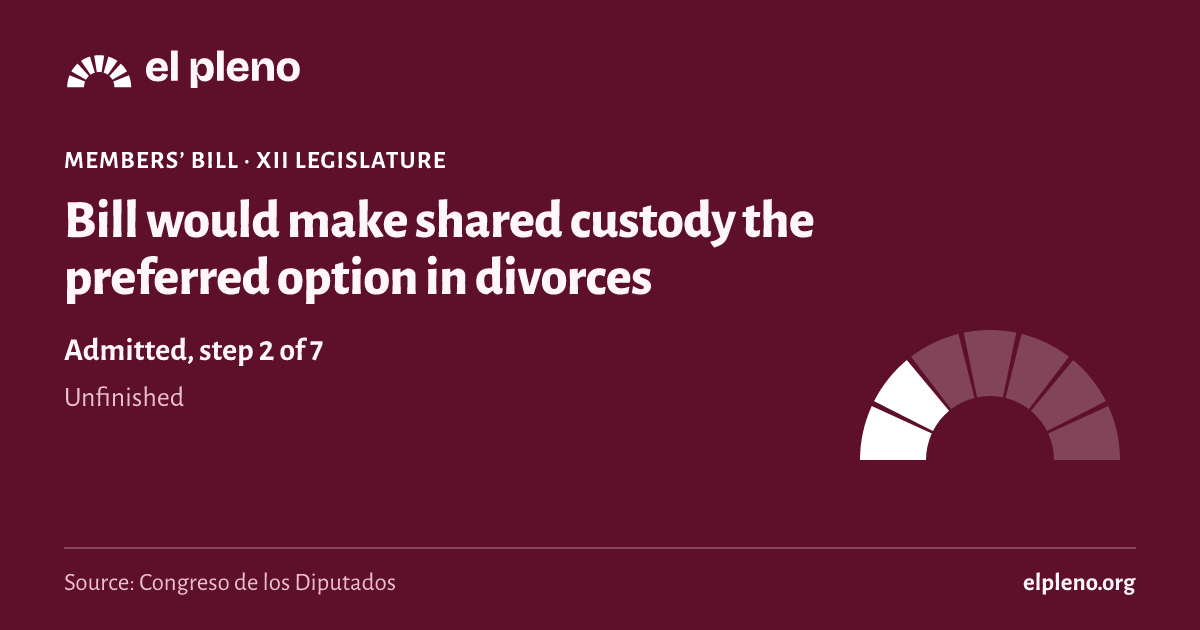
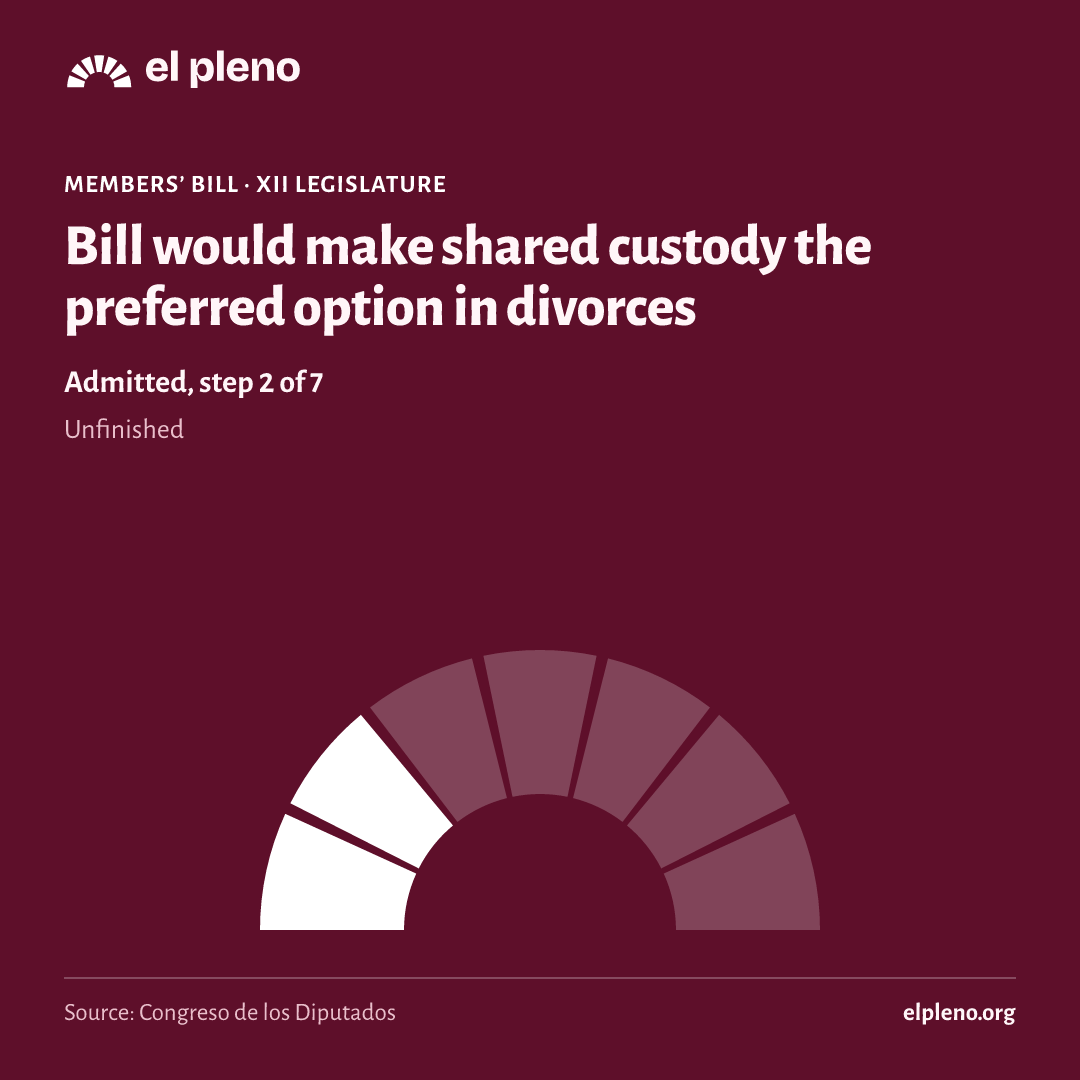
It took 2 of 7 steps. It reached Admitted, and today it is unfinished.
- Introduced27 September 2018Someone registers the text in the Congreso.
- Admitted9 October 2018The Bureau of the Congreso accepts it and, for a members’ bill, the plenary decides whether to consider it.
- Amendmentsnot reachedGroups propose changes.
- Committeenot reachedA committee goes through the text in detail.
- Plenarynot reachedAll 350 deputies vote.
- Senatenot reachedThe Senate can pass it, amend it or veto it.
- BOEnot reachedIt is published in the Official State Gazette (BOE) and comes into force.
See the 6 official steps on a timeline
Was there a plenary vote?
We have no plenary vote linked to this law in the Congreso’s data.
What happens next
What happens now?
The legislature ended before it finished. To go on, someone would have to introduce it again in the new Cortes.
It was presented again:
- XIV Legislature, Congreso de los Diputados· Unfinished Bill to make shared child custody the judges' preferred option
Sources
Where does all this come from?
- Congreso de los Diputados, file 122/000277
Official title, type, author, dates and stage.
Retrieved 11 November 2026
- The data comes from the open files of the Congreso, the Senate and the BOE, unaltered.
- Each deputy’s province is the one of their seat on the day of the vote.
- We only say “passed” or “rejected” when the majority needed is certain; otherwise we say which side had more votes.