What it is
Proposal to cut and standardize Spain's inheritance and gift tax
It is a members’ bill. Introduced by parliamentary groups, the Senate, regional governments or citizens. It was introduced on 4 September 2018. Introduced by: Grupo Parlamentario Ciudadanos.
Official title: Private member's bill amending Law 29/1987, of 18 December, on Inheritance and Gift Tax.
Source: Congreso de los Diputados, file 122/000270· updated 11 Nov
Automatic summary, not yet reviewed
- The bill would reorganize kinship groups: spouses, registered partners, ascendants and descendants would all fall into Group I, regardless of age, ending the disadvantage faced by children over 21 and unmarried couples.
- It would set minimum state reductions by kinship (€1,000,000 for Group I, €350,000 for Group II and €125,000 for Group III) plus a 100% credit on the tax bill for Group I, so inheritances and gifts within the close family would not be taxed. Regional governments could not set lower amounts.
- It would expand other state reductions: €180,000 or €360,000 for disability or dependency, 100% of the value of the deceased's main home, of family businesses and professional practices, of farms and forests, plus a new reduction for cash gifts used to start or expand a business.
- The deadline to file and pay would go from six months to one year when at least 75% of the estate is illiquid assets, such as real estate, and payment in kind with homes or rural land would be allowed if the regional government provides for it.
- The tax cut would have to be factored into the future reform of regional funding, and the state would push for tax obligations in the Basque Country and Navarre to be similar to those in the rest of Spain.
- The new rules would also apply to people still within the filing deadline when the law takes effect, and it would enter into force on January 1 of the year after its publication in the official state gazette.
Who it affects
- People inheriting or receiving gifts from parents, children, spouses or partners: They would pay no tax, regardless of the region where they live.
- Siblings and more distant relatives: They would get fixed reductions of €350,000 or €125,000 and access to other reductions.
- People with a disability or in a situation of dependency: They could apply extra reductions of €180,000 or €360,000.
- People inheriting the deceased's main home, a business, or a farm or forest: They could reduce 100% of its value if they meet the holding requirements.
- Taxpayers with estates made up of illiquid assets: They would have one year, instead of six months, to file and pay.
Words worth knowing
- Base liquidable
- The amount on which the tax is calculated, after applying reductions to what is inherited or gifted.
- Bonificación
- A credit applied to the tax bill, that is, to the final amount to pay.
- Adquisiciones mortis causa e inter vivos
- What is received by inheritance (after a death) and what is received by gift (during the giver's lifetime).
- Causahabiente
- The person who inherits or receives assets from someone who has died.
- Activos ilíquidos
- Assets that are not cash and are harder to turn into cash, such as apartments or land.
It summarizes the text as it was introduced. It is written by artificial intelligence and may contain mistakes: the official text is what counts. Read the official text · How we make summaries
Where it stands
How far did it get?
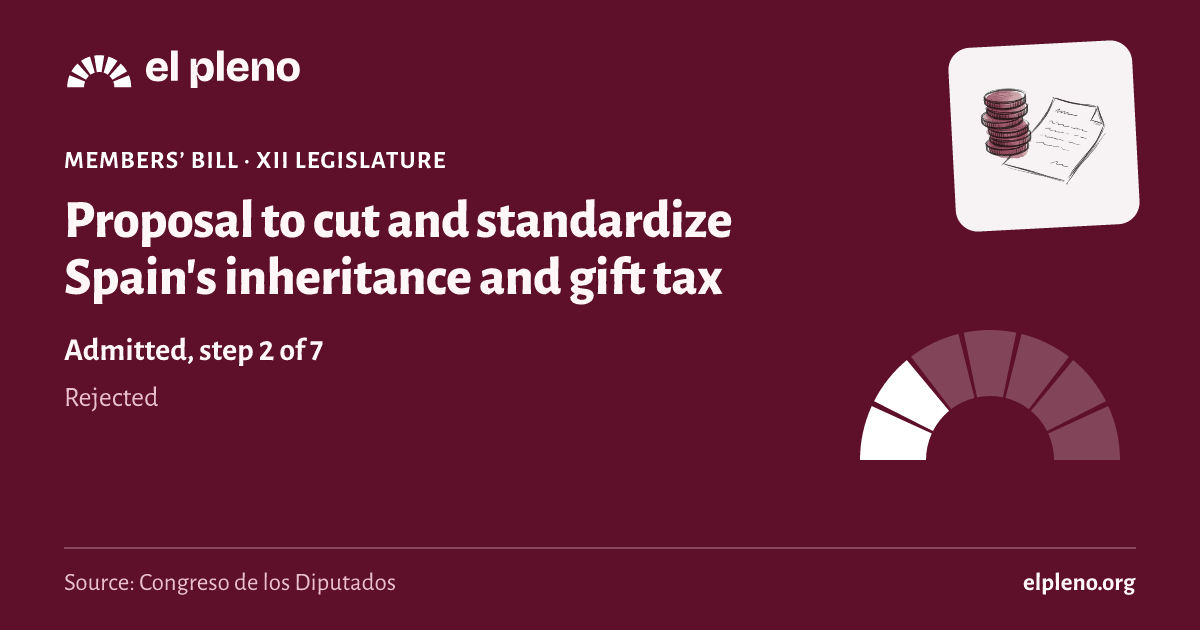
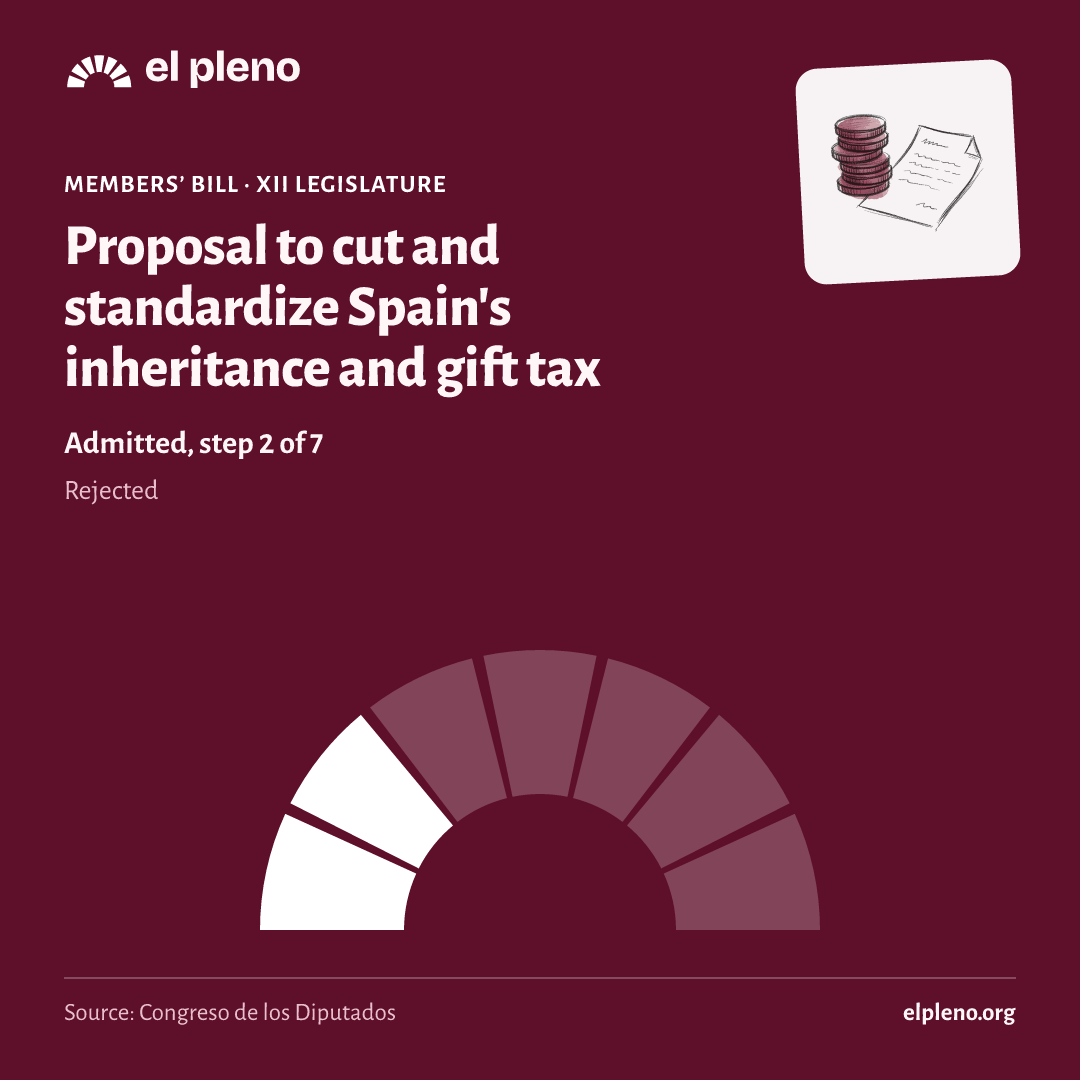
It took 2 of 7 steps. It reached Admitted, and today it is rejected.
- Introduced4 September 2018Someone registers the text in the Congreso.
- Admitted11 September 2018The Bureau of the Congreso accepts it and, for a members’ bill, the plenary decides whether to consider it.
- Amendmentsnot reachedGroups propose changes.
- Committeenot reachedA committee goes through the text in detail.
- Plenarynot reachedAll 350 deputies vote.
- Senatenot reachedThe Senate can pass it, amend it or veto it.
- BOEnot reachedIt is published in the Official State Gazette (BOE) and comes into force.
See the 6 official steps on a timeline
30 October 2018
How did the plenary vote?
Voted on: Private member's bill from the Ciudadanos Parliamentary Group, to amend Law 29/1987, of 18 December, on Inheritance and Gift Tax.
Source: Congreso de los Diputados, vote 2 of sitting 154· updated 10 Nov
Each dot is a seat. Tap one, or use the arrow keys, to see who it is.
Your province
How did the deputies from your province vote?
And your senators: the Senate does not link its votes to this law in its open data, so we cannot put them side by side here.
Or see how most of each province voted
- A Coruña Tie 4 yes · 4 no
- Albacete More votes against 1 yes · 2 no
- Alicante/Alacant More votes in favour 7 yes · 5 no
- Almería More votes in favour 4 yes · 2 no
- Araba/Álava More votes against 1 yes · 3 no
- Asturias Tie 4 yes · 4 no
- Ávila More votes in favour 2 yes · 1 no
- Badajoz Tie 3 yes · 3 no
- Barcelona More votes against 8 yes · 21 no
- Bizkaia More votes against 1 yes · 7 no
- Burgos Tie 2 yes · 2 no
- Cáceres Tie 2 yes · 2 no
- Cádiz More votes against 4 yes · 5 no
- Cantabria More votes in favour 3 yes · 2 no
- Castellón/Castelló More votes in favour 3 yes · 2 no
- Ceuta More votes in favour 1 yes · 0 no
- Ciudad Real More votes in favour 3 yes · 2 no
- Córdoba Tie 3 yes · 3 no
- Cuenca More votes in favour 2 yes · 1 no
- Gipuzkoa More votes against 0 yes · 5 no
- Girona More votes against 0 yes · 6 no
- Granada More votes in favour 4 yes · 3 no
- Guadalajara More votes in favour 2 yes · 1 no
- Huelva More votes against 2 yes · 3 no
- Huesca More votes against 1 yes · 2 no
- Illes Balears Tie 4 yes · 4 no
- Jaén More votes against 2 yes · 3 no
- La Rioja Tie 2 yes · 2 no
- Las Palmas Tie 4 yes · 4 no
- León Tie 2 yes · 2 no
- Lleida Tie 1 yes · 1 no
- Lugo Tie 2 yes · 2 no
- Madrid More votes in favour 21 yes · 15 no
- Málaga More votes in favour 6 yes · 5 no
- Melilla More votes in favour 1 yes · 0 no
- Murcia More votes in favour 7 yes · 3 no
- Navarra More votes against 0 yes · 5 no
- Ourense More votes in favour 3 yes · 1 no
- Palencia More votes in favour 2 yes · 1 no
- Pontevedra More votes against 3 yes · 4 no
- Salamanca More votes in favour 3 yes · 1 no
- Santa Cruz de Tenerife More votes in favour 4 yes · 2 no · 1 abst.
- Segovia More votes in favour 2 yes · 1 no
- Sevilla More votes against 4 yes · 7 no
- Soria Tie 1 yes · 1 no
- Tarragona More votes against 2 yes · 4 no
- Teruel More votes in favour 2 yes · 1 no
- Toledo Tie 3 yes · 3 no
- Valencia/València More votes against 7 yes · 8 no
- Valladolid Tie 2 yes · 2 no
- Zamora More votes in favour 2 yes · 1 no
- Zaragoza More votes in favour 4 yes · 3 no
More details: how each group and each province voted
The groups
Who voted in favour and who against?
In favour, most of Ciudadanos and Popular en el Congreso. Against, most of Socialista, Vasco (EAJ-PNV), Mixto, Gcup-ec-em and GER. 2 deputies voted differently from their group.
By province: in 22 most voted in favour; in 15, against.
Coloured by how most of each province’s deputies voted.
- In favour: 22
- Against: 15
- Tie: 15
| Group | Seats | How it voted |
|---|---|---|
| Socialista | 84 | 84 against |
| Vasco (EAJ-PNV) | 5 | 5 against |
| Mixto | 19 | 1 in favour · 13 against · 1 abst. · 4 did not vote |
| Ciudadanos | 32 | 32 in favour |
| Gcup-ec-em | 67 | 67 against |
| GER | 9 | 8 against · 1 did not vote |
| Popular en el Congreso | 134 | 130 in favour · 4 did not vote |
What happens next
What happens now?
It goes no further. A similar one could be introduced later.
Sources
Where does all this come from?
- Congreso de los Diputados, file 122/000270
Official title, type, author, dates and stage.
Retrieved 11 November 2026
- Congreso de los Diputados, vote 2 of sitting 154
The count and every seat’s vote.
Retrieved 10 November 2026
- The data comes from the open files of the Congreso, the Senate and the BOE, unaltered.
- Each deputy’s province is the one of their seat on the day of the vote.
- We only say “passed” or “rejected” when the majority needed is certain; otherwise we say which side had more votes.