What it is
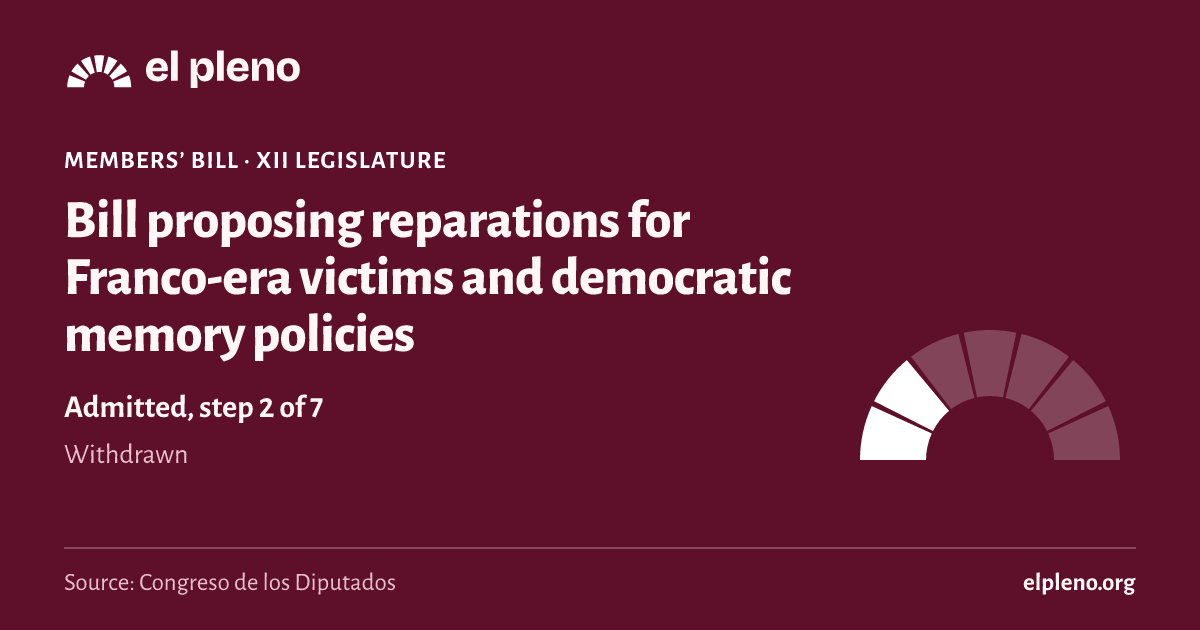
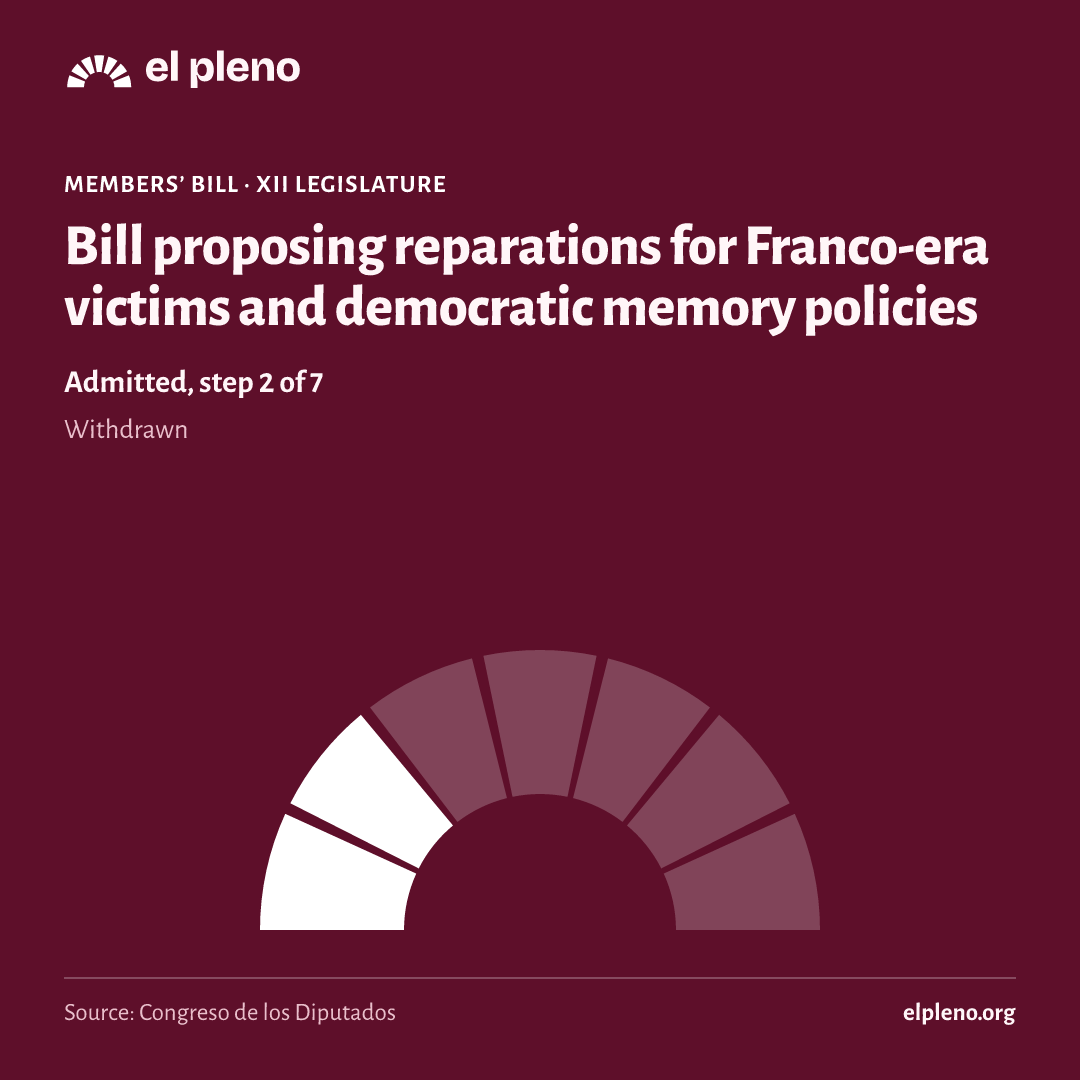
Bill proposing reparations for Franco-era victims and democratic memory policies
It is a members’ bill. Introduced by parliamentary groups, the Senate, regional governments or citizens. It was introduced on 29 June 2018. Introduced by: Grupo Parlamentario Confederal de Unidos Podemos-En Comú Podem-En Marea.
Official title: Private member's comprehensive bill on democratic memory and the recognition and reparation of victims of Francoism and the Transition.
Source: Congreso de los Diputados, file 122/000254· updated 11 Nov
Automatic summary, not yet reviewed
- The bill would formally condemn the July 18, 1936 military coup and the Franco dictatorship, and recognize as victims those who suffered repression from 1936 and during the Transition, at least until 1983.
- It would declare illegal and null all summary court-martial proceedings and sentences issued for political reasons since July 17, 1936, and provide nullity certificates and compensation for those convicted.
- It would create a democratic memory census with information on the disappeared and victims, plus a map of mass graves. Courts would have to investigate, exhume and identify disappeared persons, with public teams of archaeologists and forensic experts.
- It would require investigating cases of stolen children up to December 31, 1999, treating them as ongoing crimes, and guarantee access to public and church archives related to disappeared persons.
- It would recognize compensation of 80,000 euros for beneficiaries of those killed or left disabled by repression until October 15, 1977, plus restitution of seized property. It would also recognize the right to reparation for those forced to work for private companies.
- It would ban and order the removal of symbols and tributes glorifying the 1936 coup and Francoism, including noble titles and payments to repressors. The Valley of the Fallen would come under public management, be renamed Valle de Cuelgamuros, and the remains of Franco and José Antonio Primo de Rivera would be exhumed.
- It would declare null sections e) and f) of Article 2 of the 1977 Amnesty Law, since they cannot amnesty crimes against humanity, and amend Article 510 of the Criminal Code to include Franco-era crimes among those protected from denial or glorification.
- It would set a sanction regime with fines from 50 to 50,000 euros depending on severity, and provide for the Government to denounce the Concordat with the Holy See and declassify all official documents of the dictatorship and Transition issued before January 1, 1983.
Words worth knowing
- Consejo de guerra sumarísimo (summary court-martial)
- A fast military trial without guarantees used by the Franco dictatorship to convict opponents.
- Desaparición forzada (forced disappearance)
- Deprivation of liberty by public authorities who then refuse to acknowledge it or report the person's whereabouts.
- Ley de Amnistía de 1977 (1977 Amnesty Law)
- A law that exempted from punishment crimes committed during the dictatorship and the Transition; the bill proposes voiding part of it.
- Bien de Interés Cultural
- The highest protection category for Spanish historical heritage.
- Concordato (Concordat)
- An international agreement between the Spanish State and the Holy See (the Vatican) on relations with the Catholic Church.
It summarizes the text as it was introduced. It is written by artificial intelligence and may contain mistakes: the official text is what counts. Read the official text · How we make summaries
Where it stands
How far did it get?
It took 2 of 7 steps. It reached Admitted, and today it is withdrawn.
- Introduced29 June 2018Someone registers the text in the Congreso.
- Admitted10 July 2018The Bureau of the Congreso accepts it and, for a members’ bill, the plenary decides whether to consider it.
- Amendmentsnot reachedGroups propose changes.
- Committeenot reachedA committee goes through the text in detail.
- Plenarynot reachedAll 350 deputies vote.
- Senatenot reachedThe Senate can pass it, amend it or veto it.
- BOEnot reachedIt is published in the Official State Gazette (BOE) and comes into force.
See the 6 official steps on a timeline
Was there a plenary vote?
We have no plenary vote linked to this law in the Congreso’s data.
What happens next
What happens now?
Whoever introduced it withdrew it, or it was merged into another one. It goes no further.
Sources
Where does all this come from?
- Congreso de los Diputados, file 122/000254
Official title, type, author, dates and stage.
Retrieved 11 November 2026
- The data comes from the open files of the Congreso, the Senate and the BOE, unaltered.
- Each deputy’s province is the one of their seat on the day of the vote.
- We only say “passed” or “rejected” when the majority needed is certain; otherwise we say which side had more votes.