What it is
Bill proposing emission cuts and an energy transition for Spain
It is a members’ bill. Introduced by parliamentary groups, the Senate, regional governments or citizens. It was introduced on 22 June 2018. Introduced by: Grupo Parlamentario Popular en el Congreso.
Official title: Private member's bill for a Climate Change and Energy Transition Law.
Source: Congreso de los Diputados, file 122/000247· updated 11 Nov
Automatic summary, not yet reviewed
- The bill would set national targets: cutting greenhouse gas emissions by at least 26% by 2030 compared to 2005 in sectors outside the emissions trading system, and by at least 80% by 2050 compared to 1990 for the whole economy.
- It would create two planning tools: the Integrated National Energy and Climate Plans, for the medium term, and the 2050 Low Emissions Strategy, to be approved before December 31, 2019, with an intermediate target for 2040.
- All Public Administrations would have to spend more than 20% of their annual budget on climate action, and revenue from emissions allowance auctions would go toward the bill's goals.
- The autonomous communities would need mitigation and adaptation plans before December 31, 2021, and municipalities with over 100,000 residents would need local plans covering mobility, air conditioning and waste.
- It would impose duties on companies and the financial sector: the Bank of Spain would issue a report every two years on climate risks, and the Government would decide which companies must calculate and publish their carbon footprint with a reduction plan.
- It would strengthen adaptation and monitoring: a National Adaptation Plan revised before 2019, sector plans on health, water and agriculture before 2020, and an Observatory on Climate Change and Energy Transition.
Who it affects
- Public Administrations: They would have to spend over 20% of their budget on climate action, calculate their carbon footprint and apply climate criteria in public procurement.
- Autonomous communities and large municipalities: They would need their own mitigation and adaptation plans; municipalities over 100,000 residents starting in 2021.
- Companies: Those designated by the Government would have to calculate and publish their carbon footprint and adopt emission reduction plans.
- Financial sector: It would have to calculate its carbon footprint and apply upcoming EU sustainable finance rules.
- Workers in transforming sectors: A Strategic Plan for Sustainable Transition and a Green Training Plan would support their retraining and employment.
Words worth knowing
- Gases de efecto invernadero (greenhouse gases)
- Gases that trap heat in the atmosphere and cause global warming, such as carbon dioxide.
- Derechos de emisión (emission allowances)
- A permit to emit one ton of carbon dioxide; allowances are bought and sold in a European market.
- Huella de carbono (carbon footprint)
- The total greenhouse gases produced by an activity, directly or indirectly.
- Mitigación (mitigation)
- Action to reduce emissions or increase what absorbs them, such as forests.
- Sumidero (sink)
- Any process that absorbs greenhouse gases from the atmosphere, for example a forest.
It summarizes the text as it was introduced. It is written by artificial intelligence and may contain mistakes: the official text is what counts. Read the official text · How we make summaries
Where it stands
How far did it get?
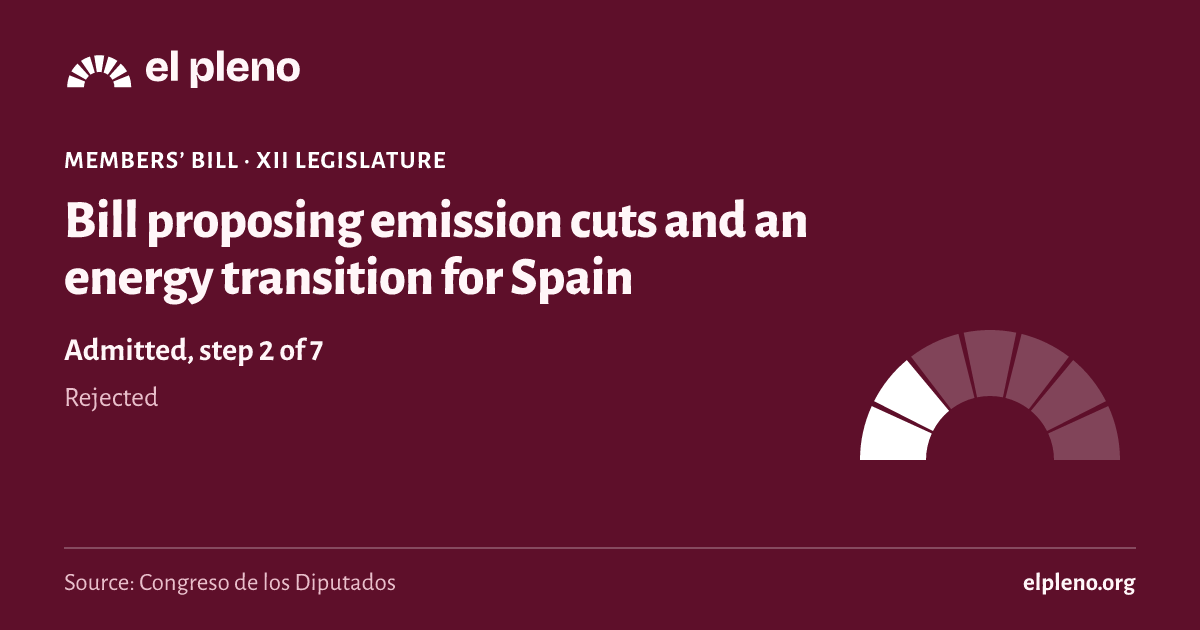
It took 2 of 7 steps. It reached Admitted, and today it is rejected.
- Introduced22 June 2018Someone registers the text in the Congreso.
- Admitted26 June 2018The Bureau of the Congreso accepts it and, for a members’ bill, the plenary decides whether to consider it.
- Amendmentsnot reachedGroups propose changes.
- Committeenot reachedA committee goes through the text in detail.
- Plenarynot reachedAll 350 deputies vote.
- Senatenot reachedThe Senate can pass it, amend it or veto it.
- BOEnot reachedIt is published in the Official State Gazette (BOE) and comes into force.
See the 6 official steps on a timeline
9 October 2018
How did the plenary vote?
Voted on: Private member's bill by the Popular Parliamentary Group in the Congress, on Climate Change and Energy Transition.
Source: Congreso de los Diputados, vote 2 of sitting 146· updated 10 Nov
Each dot is a seat. Tap one, or use the arrow keys, to see who it is.
Your province
How did the deputies from your province vote?
And your senators: the Senate does not link its votes to this law in its open data, so we cannot put them side by side here.
Or see how most of each province voted
- A Coruña Tie 4 yes · 4 no
- Albacete Tie 2 yes · 2 no
- Alicante/Alacant Tie 5 yes · 5 no · 2 abst.
- Almería More votes in favour 3 yes · 2 no · 1 abst.
- Araba/Álava More votes against 1 yes · 3 no
- Asturias More votes against 3 yes · 4 no · 1 abst.
- Ávila More votes in favour 2 yes · 1 no
- Badajoz Tie 3 yes · 3 no
- Barcelona More votes against 4 yes · 21 no · 4 abst.
- Bizkaia More votes against 1 yes · 7 no
- Burgos Tie 2 yes · 2 no
- Cáceres Tie 2 yes · 2 no
- Cádiz More votes against 3 yes · 5 no · 1 abst.
- Cantabria Tie 2 yes · 2 no · 1 abst.
- Castellón/Castelló Tie 2 yes · 2 no · 1 abst.
- Ceuta More votes in favour 1 yes · 0 no
- Ciudad Real More votes in favour 3 yes · 2 no
- Córdoba More votes against 2 yes · 3 no · 1 abst.
- Cuenca More votes in favour 2 yes · 1 no
- Gipuzkoa More votes against 0 yes · 6 no
- Girona More votes against 0 yes · 5 no
- Granada Tie 3 yes · 3 no · 1 abst.
- Guadalajara More votes in favour 2 yes · 1 no
- Huelva More votes against 2 yes · 3 no
- Huesca More votes against 1 yes · 2 no
- Illes Balears More votes against 3 yes · 4 no · 1 abst.
- Jaén More votes against 2 yes · 3 no
- La Rioja Tie 2 yes · 2 no
- Las Palmas More votes against 3 yes · 4 no · 1 abst.
- León Tie 2 yes · 2 no
- Lleida More votes against 1 yes · 3 no
- Lugo Tie 2 yes · 2 no
- Madrid More votes in favour 17 yes · 13 no · 5 abst.
- Málaga More votes against 4 yes · 5 no · 2 abst.
- Melilla More votes in favour 1 yes · 0 no
- Murcia More votes in favour 5 yes · 3 no · 2 abst.
- Navarra More votes against 2 yes · 3 no
- Ourense More votes in favour 3 yes · 1 no
- Palencia Tie 1 yes · 1 no
- Pontevedra More votes against 3 yes · 4 no
- Salamanca More votes in favour 3 yes · 1 no
- Santa Cruz de Tenerife More votes in favour 4 yes · 2 no
- Segovia More votes in favour 2 yes · 1 no
- Sevilla More votes against 4 yes · 7 no · 1 abst.
- Soria Tie 1 yes · 1 no
- Tarragona More votes against 1 yes · 4 no · 1 abst.
- Teruel More votes against 1 yes · 2 no
- Toledo Tie 3 yes · 3 no
- Valencia/València More votes against 6 yes · 8 no · 2 abst.
- Valladolid Tie 2 yes · 2 no · 1 abst.
- Zamora More votes in favour 2 yes · 1 no
- Zaragoza Tie 3 yes · 3 no · 1 abst.
More details: how each group and each province voted
The groups
Who voted in favour and who against?
In favour, most of Popular en el Congreso. Against, most of Socialista, Vasco (EAJ-PNV), Mixto, Gcup-ec-em and GER. 7 deputies voted differently from their group.
By province: in 14 most voted in favour; in 21, against.
Coloured by how most of each province’s deputies voted.
- In favour: 14
- Against: 21
- Tie: 17
| Group | Seats | How it voted |
|---|---|---|
| Socialista | 84 | 84 against |
| Vasco (EAJ-PNV) | 5 | 5 against |
| Mixto | 19 | 4 in favour · 12 against · 3 did not vote |
| Ciudadanos | 32 | 30 abst. · 2 did not vote |
| Gcup-ec-em | 67 | 2 in favour · 65 against |
| GER | 9 | 9 against |
| Popular en el Congreso | 134 | 132 in favour · 1 against · 1 did not vote |
What happens next
What happens now?
It goes no further. A similar one could be introduced later.
It was presented again:
- XIV Legislature, Congreso de los Diputados· Passed Spain's goals and measures against climate change
- XIV Legislature, Senate Government bill on climate change and energy transition.
Sources
Where does all this come from?
- Congreso de los Diputados, file 122/000247
Official title, type, author, dates and stage.
Retrieved 11 November 2026
- Congreso de los Diputados, vote 2 of sitting 146
The count and every seat’s vote.
Retrieved 10 November 2026
- The data comes from the open files of the Congreso, the Senate and the BOE, unaltered.
- Each deputy’s province is the one of their seat on the day of the vote.
- We only say “passed” or “rejected” when the majority needed is certain; otherwise we say which side had more votes.