What it is
Proposal to punish those who profit from other people's prostitution
It is a members’ bill. Introduced by parliamentary groups, the Senate, regional governments or citizens. It was introduced on 22 June 2018. Introduced by: Grupo Parlamentario Confederal de Unidos Podemos-En Comú Podem-En Marea.
Official title: Private member's organic bill on measures for the eradication of the sexual exploitation of women.
Source: Congreso de los Diputados, file 122/000246· updated 11 Nov
Automatic summary, not yet reviewed
- This is a bill introduced by Unidos Podemos-En Comú Podem-En Marea, not yet passed. Its goals are to criminalize profiting from prostitution even if the victim consents, ban prostitution ads, and remove all liability from prostituted women.
- The bill would rewrite Article 187 of the Criminal Code. It would punish with two to four years in prison anyone who profits from another person's prostitution, even with that person's consent, when she is in a situation of vulnerability, and with one to two years anyone who promotes or facilitates prostitution for profit. Penalties would increase if the offender is a public official, belongs to a criminal organization, or endangers the victim's life.
- The bill would amend the General Advertising Law. Ads using women's bodies as bait for prostitution or as sexual objects would be illegal, and several institutions and feminist organizations could take legal action against such illegal advertising.
- The bill would change the Citizen Security Law. The serious offense would punish those who demand or accept paid sexual activity, instead of those who request it in public transit areas, which according to the bill's statement of reasons hid the exploitation.
- The Government would be empowered to issue the rules needed to apply the law, which would take effect the day after its publication in the Official State Gazette.
Who it affects
- Pimps and anyone who profits from other people's prostitution: They would face prison sentences and fines for profiting from, promoting, or facilitating other people's prostitution, even with the victim's consent.
- People who pay for sexual services: They would be sanctioned with a serious offense for demanding or accepting paid sexual activity.
- Women in prostitution: The bill removes any liability placed on them and bans ads presenting them as sexual objects or bait for prostitution.
- Equality institutions, feminist organizations, and the Public Prosecutor's Office: They could take legal action against illegal advertising that presents women in a degrading or discriminatory way.
Words worth knowing
- Proxenetismo (pimping)
- Profiting from another person's prostitution, that is, acting as a middleman.
- Proposición de ley orgánica (organic bill)
- A text introduced by members of Congress to pass a law on especially important matters; here it has not been passed yet.
- Infracción grave (serious offense)
- Conduct the law punishes with strong sanctions, in this case fines.
It summarizes the text as it was introduced. It is written by artificial intelligence and may contain mistakes: the official text is what counts. Read the official text · How we make summaries
Where it stands
How far did it get?
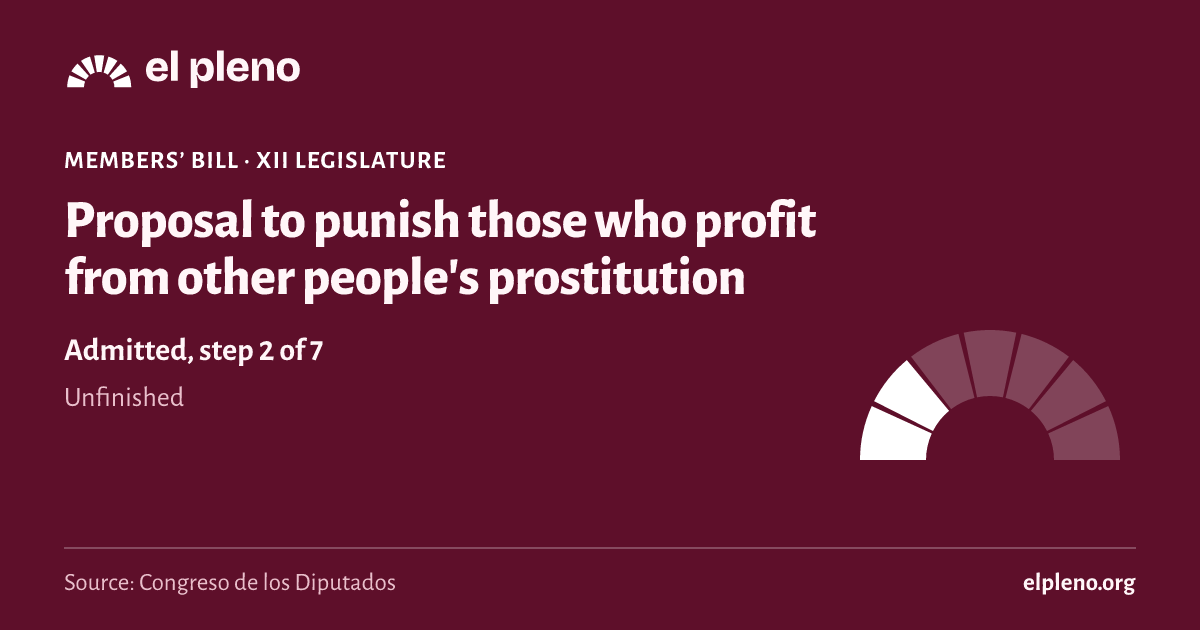
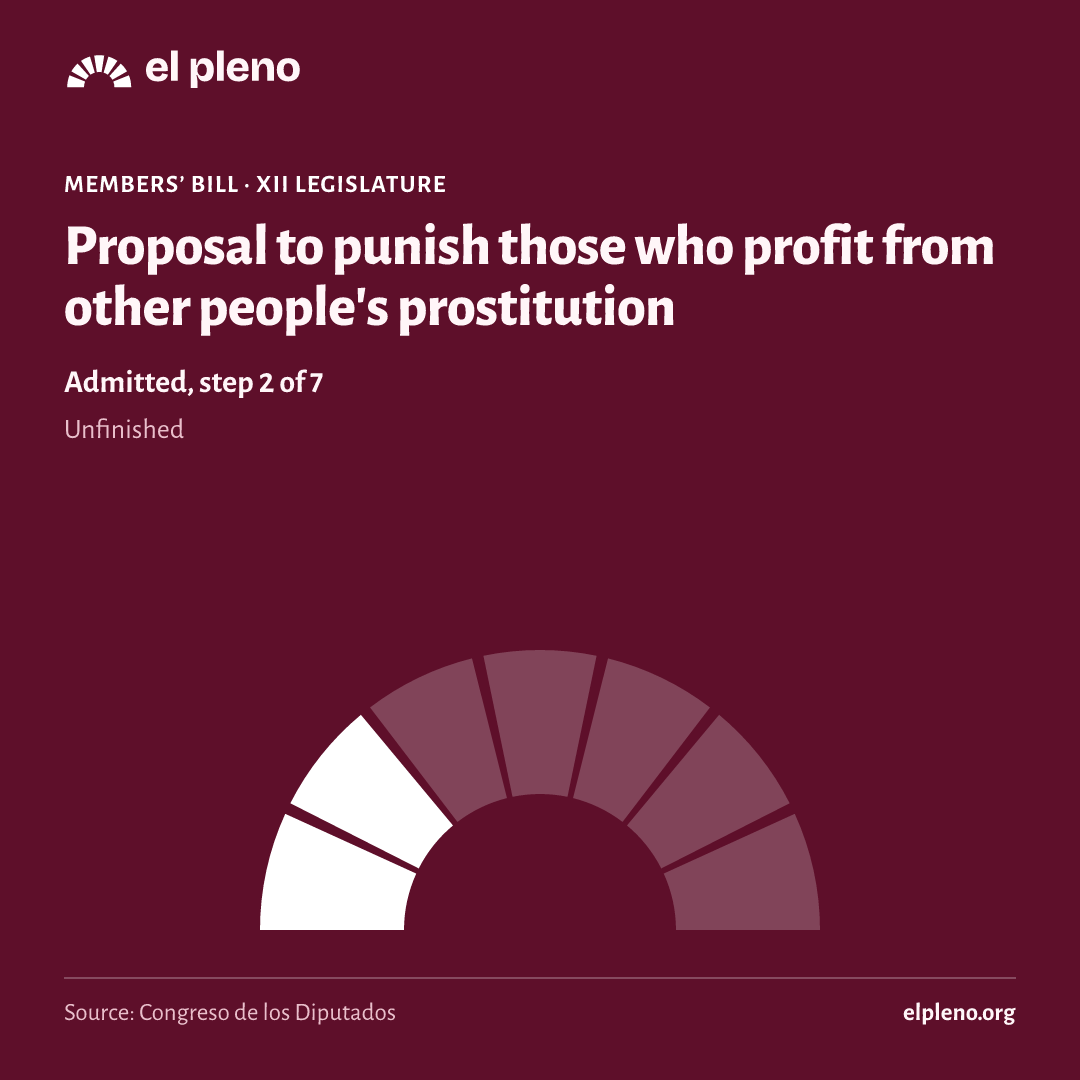
It took 2 of 7 steps. It reached Admitted, and today it is unfinished.
- Introduced22 June 2018Someone registers the text in the Congreso.
- Admitted26 June 2018The Bureau of the Congreso accepts it and, for a members’ bill, the plenary decides whether to consider it.
- Amendmentsnot reachedGroups propose changes.
- Committeenot reachedA committee goes through the text in detail.
- Plenarynot reachedAll 350 deputies vote.
- Senatenot reachedThe Senate can pass it, amend it or veto it.
- BOEnot reachedIt is published in the Official State Gazette (BOE) and comes into force.
See the 6 official steps on a timeline
Was there a plenary vote?
We have no plenary vote linked to this law in the Congreso’s data.
What happens next
What happens now?
The legislature ended before it finished. To go on, someone would have to introduce it again in the new Cortes.
It has not been presented again yet.
Sources
Where does all this come from?
- Congreso de los Diputados, file 122/000246
Official title, type, author, dates and stage.
Retrieved 11 November 2026
- The data comes from the open files of the Congreso, the Senate and the BOE, unaltered.
- Each deputy’s province is the one of their seat on the day of the vote.
- We only say “passed” or “rejected” when the majority needed is certain; otherwise we say which side had more votes.