What it is
Bill would give free legal aid to nonprofit environmental groups
It is a members’ bill. Introduced by parliamentary groups, the Senate, regional governments or citizens. It was introduced on 27 April 2018. Introduced by: Grupo Parlamentario Confederal de Unidos Podemos-En Comú Podem-En Marea.
Official title: Private member's bill to reform Law 1/1996, of January 10, on free legal aid.
Source: Congreso de los Diputados, file 122/000226· updated 11 Nov
Automatic summary, not yet reviewed
- The bill would grant free legal aid to nonprofit organizations whose purpose is protecting the environment, when they bring popular action in environmental matters or any other action defending environmental interests before any court.
- The proposal responds to the fact that environmental organizations must currently prove they lack resources to litigate or be declared of public utility, which in practice denies them free legal aid.
- The text notes that since 2014 the United Nations Aarhus Convention Compliance Committee has found Spain in breach of this obligation, and that the Court of Justice of the European Union could impose a penalty.
- The law would take effect the day after its publication in the Boletín Oficial del Estado, except for measures that increase spending or reduce revenue in the current budget, which would take effect in the next fiscal year.
Who it affects
- Nonprofit associations and foundations that protect the environment: Would be able to litigate without paying and without proving lack of resources, if the law is passed.
- Small or local environmental organizations: Would no longer be excluded from free legal aid for not being declared of public utility.
- The courts and the justice system: Would stop denying them free legal aid for requiring proof of insufficient resources.
Words worth knowing
- Asistencia jurídica gratuita
- Free legal aid: the State pays for a lawyer and court representative when someone cannot afford the costs of a lawsuit.
- Acción popular
- Popular action: allows anyone to go to court to defend a general interest, even if not directly affected.
- Persona jurídica sin ánimo de lucro
- Nonprofit legal entity: an organization such as an association or foundation that does not distribute profits, unlike a company.
- Declaración de utilidad pública
- Declaration of public utility: official recognition given to an association that pursues general interest goals and meets certain requirements.
- Convenio de Aarhus
- Aarhus Convention: international treaty guaranteeing access to information, participation and justice in environmental matters.
It summarizes the text as it was introduced. It is written by artificial intelligence and may contain mistakes: the official text is what counts. Read the official text · How we make summaries
Where it stands
How far did it get?
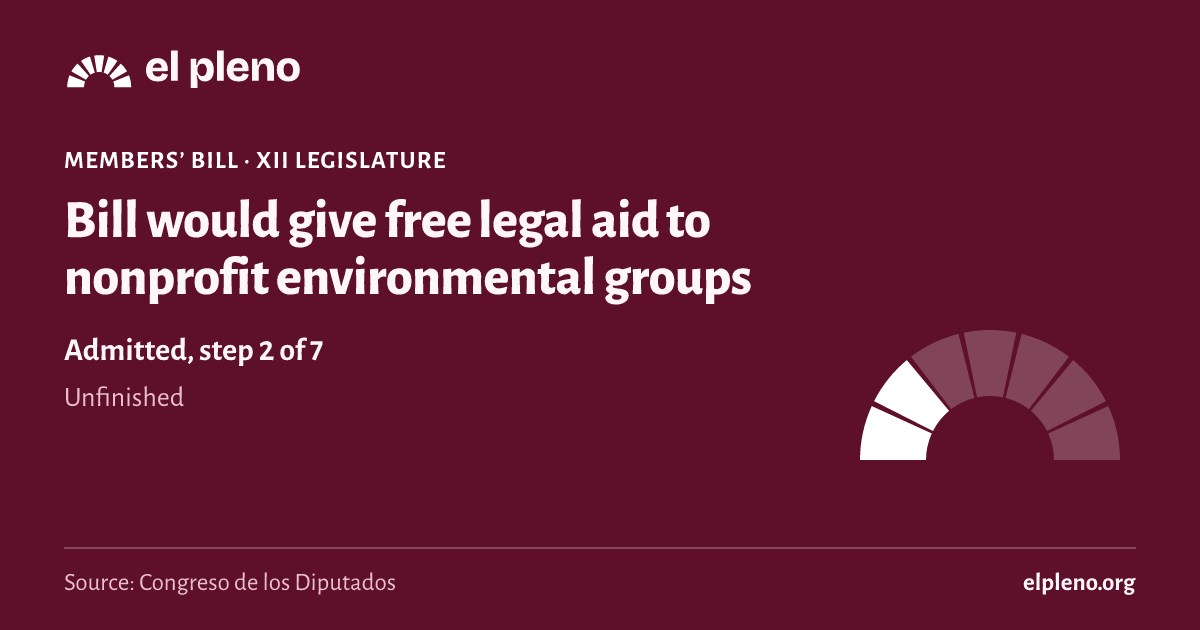
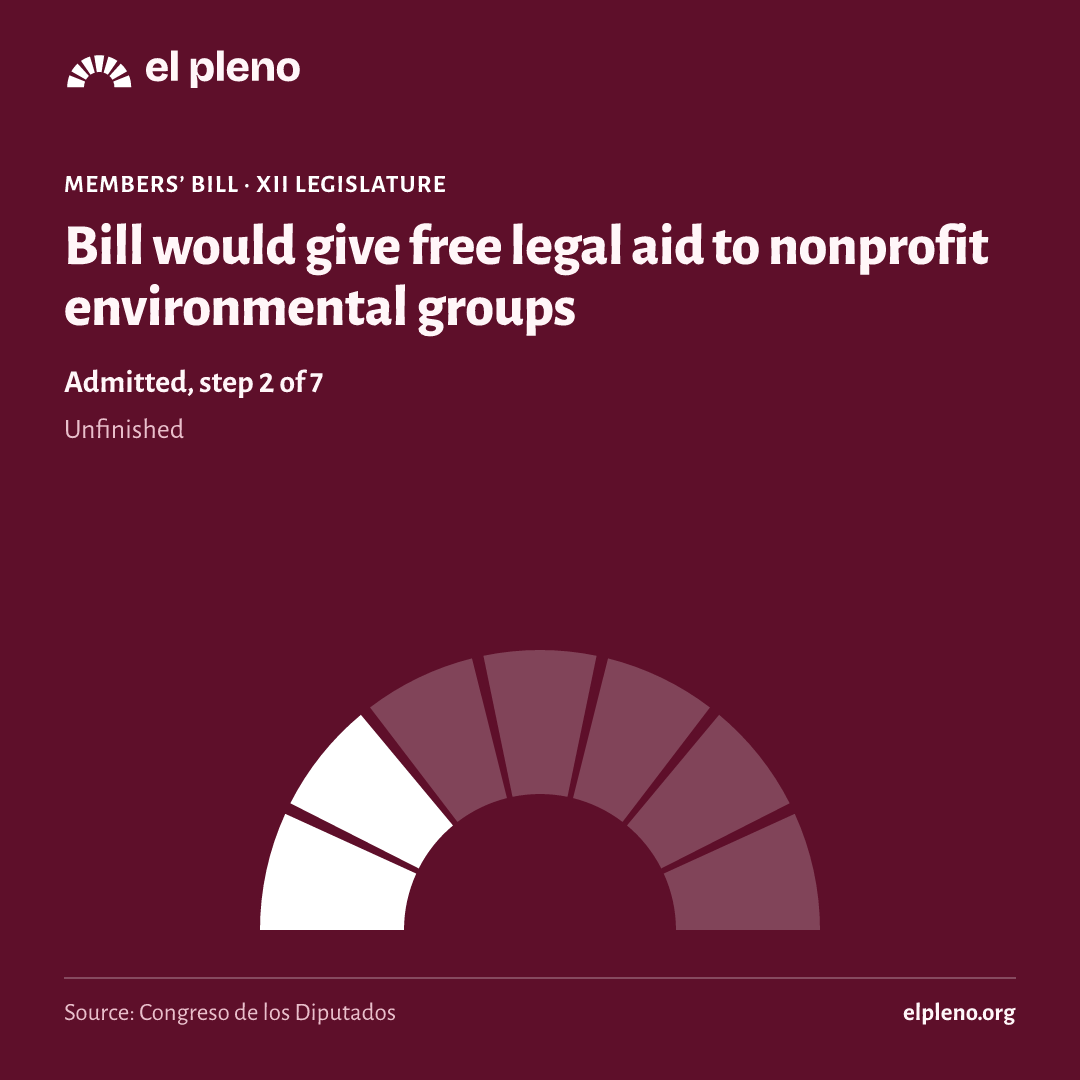
It took 2 of 7 steps. It reached Admitted, and today it is unfinished.
- Introduced27 April 2018Someone registers the text in the Congreso.
- Admitted3 May 2018The Bureau of the Congreso accepts it and, for a members’ bill, the plenary decides whether to consider it.
- Amendmentsnot reachedGroups propose changes.
- Committeenot reachedA committee goes through the text in detail.
- Plenarynot reachedAll 350 deputies vote.
- Senatenot reachedThe Senate can pass it, amend it or veto it.
- BOEnot reachedIt is published in the Official State Gazette (BOE) and comes into force.
See the 6 official steps on a timeline
Was there a plenary vote?
We have no plenary vote linked to this law in the Congreso’s data.
What happens next
What happens now?
The legislature ended before it finished. To go on, someone would have to introduce it again in the new Cortes.
It has not been presented again yet.
Sources
Where does all this come from?
- Congreso de los Diputados, file 122/000226
Official title, type, author, dates and stage.
Retrieved 11 November 2026
- The data comes from the open files of the Congreso, the Senate and the BOE, unaltered.
- Each deputy’s province is the one of their seat on the day of the vote.
- We only say “passed” or “rejected” when the majority needed is certain; otherwise we say which side had more votes.