What it is
Proposal to improve unemployment benefits in Spain
It is a members’ bill. Introduced by parliamentary groups, the Senate, regional governments or citizens. It was introduced on 22 March 2018. Introduced by: Grupo Parlamentario Confederal de Unidos Podemos-En Comú Podem-En Marea.
Official title: Private member's bill on unemployment protection.
Source: Congreso de los Diputados, file 122/000215· updated 11 Nov
Automatic summary, not yet reviewed
- The bill would reverse cuts to unemployment benefits and return to the situation before the 2012 reforms, which lowered payment amounts and tightened access requirements.
- It would lower the minimum contribution period to receive unemployment benefits to 180 days for people under 30, instead of the current 365 days, with a four-month duration.
- It would restore the 70% rate applied to the calculation base for the entire duration of the benefit, instead of the 50% rate after day 181 set by the 2012 reform.
- The means-tested allowance would rise to 100% of the IPREM Indicador público de rentas de efectos múltiples: a public income reference used in Spain to calculate benefits and income limits. (or 127% with family dependents), the early retirement allowance would return to age 52, and the proportional reduction for part-time work would be removed.
- It would extend unemployment protection to domestic workers, removing their current exclusion from the system.
- The Government would have to review active employment policies, moving money from company incentives toward training, counseling, and a special program for young people without professional qualifications.
Who it affects
- Unemployed people receiving or eligible for benefits: Changes would affect the amount, duration, and access requirements for benefits and allowances.
- Young people under 30: They would need fewer contributions to qualify for benefits and would get a special employment program if unqualified.
- Domestic workers: They could access unemployment protection for the first time.
- Unemployed workers over 52: They would regain the early retirement allowance with better amount and duration conditions.
- Part-time and discontinuous permanent workers: Their unemployment protection would be equal to that of full-time workers.
Words worth knowing
- Prestación contributiva (unemployment benefit)
- Money paid by the State to someone who lost their job and contributed enough beforehand through social security payments.
- Subsidio asistencial (means-tested allowance)
- Financial aid for unemployed people who exhausted regular benefits or do not meet the requirements, at a lower amount.
- IPREM
- Indicador público de rentas de efectos múltiples: a public income reference used in Spain to calculate benefits and income limits.
- Base reguladora (calculation base)
- Reference amount, calculated from social security contributions, used to set how much a benefit pays.
- Fijo discontinuo (discontinuous permanent worker)
- Worker with a permanent contract who only works during certain periods of the year, depending on the company's activity.
It summarizes the text as it was introduced. It is written by artificial intelligence and may contain mistakes: the official text is what counts. Read the official text · How we make summaries
Where it stands
How far did it get?
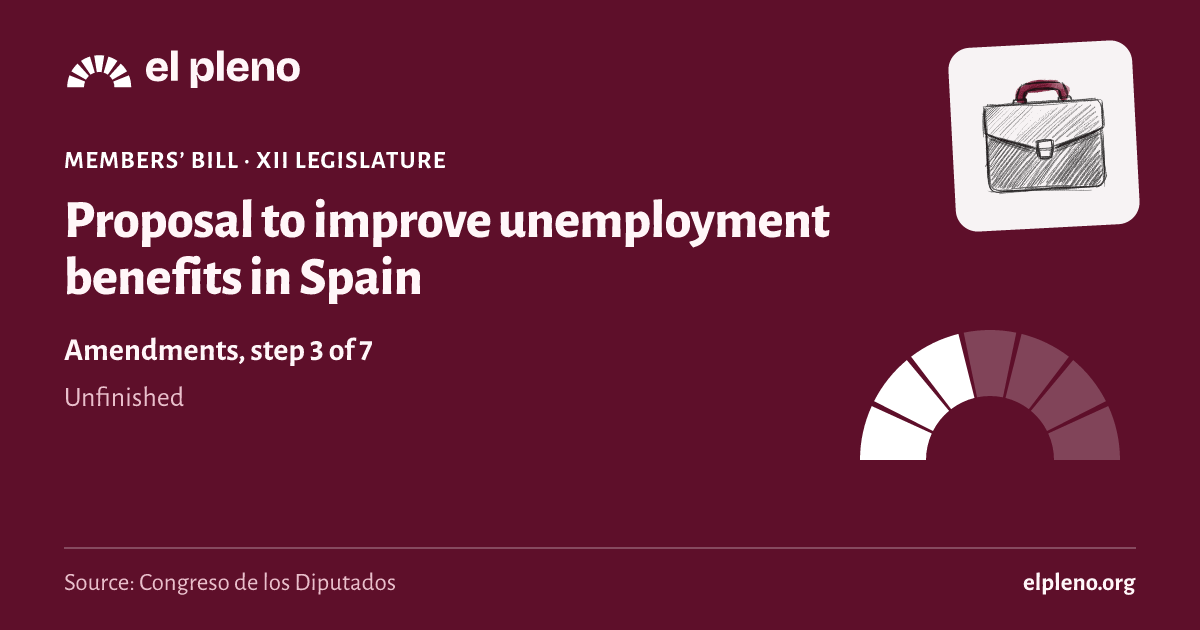
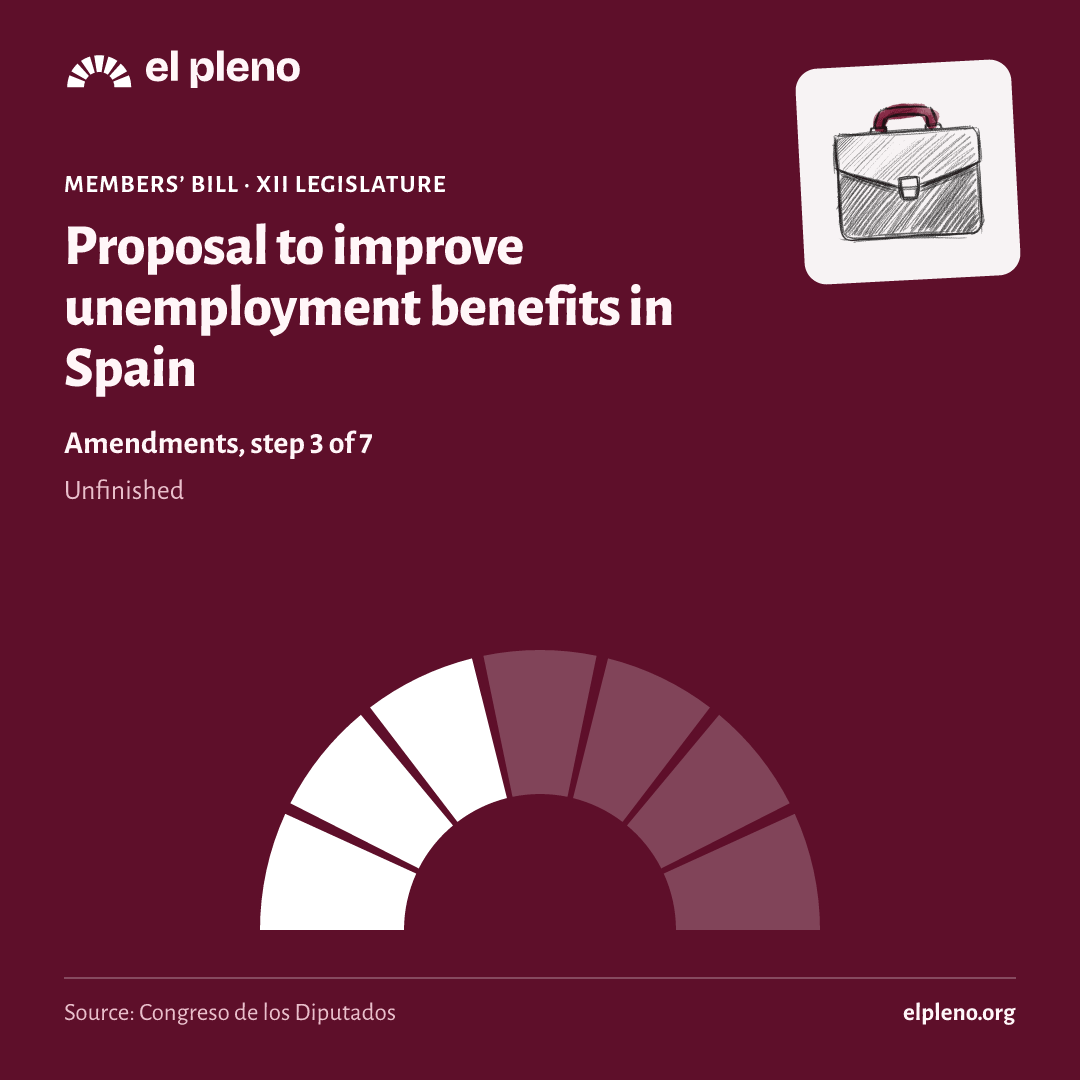
It took 3 of 7 steps. It reached Amendments, and today it is unfinished.
- Introduced22 March 2018Someone registers the text in the Congreso.
- Admitted2 April 2018The Bureau of the Congreso accepts it and, for a members’ bill, the plenary decides whether to consider it.
- Amendments12 June 2018Groups propose changes.
- Committeenot reachedA committee goes through the text in detail.
- Plenarynot reachedAll 350 deputies vote.
- Senatenot reachedThe Senate can pass it, amend it or veto it.
- BOEnot reachedIt is published in the Official State Gazette (BOE) and comes into force.
See the 10 official steps on a timeline
29 May 2018
How did the plenary vote?
Voted on: Private member's bill from the Confederal Parliamentary Group of Unidos Podemos-En Comú Podem-En Marea, on unemployment protection.
Source: Congreso de los Diputados, vote 1 of sitting 119· updated 10 Nov
Each dot is a seat. Tap one, or use the arrow keys, to see who it is.
Your province
How did the deputies from your province vote?
And your senators: the Senate does not link its votes to this law in its open data, so we cannot put them side by side here.
Or see how most of each province voted
- A Coruña Tie 4 yes · 4 no
- Albacete Tie 2 yes · 2 no
- Alicante/Alacant Tie 5 yes · 5 no · 2 abst.
- Almería More votes against 2 yes · 3 no · 1 abst.
- Araba/Álava More votes in favour 2 yes · 1 no · 1 abst.
- Asturias More votes in favour 4 yes · 3 no · 1 abst.
- Ávila More votes against 1 yes · 2 no
- Badajoz Tie 3 yes · 3 no
- Barcelona More votes in favour 22 yes · 4 no · 4 abst.
- Bizkaia More votes in favour 5 yes · 1 no · 2 abst.
- Burgos Tie 2 yes · 2 no
- Cáceres Tie 2 yes · 2 no
- Cádiz More votes in favour 5 yes · 3 no · 1 abst.
- Cantabria Tie 2 yes · 2 no · 1 abst.
- Castellón/Castelló Tie 2 yes · 2 no · 1 abst.
- Ceuta More votes against 0 yes · 1 no
- Ciudad Real More votes against 2 yes · 3 no
- Córdoba More votes in favour 3 yes · 2 no · 1 abst.
- Cuenca More votes against 1 yes · 2 no
- Gipuzkoa More votes in favour 4 yes · 0 no · 2 abst.
- Girona More votes in favour 6 yes · 0 no
- Granada Tie 3 yes · 3 no · 1 abst.
- Guadalajara More votes against 1 yes · 2 no
- Huelva More votes in favour 3 yes · 1 no
- Huesca More votes in favour 2 yes · 1 no
- Illes Balears More votes in favour 4 yes · 3 no · 1 abst.
- Jaén More votes in favour 3 yes · 2 no
- La Rioja Tie 2 yes · 2 no
- Las Palmas More votes in favour 4 yes · 3 no · 1 abst.
- León Tie 2 yes · 2 no
- Lleida More votes in favour 2 yes · 1 no
- Lugo More votes against 1 yes · 2 no
- Madrid More votes in favour 14 yes · 13 no · 6 abst.
- Málaga More votes in favour 5 yes · 4 no · 2 abst.
- Melilla More votes against 0 yes · 1 no
- Murcia More votes against 3 yes · 5 no · 2 abst.
- Navarra More votes in favour 3 yes · 0 no · 2 abst.
- Ourense More votes against 1 yes · 3 no
- Palencia More votes against 1 yes · 2 no
- Pontevedra Tie 3 yes · 3 no
- Salamanca More votes against 1 yes · 3 no
- Santa Cruz de Tenerife More votes against 2 yes · 3 no · 1 abst.
- Segovia More votes against 1 yes · 2 no
- Sevilla More votes in favour 7 yes · 4 no · 1 abst.
- Soria Tie 1 yes · 1 no
- Tarragona More votes in favour 4 yes · 1 no · 1 abst.
- Teruel More votes against 1 yes · 2 no
- Toledo Tie 3 yes · 3 no
- Valencia/València More votes in favour 7 yes · 6 no · 2 abst.
- Valladolid Tie 2 yes · 2 no · 1 abst.
- Zamora More votes against 1 yes · 2 no
- Zaragoza Tie 3 yes · 3 no · 1 abst.
More details: how each group and each province voted
The groups
Who voted in favour and who against?
In favour, most of Socialista, Mixto, Gcup-ec-em and GER. Against, most of Popular en el Congreso. 3 deputies voted differently from their group.
By province: in 20 most voted in favour; in 16, against.
Coloured by how most of each province’s deputies voted.
- In favour: 20
- Against: 16
- Tie: 16
| Group | Seats | How it voted |
|---|---|---|
| Socialista | 84 | 82 in favour · 2 did not vote |
| Vasco (EAJ-PNV) | 5 | 5 abst. |
| Mixto | 19 | 14 in favour · 1 against · 2 abst. · 2 did not vote |
| Ciudadanos | 32 | 32 abst. |
| Gcup-ec-em | 67 | 65 in favour · 2 did not vote |
| GER | 9 | 8 in favour · 1 did not vote |
| Popular en el Congreso | 134 | 131 against · 3 did not vote |
What happens next
What happens now?
The legislature ended before it finished. To go on, someone would have to introduce it again in the new Cortes.
It has not been presented again yet.
Sources
Where does all this come from?
- Congreso de los Diputados, file 122/000215
Official title, type, author, dates and stage.
Retrieved 11 November 2026
- Congreso de los Diputados, vote 1 of sitting 119
The count and every seat’s vote.
Retrieved 10 November 2026
- The data comes from the open files of the Congreso, the Senate and the BOE, unaltered.
- Each deputy’s province is the one of their seat on the day of the vote.
- We only say “passed” or “rejected” when the majority needed is certain; otherwise we say which side had more votes.