What it is
Bill to make accessibility works easier in homeowners' associations
It is a members’ bill. Introduced by parliamentary groups, the Senate, regional governments or citizens. It was introduced on 21 March 2018. Introduced by: Grupo Parlamentario Confederal de Unidos Podemos-En Comú Podem-En Marea.
Official title: Private member's bill amending Law 49/1960, of July 21, on horizontal property.
Source: Congreso de los Diputados, file 122/000214· updated 11 Nov
Automatic summary, not yet reviewed
- The bill would make accessibility works requested by people with disabilities or people over seventy mandatory at all times, removing the current cost limit of twelve months of common expenses.
- It would also lower the majority needed to install an elevator or remove architectural barriers: one third of the owners representing one third of the ownership shares would be enough, the same as for telecommunications or renewable energy services.
- The Government would have to create a special line of aid, within the State Housing Plan 2018-2022, for homeowners with limited financial means who must pay for these works. The aid could cover 100% of the investment if the beneficiary's income is below twice the IPREM Indicador Público de Renta de Efectos Múltiples: a public income index used in Spain to decide who qualifies for aid and benefits..
- The law would take effect the day after its publication in the Official State Gazette (Boletín Oficial del Estado), except for measures that increase the current budget year's spending, which would take effect the following fiscal year.
Who it affects
- People with disabilities and people over seventy who live, work or volunteer in an apartment or commercial unit: Ensures that the accessibility works they request are mandatory, with no cost limit.
- Owners of apartments and commercial units in homeowners' associations: They could approve elevators and anti-barrier works with just one third of the community and of the ownership shares, but would pay the costs even above twelve ordinary months of common expenses.
- The Government: It must regulate a line of aid for those with low incomes who have to finance these works.
Words worth knowing
- Ajustes razonables (reasonable adjustments)
- Necessary and proportionate changes so that people with disabilities can use spaces and services on equal terms.
- Cuotas de participación (ownership shares)
- The percentage of common expenses each owner pays in a homeowners' association, usually set in the property deed.
- IPREM
- Indicador Público de Renta de Efectos Múltiples: a public income index used in Spain to decide who qualifies for aid and benefits.
- Título constitutivo (founding deed)
- The document describing the building and which parts are private and which are common.
It summarizes the text as it was introduced. It is written by artificial intelligence and may contain mistakes: the official text is what counts. Read the official text · How we make summaries
Where it stands
How far did it get?
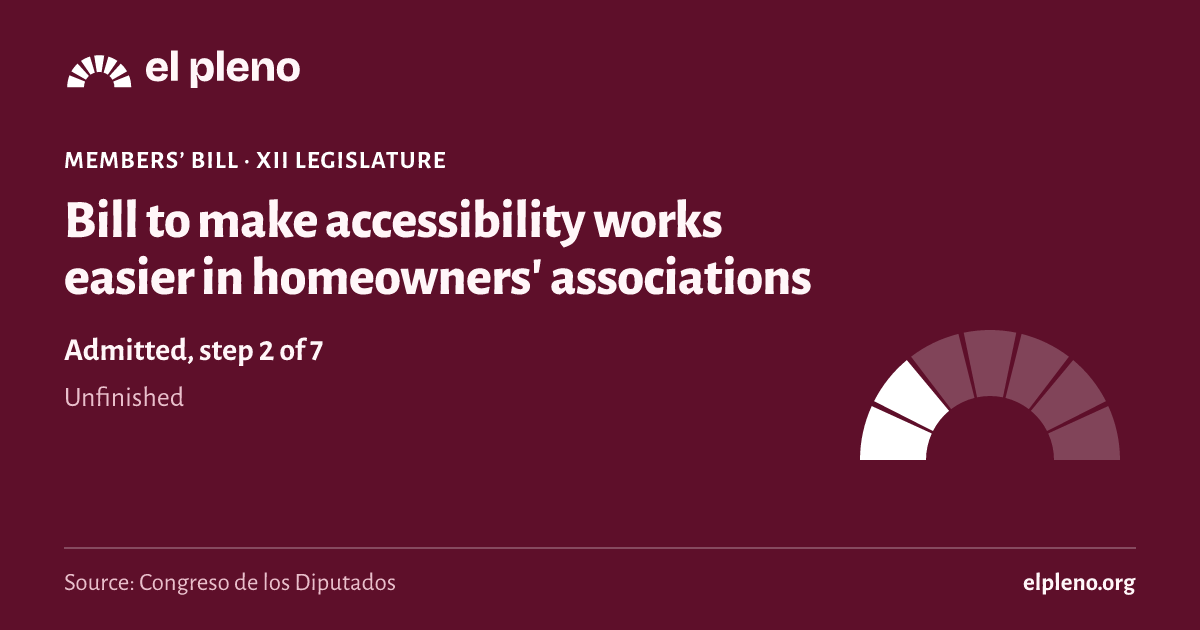
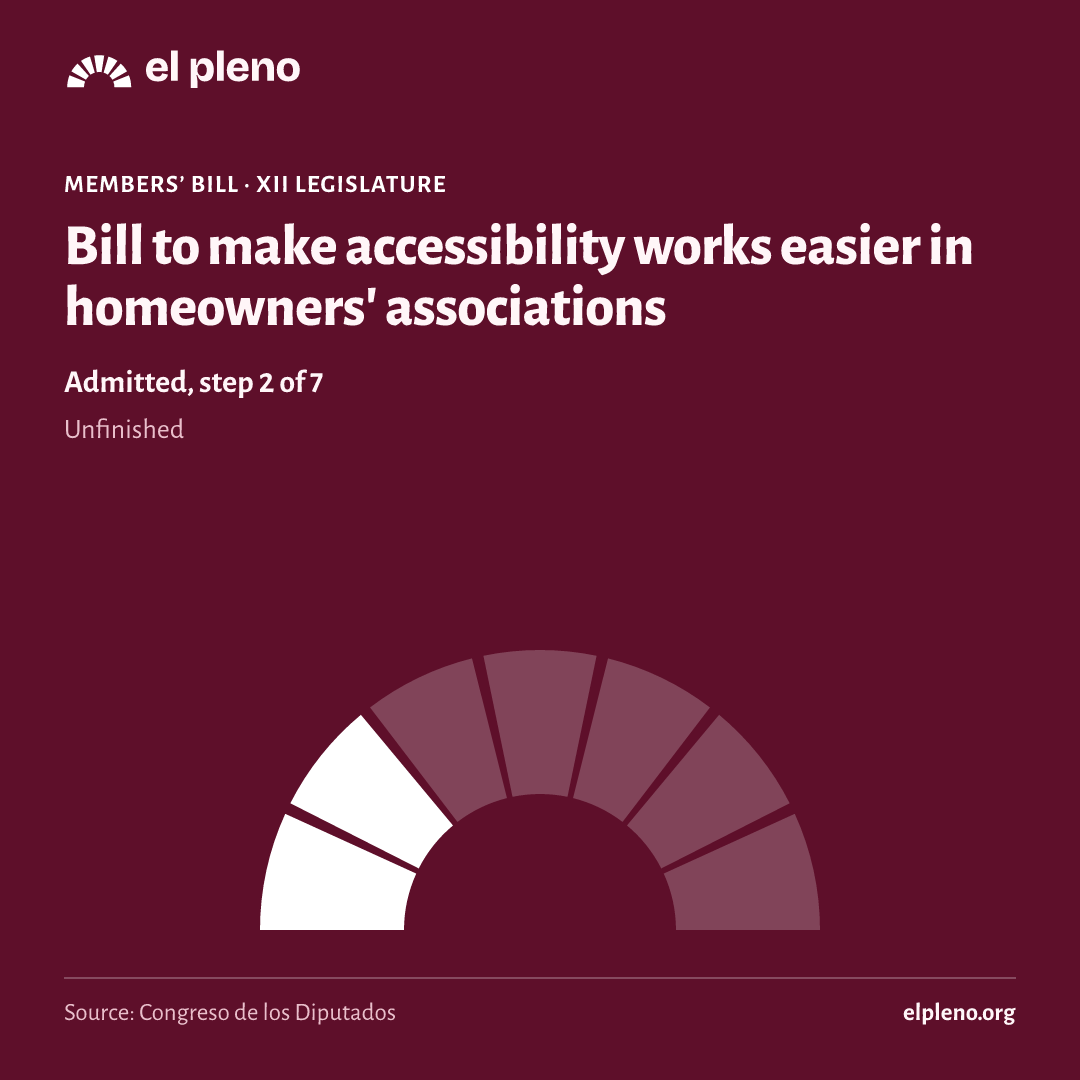
It took 2 of 7 steps. It reached Admitted, and today it is unfinished.
- Introduced21 March 2018Someone registers the text in the Congreso.
- Admitted2 April 2018The Bureau of the Congreso accepts it and, for a members’ bill, the plenary decides whether to consider it.
- Amendmentsnot reachedGroups propose changes.
- Committeenot reachedA committee goes through the text in detail.
- Plenarynot reachedAll 350 deputies vote.
- Senatenot reachedThe Senate can pass it, amend it or veto it.
- BOEnot reachedIt is published in the Official State Gazette (BOE) and comes into force.
See the 6 official steps on a timeline
Was there a plenary vote?
We have no plenary vote linked to this law in the Congreso’s data.
What happens next
What happens now?
The legislature ended before it finished. To go on, someone would have to introduce it again in the new Cortes.
It has not been presented again yet.
Presented before in:
- VI Legislature, Congreso de los Diputados· Withdrawn Private member's bill amending Law 49/1960, of 21 July, on Horizontal Property.
Sources
Where does all this come from?
- Congreso de los Diputados, file 122/000214
Official title, type, author, dates and stage.
Retrieved 11 November 2026
- The data comes from the open files of the Congreso, the Senate and the BOE, unaltered.
- Each deputy’s province is the one of their seat on the day of the vote.
- We only say “passed” or “rejected” when the majority needed is certain; otherwise we say which side had more votes.