What it is
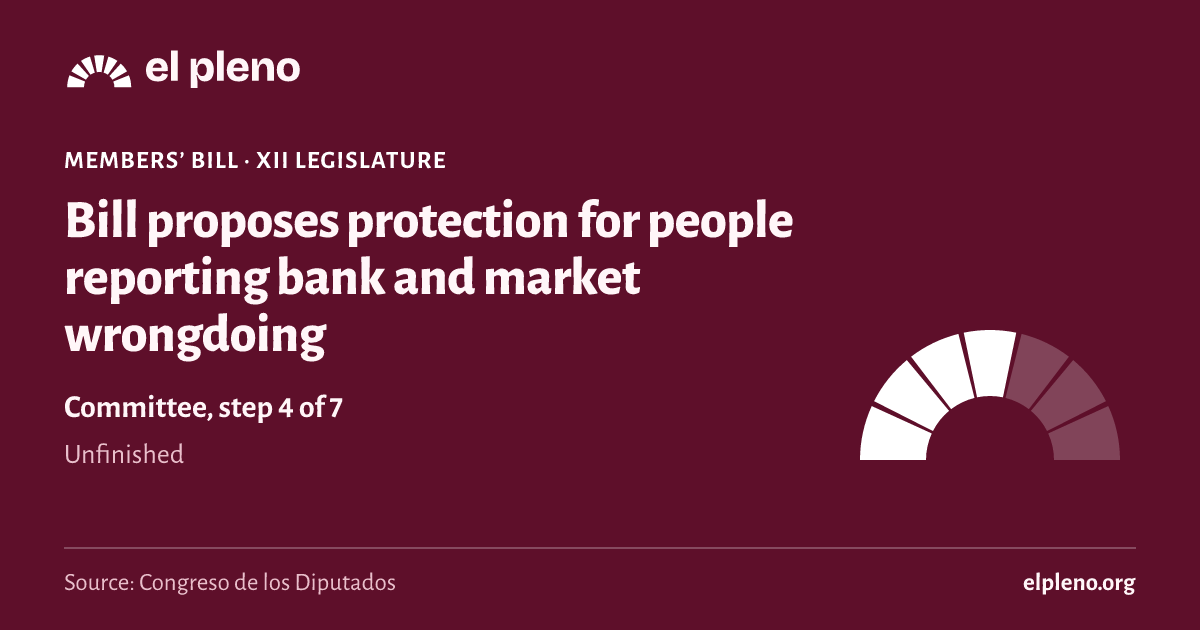
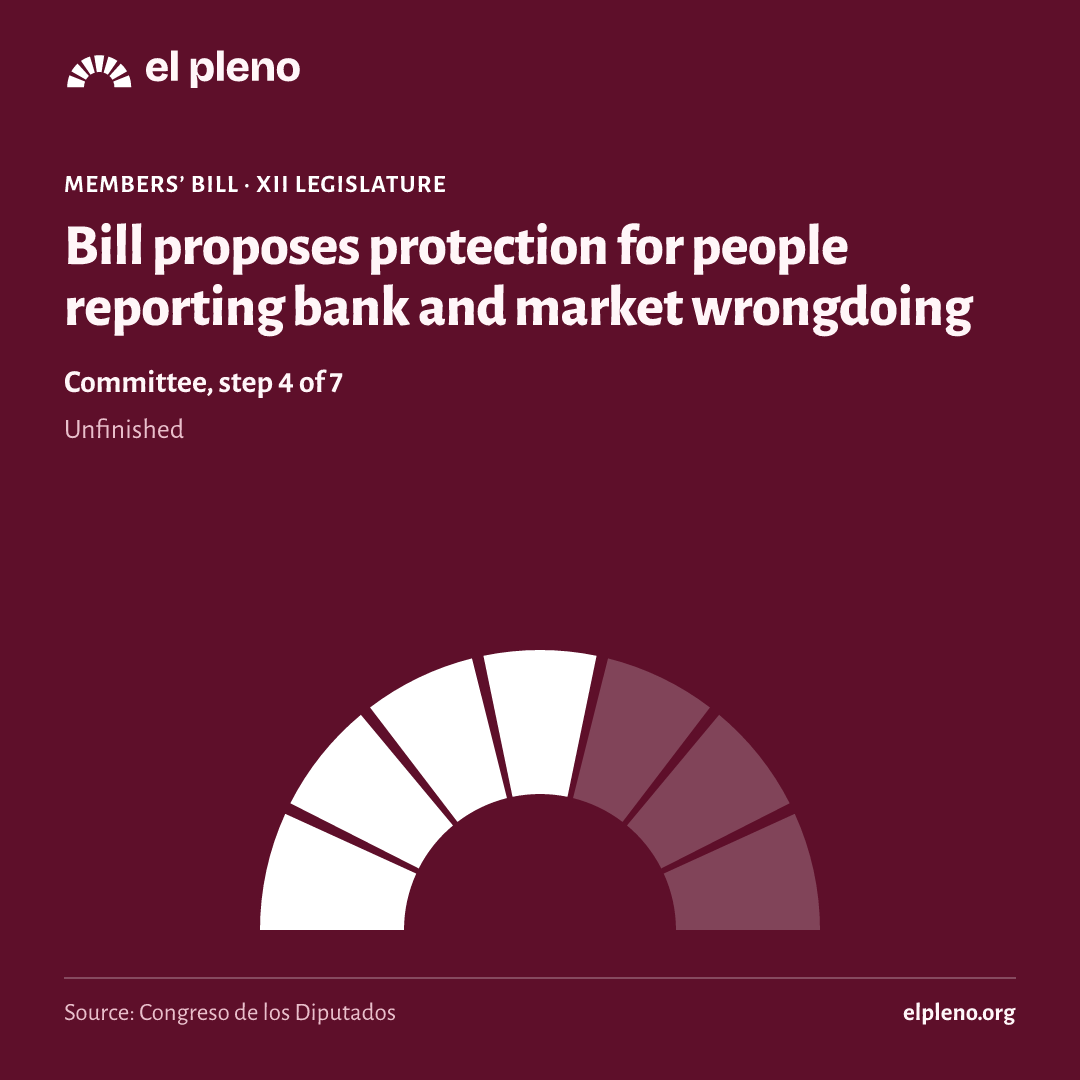
Bill proposes protection for people reporting bank and market wrongdoing
It is a members’ bill. Introduced by parliamentary groups, the Senate, regional governments or citizens. It was introduced on 9 March 2018. Introduced by: Grupo Parlamentario Popular en el Congreso.
Official title: Private member's bill amending Law 10/2014, of 26 June, on the regulation, supervision and solvency of credit institutions, and the consolidated text of the Securities Market Law, approved by Royal Legislative Decree 4/2015, of 23 October.
Source: Congreso de los Diputados, file 122/000207· updated 11 Nov
Automatic summary, not yet reviewed
- The bill would allow anyone who knows of or reasonably suspects a breach of bank supervision rules to report it to the Bank of Spain, with confidentiality guarantees and protection from workplace or contractual retaliation.
- It would provide that all activity centers that a European bank headquartered in another EU country has in Spain count as a single branch, and that the Bank of Spain may request information from the relevant European supervisor when the bank is controlled by an EU parent company.
- The bill would strengthen the supervision and inspection powers of the National Securities Market Commission, including access to electronic communications data held by telecom operators when there are reasonable grounds to suspect a breach, and only with prior judicial authorization.
- It would create a reporting system before the National Securities Market Commission for breaches of market abuse rules and collective investment scheme rules, with written, phone or in-person channels, anonymous reporting allowed, and a response within three months.
- The bill would make reports confidential and would ensure that reporting does not breach contracts or lead to unfair treatment at work; the National Securities Market Commission and the Bank of Spain would have to inform and assist whistleblowers about their rights.
- The law would take effect the day after its publication in the Official State Gazette, except the rules on public information and confidentiality of bank reports, which would take effect three months later.
Who it affects
- Anyone reporting wrongdoing by banks or securities markets: Could report it to the Bank of Spain or the National Securities Market Commission with confidentiality and protection from retaliation.
- Employees of banks and financial firms: Reporting could not be used against them in labor or contractual terms.
- Banks and investment services firms: Would face more supervision and could have internal reports passed to supervisors.
- Banks from other EU countries operating in Spain: All their activity centers in Spain would count as a single branch.
- The National Securities Market Commission and the Bank of Spain: Would get stronger supervision powers and would have to handle and protect the reports they receive.
Words worth knowing
- Supervisión prudencial
- Oversight carried out by supervisors to check that banks are solvent and manage their risks properly.
- Whistleblowing
- Reporting wrongdoing by someone who knows about it from inside an organization.
- CNMV
- Comisión Nacional del Mercado de Valores, the Spanish public agency that oversees securities markets and the firms operating in them.
- Texto refundido
- A single, consolidated version of a law that gathers all its amendments into one text.
- Libre prestación de servicios
- A regime allowing a firm licensed in one EU country to offer its services in the others without opening a branch there.
It summarizes the text as it was introduced. It is written by artificial intelligence and may contain mistakes: the official text is what counts. Read the official text · How we make summaries
Where it stands
How far did it get?
It took 4 of 7 steps. It reached Committee, and today it is unfinished.
- Introduced9 March 2018Someone registers the text in the Congreso.
- Admitted13 March 2018The Bureau of the Congreso accepts it and, for a members’ bill, the plenary decides whether to consider it.
- Amendments20 April 2018Groups propose changes.
- Committee5 September 2018A committee goes through the text in detail.
- Plenarynot reachedAll 350 deputies vote.
- Senatenot reachedThe Senate can pass it, amend it or veto it.
- BOEnot reachedIt is published in the Official State Gazette (BOE) and comes into force.
See the 11 official steps on a timeline
12 April 2018
How did the plenary vote?
Voted on: Private member's bill by the Popular in the Congress Parliamentary Group, to amend Law 10/2014, of June 26, on the organization, supervision and solvency of credit institutions, and the consolidated text of the Securities Market Law, approved by Royal Legislative Decree 4/2015, of October 23.
Source: Congreso de los Diputados, vote 1 of sitting 110· updated 10 Nov
Each dot is a seat. Tap one, or use the arrow keys, to see who it is.
Your province
How did the deputies from your province vote?
And your senators: the Senate does not link its votes to this law in its open data, so we cannot put them side by side here.
Or see how most of each province voted
- A Coruña More votes in favour 6 yes · 0 no · 2 abst.
- Albacete More votes in favour 3 yes · 0 no · 1 abst.
- Alicante/Alacant More votes in favour 9 yes · 0 no · 3 abst.
- Almería More votes in favour 6 yes · 0 no
- Araba/Álava More votes in favour 3 yes · 0 no
- Asturias More votes in favour 6 yes · 0 no · 2 abst.
- Ávila More votes in favour 3 yes · 0 no
- Badajoz More votes in favour 5 yes · 0 no · 1 abst.
- Barcelona More votes in favour 16 yes · 0 no · 14 abst.
- Bizkaia More votes in favour 3 yes · 0 no · 4 abst.
- Burgos More votes in favour 3 yes · 0 no · 1 abst.
- Cáceres More votes in favour 4 yes · 0 no
- Cádiz More votes in favour 7 yes · 0 no · 2 abst.
- Cantabria More votes in favour 4 yes · 0 no · 1 abst.
- Castellón/Castelló More votes in favour 4 yes · 0 no · 1 abst.
- Ceuta More votes in favour 1 yes · 0 no
- Ciudad Real More votes in favour 5 yes · 0 no
- Córdoba More votes in favour 5 yes · 0 no · 1 abst.
- Cuenca More votes in favour 3 yes · 0 no
- Gipuzkoa More votes in favour 3 yes · 0 no · 2 abst.
- Girona More votes in favour 3 yes · 0 no · 3 abst.
- Granada More votes in favour 6 yes · 0 no · 1 abst.
- Guadalajara More votes in favour 3 yes · 0 no
- Huelva More votes in favour 4 yes · 0 no · 1 abst.
- Huesca More votes in favour 2 yes · 0 no · 1 abst.
- Illes Balears More votes in favour 6 yes · 0 no · 2 abst.
- Jaén More votes in favour 4 yes · 0 no · 1 abst.
- La Rioja More votes in favour 3 yes · 0 no · 1 abst.
- Las Palmas More votes in favour 5 yes · 0 no · 2 abst.
- León More votes in favour 3 yes · 0 no · 1 abst.
- Lleida More votes in favour 2 yes · 0 no · 2 abst.
- Lugo More votes in favour 3 yes · 0 no · 1 abst.
- Madrid More votes in favour 23 yes · 0 no · 8 abst.
- Málaga More votes in favour 9 yes · 0 no · 1 abst.
- Melilla More votes in favour 1 yes · 0 no
- Murcia More votes in favour 9 yes · 0 no · 1 abst.
- Navarra More votes in favour 3 yes · 0 no · 2 abst.
- Ourense More votes in favour 4 yes · 0 no
- Palencia More votes in favour 3 yes · 0 no
- Pontevedra More votes in favour 5 yes · 0 no · 2 abst.
- Salamanca More votes in favour 4 yes · 0 no
- Santa Cruz de Tenerife More votes in favour 6 yes · 0 no · 1 abst.
- Segovia More votes in favour 3 yes · 0 no
- Sevilla More votes in favour 9 yes · 0 no · 3 abst.
- Soria More votes in favour 2 yes · 0 no
- Tarragona More votes in favour 4 yes · 0 no · 2 abst.
- Teruel More votes in favour 3 yes · 0 no
- Toledo More votes in favour 4 yes · 0 no · 1 abst.
- Valencia/València More votes in favour 11 yes · 0 no · 5 abst.
- Valladolid More votes in favour 4 yes · 0 no · 1 abst.
- Zamora More votes in favour 3 yes · 0 no
- Zaragoza More votes in favour 6 yes · 0 no · 1 abst.
More details: how each group and each province voted
The groups
Who voted in favour and who against?
In favour, most of Socialista, Vasco (EAJ-PNV), Mixto, Ciudadanos and Popular en el Congreso. 5 deputies voted differently from their group.
By province: in 49 most voted in favour; in 0, against.
Coloured by how most of each province’s deputies voted.
- In favour: 49
- Against: 0
- Abstained: 1
- Tie: 2
| Group | Seats | How it voted |
|---|---|---|
| Socialista | 84 | 82 in favour · 2 did not vote |
| Vasco (EAJ-PNV) | 5 | 5 in favour |
| Mixto | 19 | 12 in favour · 5 abst. · 2 did not vote |
| Ciudadanos | 32 | 32 in favour |
| Gcup-ec-em | 67 | 65 abst. · 2 did not vote |
| GER | 9 | 9 abst. |
| Popular en el Congreso | 134 | 128 in favour · 6 did not vote |
What happens next
What happens now?
The legislature ended before it finished. To go on, someone would have to introduce it again in the new Cortes.
It has not been presented again yet.
Sources
Where does all this come from?
- Congreso de los Diputados, file 122/000207
Official title, type, author, dates and stage.
Retrieved 11 November 2026
- Congreso de los Diputados, vote 1 of sitting 110
The count and every seat’s vote.
Retrieved 10 November 2026
- The data comes from the open files of the Congreso, the Senate and the BOE, unaltered.
- Each deputy’s province is the one of their seat on the day of the vote.
- We only say “passed” or “rejected” when the majority needed is certain; otherwise we say which side had more votes.