What it is
Proposal to stop penalizing returned emigrants with foreign pensions
It is a members’ bill. Introduced by parliamentary groups, the Senate, regional governments or citizens. It was introduced on 9 March 2018. Introduced by: Grupo Parlamentario Socialista.
Official title: Private member's bill on urgent measures regarding the taxation of pensions from abroad.
Source: Congreso de los Diputados, file 122/000206· updated 11 Nov
Automatic summary, not yet reviewed
- The bill would have the Ministry of Finance urgently recognize foreign pensions for absolute incapacity or major disability as equivalent to Spanish ones, so they get the same tax exemption. The exemption would apply automatically, and IRPF Impuesto sobre la Renta de las Personas Físicas: Spain's personal income tax, paid on income such as wages or pensions. assessments on these pensions would be suspended until the procedure is approved, with no surcharges, interest or penalties.
- The tax agency would automatically apply the exemption for foreign pensions paid from public funds when double taxation treaties require it, using court rulings that already recognize it. It would also automatically refund, with interest, amounts wrongly collected from pensioners, whatever the tax year.
- The tax agency would be required to give these taxpayers a draft IRPF return showing the foreign pensions it considers taxable. If the taxpayer claims the disability exemption, the corresponding part would be suspended until the recognition or the report is completed.
- Surcharges, interest and penalties already paid but never claimed back would be refunded automatically within a maximum of six months. In addition, regularization procedures and supplementary returns for these pensions would carry no surcharges or penalties for the share corresponding to the pensions regularized.
Who it affects
- Returned emigrants receiving pensions from abroad: They would get the exemption automatically and recover surcharges, interest and penalties already paid.
- People with foreign pensions for absolute incapacity or major disability: Their pensions would be recognized as equivalent to Spanish ones for the exemption, and ongoing procedures would be suspended.
- Taxpayers covered by double taxation treaties, especially with Germany: The tax agency would apply court rulings recognizing the exemption and refund amounts wrongly collected.
- Those who missed the deadline to claim refunds after the 2014 regularization: They would automatically receive, within six months, the amounts they paid and never got back.
Words worth knowing
- IRPF
- Impuesto sobre la Renta de las Personas Físicas: Spain's personal income tax, paid on income such as wages or pensions.
- Homologación
- Official recognition that a foreign pension is equivalent to a Spanish one, so it gets the same tax treatment.
- Convenio para evitar la doble imposición
- Double taxation treaty: an agreement between two countries so income, such as a pension, is not taxed in both.
- Prescrito
- Past periods that can no longer be claimed or regularized for tax purposes.
- De oficio
- Automatically: the administration acts on its own, without the taxpayer having to ask.
It summarizes the text as it was introduced. It is written by artificial intelligence and may contain mistakes: the official text is what counts. Read the official text · How we make summaries
Where it stands
How far did it get?
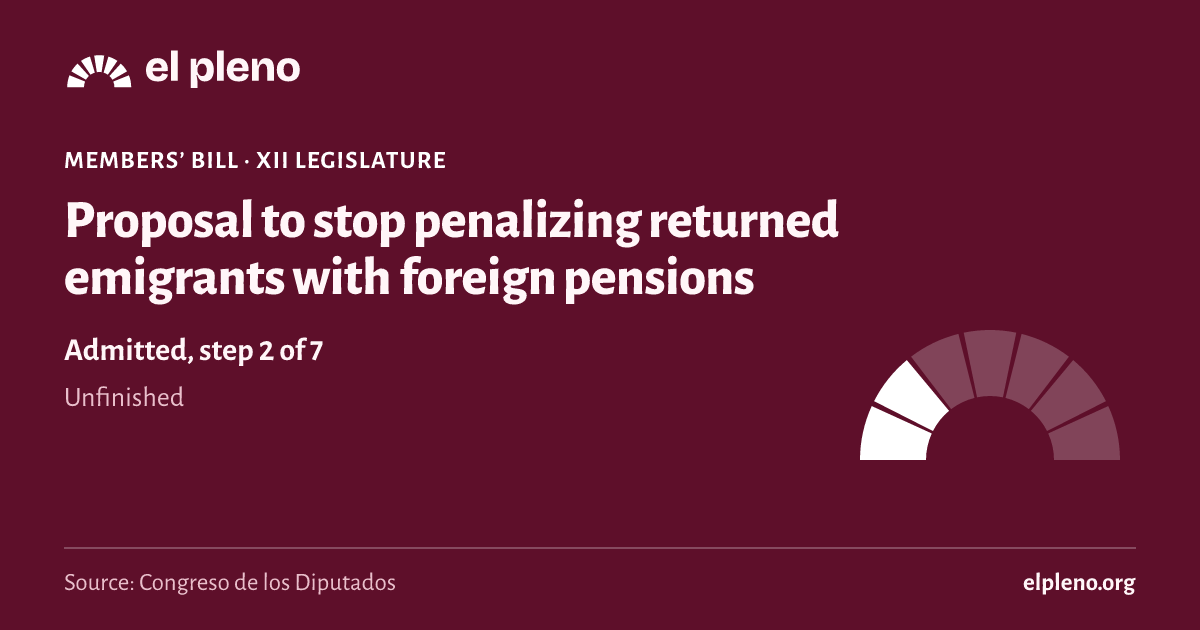
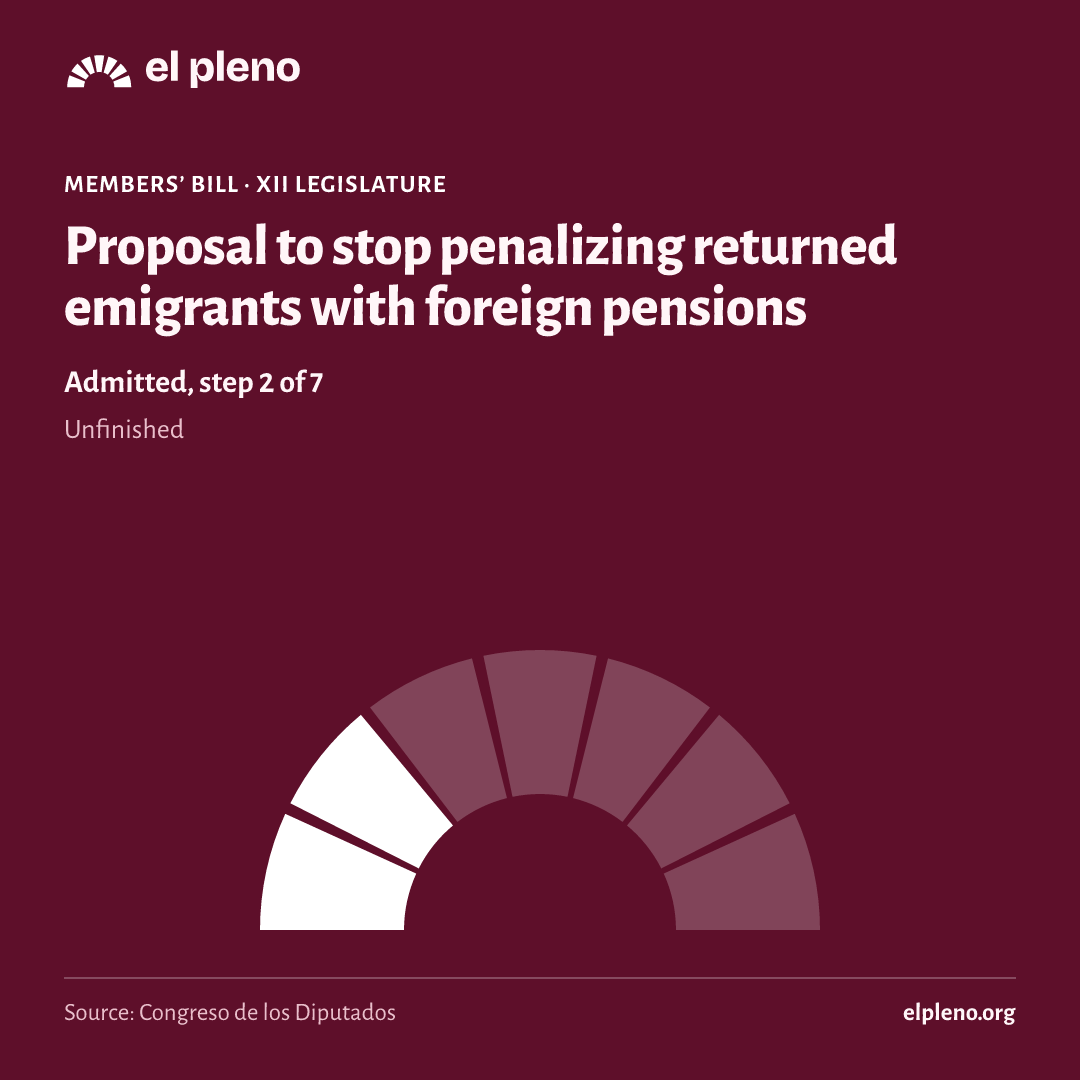
It took 2 of 7 steps. It reached Admitted, and today it is unfinished.
- Introduced9 March 2018Someone registers the text in the Congreso.
- Admitted13 March 2018The Bureau of the Congreso accepts it and, for a members’ bill, the plenary decides whether to consider it.
- Amendmentsnot reachedGroups propose changes.
- Committeenot reachedA committee goes through the text in detail.
- Plenarynot reachedAll 350 deputies vote.
- Senatenot reachedThe Senate can pass it, amend it or veto it.
- BOEnot reachedIt is published in the Official State Gazette (BOE) and comes into force.
See the 6 official steps on a timeline
Was there a plenary vote?
We have no plenary vote linked to this law in the Congreso’s data.
What happens next
What happens now?
The legislature ended before it finished. To go on, someone would have to introduce it again in the new Cortes.
It has not been presented again yet.
Sources
Where does all this come from?
- Congreso de los Diputados, file 122/000206
Official title, type, author, dates and stage.
Retrieved 11 November 2026
- The data comes from the open files of the Congreso, the Senate and the BOE, unaltered.
- Each deputy’s province is the one of their seat on the day of the vote.
- We only say “passed” or “rejected” when the majority needed is certain; otherwise we say which side had more votes.