What it is
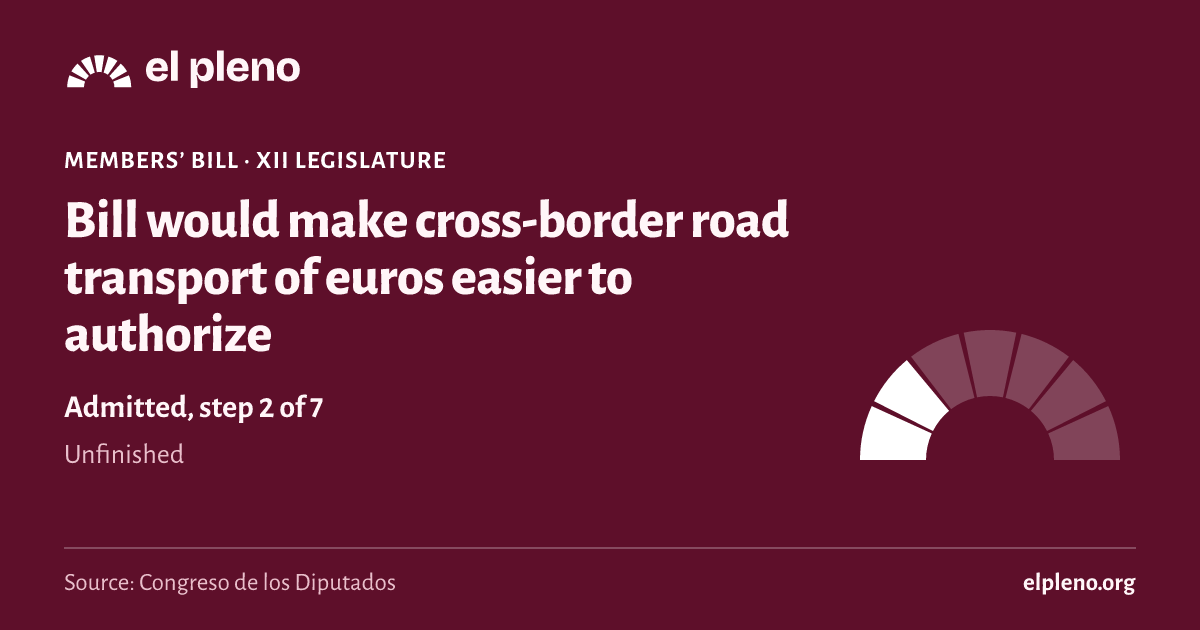
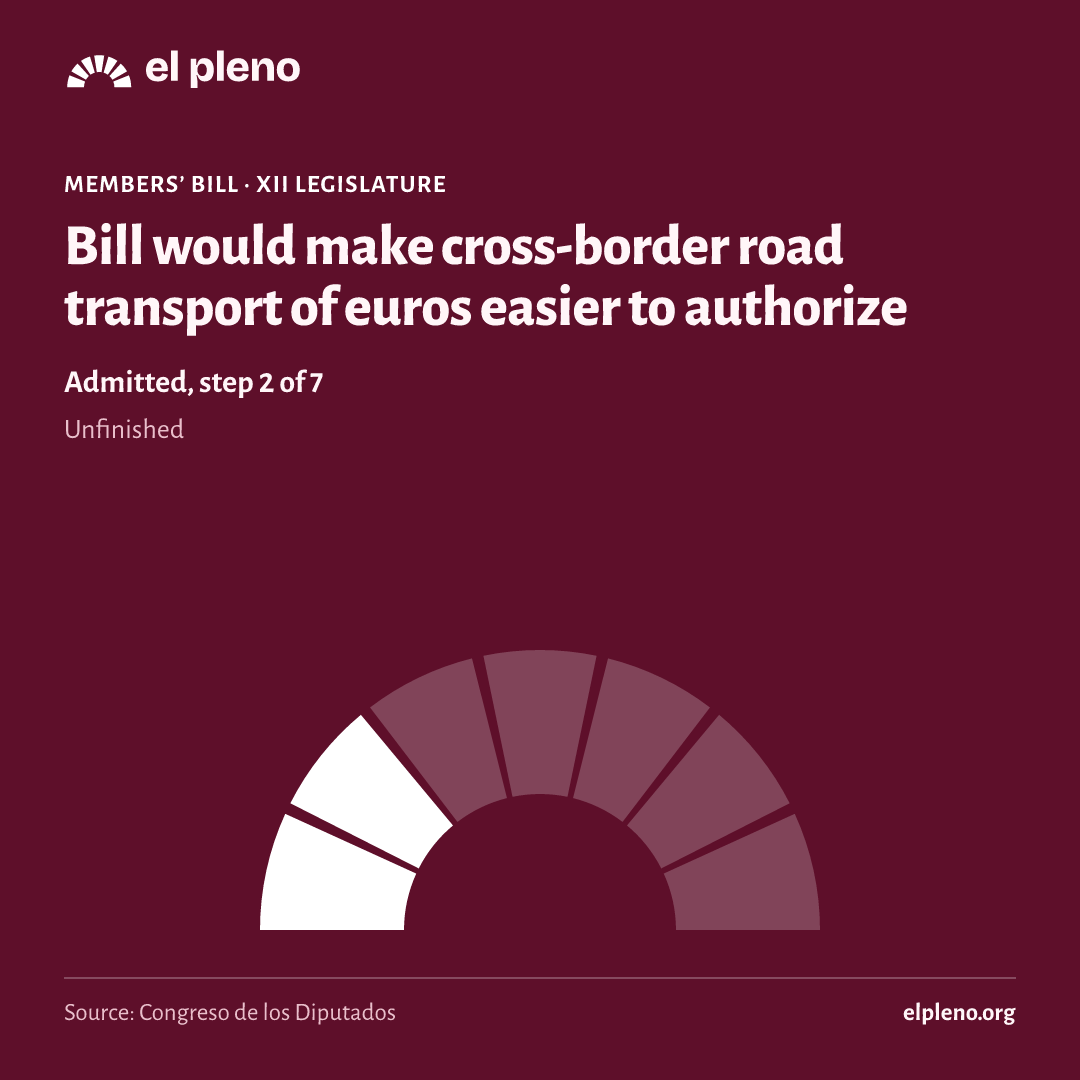
Bill would make cross-border road transport of euros easier to authorize
It is a members’ bill. Introduced by parliamentary groups, the Senate, regional governments or citizens. It was introduced on 21 February 2018. Introduced by: Grupo Parlamentario Socialista.
Official title: Private member's bill regarding cross-border road transport of funds in euros and Euro banknotes.
Source: Congreso de los Diputados, file 122/000187· updated 11 Nov
Automatic summary, not yet reviewed
- The bill would add a provision to Law 5/2014 on Private Security so that, when the transport of euro funds is covered by EU Regulation No. 1214/2011, the Ministry of the Interior would only check that the company meets conditions and guarantees in its home country equivalent to Spain's, with no new guarantees required.
- Following the European Central Bank's criteria, the EU regulation would also apply to the transport of euro banknotes.
- Spanish authorities could grant authorization for each cross-border transport operation within a maximum of one month from the request.
- Each authorization would be individual and would set the personnel, route and maximum completion time, warning that breaking it can lead to penalties under Spanish law. The law would take effect the day after its publication in the official state gazette.
Who it affects
- Cash-in-transit and private security companies: They could carry out cross-border road transport of euros with fewer procedures and no extra guarantees.
- Private security workers from other EU countries: The text notes they can work in Spain if the Ministry of the Interior verifies they meet the requirements.
- Ministry of the Interior: Its role would be limited to checking the company's guarantees, and it would have to decide within one month.
Words worth knowing
- Proposición de ley
- A bill introduced by parliamentary groups to become a law. In this case it is not yet passed.
- Transporte transfronterizo
- Cross-border transport, meaning transport that crosses the border between two countries.
- Libre prestación de servicios
- Free provision of services, an EU principle allowing companies to offer services in any member country.
- Disposición adicional
- An additional provision, a section added at the end of a law to regulate a specific point.
It summarizes the text as it was introduced. It is written by artificial intelligence and may contain mistakes: the official text is what counts. Read the official text · How we make summaries
Where it stands
How far did it get?
It took 2 of 7 steps. It reached Admitted, and today it is unfinished.
- Introduced21 February 2018Someone registers the text in the Congreso.
- Admitted27 February 2018The Bureau of the Congreso accepts it and, for a members’ bill, the plenary decides whether to consider it.
- Amendmentsnot reachedGroups propose changes.
- Committeenot reachedA committee goes through the text in detail.
- Plenarynot reachedAll 350 deputies vote.
- Senatenot reachedThe Senate can pass it, amend it or veto it.
- BOEnot reachedIt is published in the Official State Gazette (BOE) and comes into force.
See the 6 official steps on a timeline
Was there a plenary vote?
We have no plenary vote linked to this law in the Congreso’s data.
What happens next
What happens now?
The legislature ended before it finished. To go on, someone would have to introduce it again in the new Cortes.
It has not been presented again yet.
Sources
Where does all this come from?
- Congreso de los Diputados, file 122/000187
Official title, type, author, dates and stage.
Retrieved 11 November 2026
- The data comes from the open files of the Congreso, the Senate and the BOE, unaltered.
- Each deputy’s province is the one of their seat on the day of the vote.
- We only say “passed” or “rejected” when the majority needed is certain; otherwise we say which side had more votes.