What it is
Bill proposes reforming Spain's Water Law with environmental criteria
It is a members’ bill. Introduced by parliamentary groups, the Senate, regional governments or citizens. It was introduced on 21 February 2018. Introduced by: Grupo Parlamentario Confederal de Unidos Podemos-En Comú Podem-En Marea.
Official title: Private member's bill to reform Royal Legislative Decree 1/2001, of July 20, approving the consolidated text of the Water Law in coherence with the Water Framework Directive and the context of Climate Change.
Source: Congreso de los Diputados, file 122/000186· updated 11 Nov
Automatic summary, not yet reviewed
- The bill would recognize the right to drinking water and sanitation as human rights, and would guarantee everyone a minimum amount of clean, safe water even if they cannot pay for it.
- It would shift water planning from supply-based strategies to demand management, apply the precautionary principle in the face of climate change, and place drought and flood risk management at the center of planning.
- It would tighten the water concession system: maximum terms of 25 years, review according to hydrological plans, expiration for failing environmental objectives, and no compensation for restrictions caused by ecological flows. It would also abolish water transfer contracts and repeal several related articles.
- It would require that, when a hydroelectric concession ends, the possibility of dismantling the dam be studied to improve the river's condition; if operation continues, the new concession would last at most 4 years (service) or 20 years (works).
- It would strengthen cost recovery and economic rationality: calculating and publishing the costs future beneficiaries of new projects will pay before approval, applying the polluter pays principle, and basing charges on real volumetric control data.
- It would set deadlines: within one year, start restoring groundwater bodies in poor condition and conduct a public audit of hydroelectric concessions; within three months, create public companies to operate hydroelectric plants and approve dam safety rules.
Who it affects
- Water users: They would be recognized the human right to drinking water and sanitation, with a guaranteed minimum even if they cannot pay.
- Water and hydroelectric concession holders: Shorter, reviewable concessions that can expire on environmental grounds, with possible dam dismantling when concessions end.
- Farmers and livestock breeders: They would pay the discharge control charge for diffuse pollution from fertilizers and pesticides, and be subject to flow measurement systems.
- Beneficiaries of water infrastructure projects: They would have to commit in writing to pay the calculated costs before any new project is definitively approved.
- Communities near large dams: The precautionary principle would apply to dam safety, with experts proposed by those affected.
Words worth knowing
- Concesión (concession)
- An administrative permit to privately use a public asset, such as water, for a limited time.
- Dominio público hidráulico (public water domain)
- Assets owned by the State, such as continental waters, riverbeds and aquifers.
- Canon (charge)
- A fee paid for using a public asset, in this case water.
- Caudal ecológico (ecological flow)
- The amount of water that must remain in a river to preserve its ecosystems.
- Principio de quien contamina paga (polluter pays principle)
- Whoever causes environmental damage must bear the cost of preventing or repairing it.
It summarizes the text as it was introduced. It is written by artificial intelligence and may contain mistakes: the official text is what counts. Read the official text · How we make summaries
Where it stands
How far did it get?
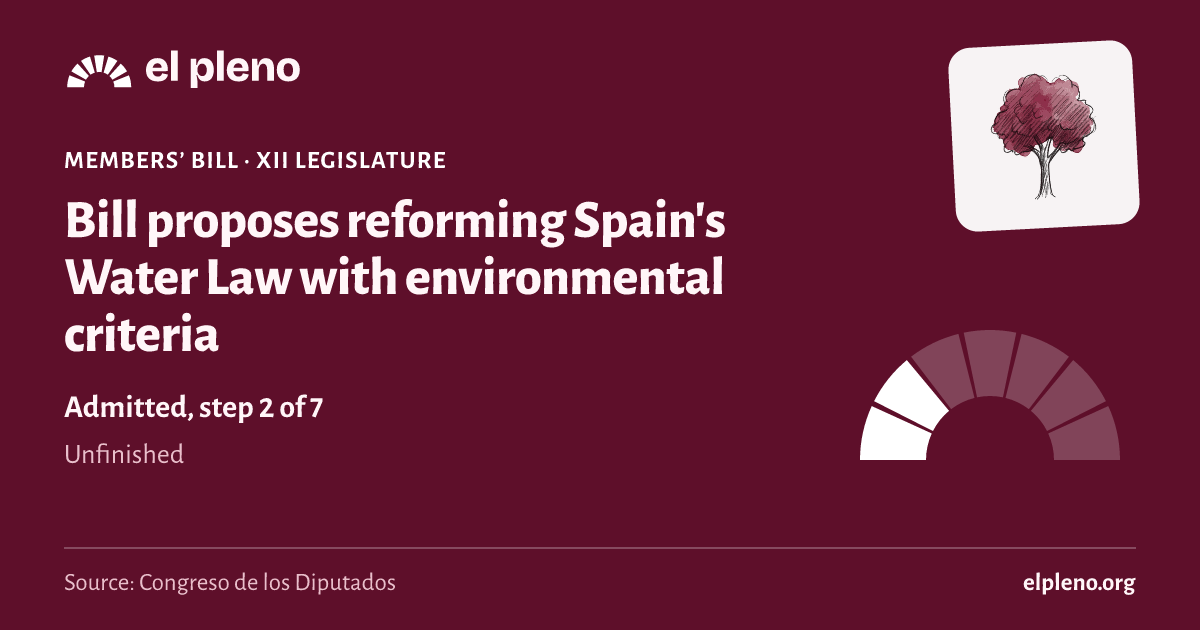
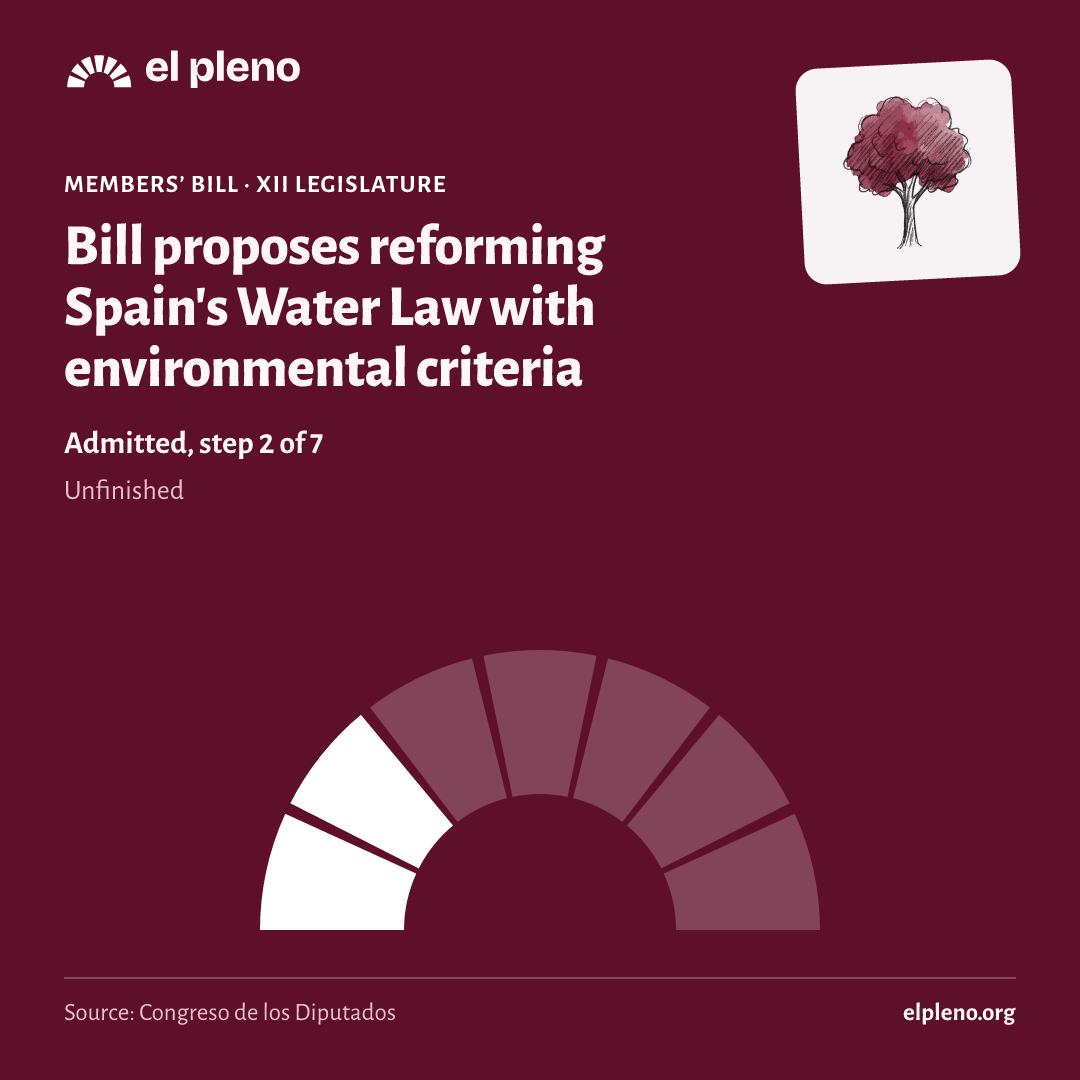
It took 2 of 7 steps. It reached Admitted, and today it is unfinished.
- Introduced21 February 2018Someone registers the text in the Congreso.
- Admitted27 February 2018The Bureau of the Congreso accepts it and, for a members’ bill, the plenary decides whether to consider it.
- Amendmentsnot reachedGroups propose changes.
- Committeenot reachedA committee goes through the text in detail.
- Plenarynot reachedAll 350 deputies vote.
- Senatenot reachedThe Senate can pass it, amend it or veto it.
- BOEnot reachedIt is published in the Official State Gazette (BOE) and comes into force.
See the 6 official steps on a timeline
Was there a plenary vote?
We have no plenary vote linked to this law in the Congreso’s data.
What happens next
What happens now?
The legislature ended before it finished. To go on, someone would have to introduce it again in the new Cortes.
It has not been presented again yet.
Sources
Where does all this come from?
- Congreso de los Diputados, file 122/000186
Official title, type, author, dates and stage.
Retrieved 11 November 2026
- The data comes from the open files of the Congreso, the Senate and the BOE, unaltered.
- Each deputy’s province is the one of their seat on the day of the vote.
- We only say “passed” or “rejected” when the majority needed is certain; otherwise we say which side had more votes.