What it is
Bill to strengthen the independence and transparency of Spain's Nuclear Safety Council
It is a members’ bill. Introduced by parliamentary groups, the Senate, regional governments or citizens. It was introduced on 14 February 2018. Introduced by: Grupo Parlamentario Confederal de Unidos Podemos-En Comú Podem-En Marea.
Official title: Private member's bill on the functioning of the Nuclear Safety Council.
Source: Congreso de los Diputados, file 122/000180· updated 11 Nov
Automatic summary, not yet reviewed
- The bill would bar anyone from being appointed Council member or Technical Director of the Nuclear Safety Council without the approval of three fifths of the relevant committee of the Congress of Deputies. It would also set a six-year term, renewable only once, and ban anyone over seventy from holding these posts.
- It would grant citizens rights vis-à-vis the Council: access to its records and files, requests to investigate failures at nuclear facilities, proposals for new rules, and the ability to appeal its decisions. The Council would always have to give reasoned answers.
- It would make the Council's plenary sessions public, recorded and streamed live on its website, which would also host past recordings.
- It would expand the Advisory Committee with one representative from each parliamentary group in the Congress of Deputies and strengthen its access to Council information. It would also regulate Technical Advisory Committees, which could be convened by three Council members or three fifths of the Congress Energy Committee.
- It would change the nuclear energy penalty regime: fines for very serious offenses at nuclear power plants could reach twice the profit gained from the offense, and the Council could suspend or revoke the licenses of workers who fail to report safety deficiencies.
- The Council's Statute would have to be adapted to the law within a maximum of six months, and the law would take effect the day after publication in the Official State Gazette, except for measures with budget costs.
Who it affects
- The Nuclear Safety Council and its staff: They would have to hold public sessions, handle confidential complaints through electronic means, and share more information with citizens and the Advisory Committee.
- Members of Congress: They would play a key role in appointing Council members and Technical Directors and in convening Technical Advisory Committees.
- People living near nuclear facilities or working in them: They would have more ways to report safety problems and access Council information.
- Companies in the nuclear and radioactive sector: They would face higher fines and precautionary measures such as sealing equipment or suspending operations.
Words worth knowing
- Consejo de Seguridad Nuclear (CSN)
- Spain's independent public body that oversees nuclear safety and radiation protection.
- Pleno
- The meeting of all members of the body, where decisions are made.
- Multas coercitivas (coercive fines)
- Repeated fines used to force someone to comply with an order, not as punishment for an offense.
- Medidas cautelares (precautionary measures)
- Temporary measures to prevent harm while it is decided whether an offense occurred, such as sealing equipment or shutting down a facility.
- Tres quintos (three fifths)
- A special majority: three out of every five members of the deciding body, here a committee of the Congress.
It summarizes the text as it was introduced. It is written by artificial intelligence and may contain mistakes: the official text is what counts. Read the official text · How we make summaries
Where it stands
How far did it get?
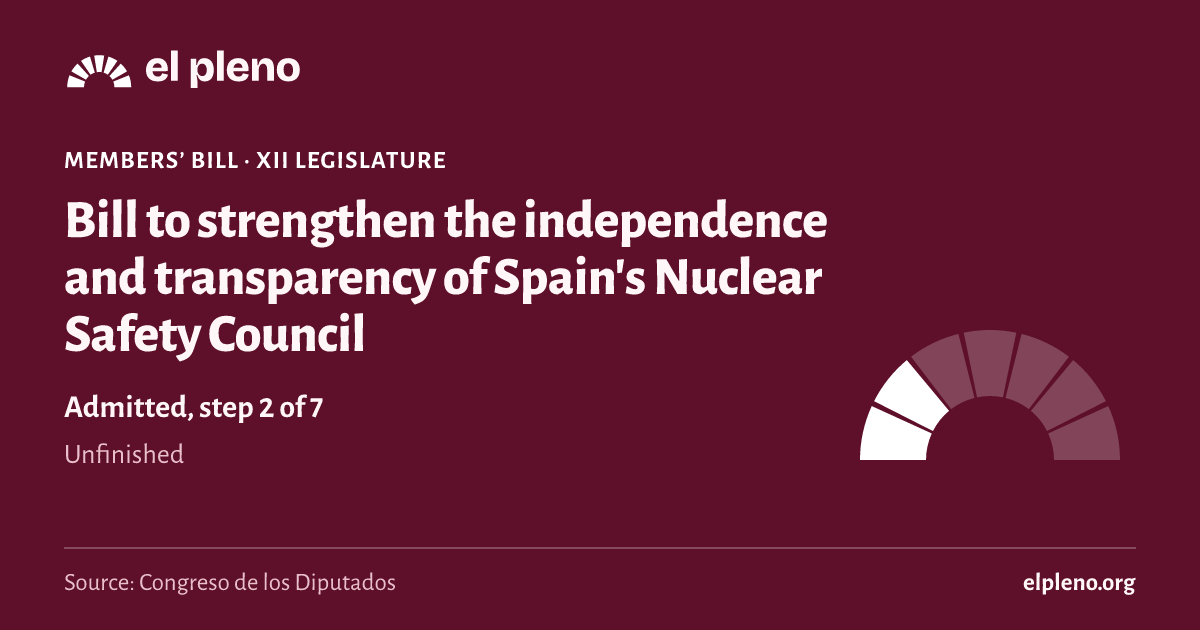
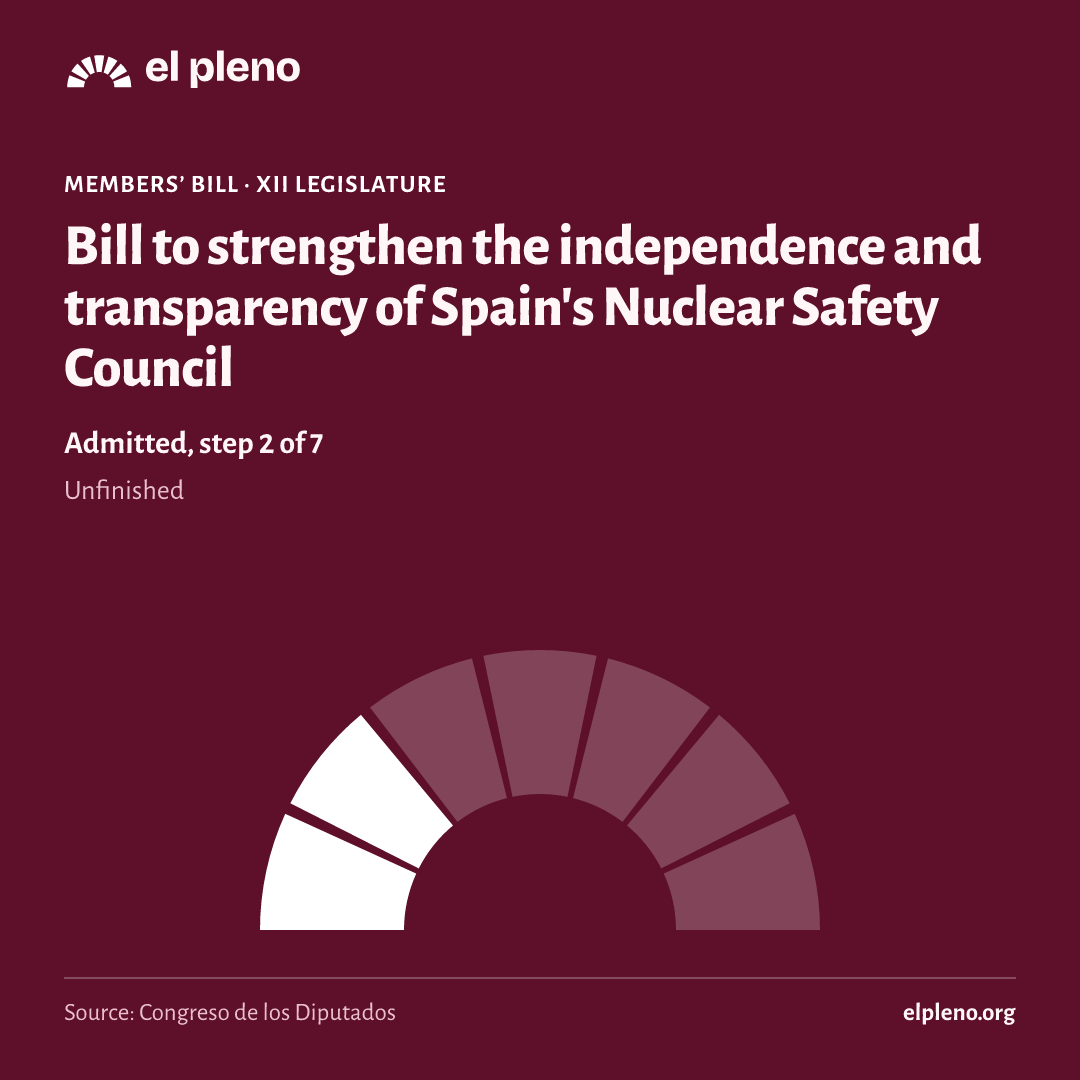
It took 2 of 7 steps. It reached Admitted, and today it is unfinished.
- Introduced14 February 2018Someone registers the text in the Congreso.
- Admitted20 February 2018The Bureau of the Congreso accepts it and, for a members’ bill, the plenary decides whether to consider it.
- Amendmentsnot reachedGroups propose changes.
- Committeenot reachedA committee goes through the text in detail.
- Plenarynot reachedAll 350 deputies vote.
- Senatenot reachedThe Senate can pass it, amend it or veto it.
- BOEnot reachedIt is published in the Official State Gazette (BOE) and comes into force.
See the 6 official steps on a timeline
Was there a plenary vote?
We have no plenary vote linked to this law in the Congreso’s data.
What happens next
What happens now?
The legislature ended before it finished. To go on, someone would have to introduce it again in the new Cortes.
It has not been presented again yet.
Sources
Where does all this come from?
- Congreso de los Diputados, file 122/000180
Official title, type, author, dates and stage.
Retrieved 11 November 2026
- The data comes from the open files of the Congreso, the Senate and the BOE, unaltered.
- Each deputy’s province is the one of their seat on the day of the vote.
- We only say “passed” or “rejected” when the majority needed is certain; otherwise we say which side had more votes.