What it is
Bill so calling unauthorized referendums would no longer be a crime
It is a members’ bill. Introduced by parliamentary groups, the Senate, regional governments or citizens. It was introduced on 9 February 2018. Introduced by: Grupo Parlamentario de Esquerra Republicana.
Official title: Private member's Organic bill amending Organic Law 10/1995, of November 23, on the Penal Code.
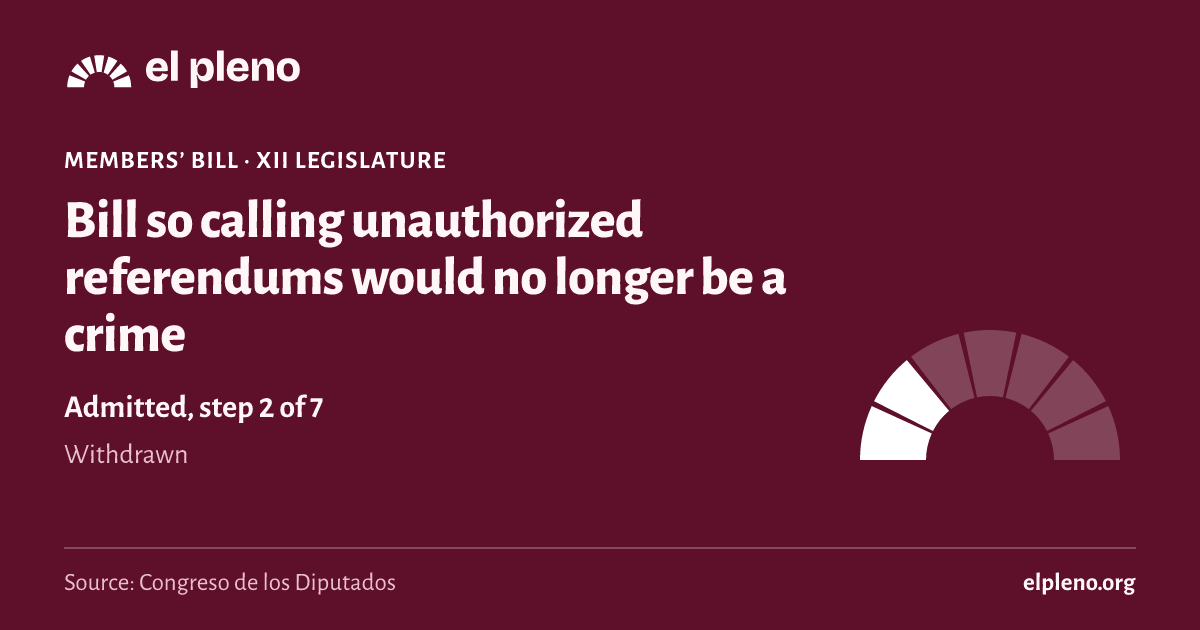
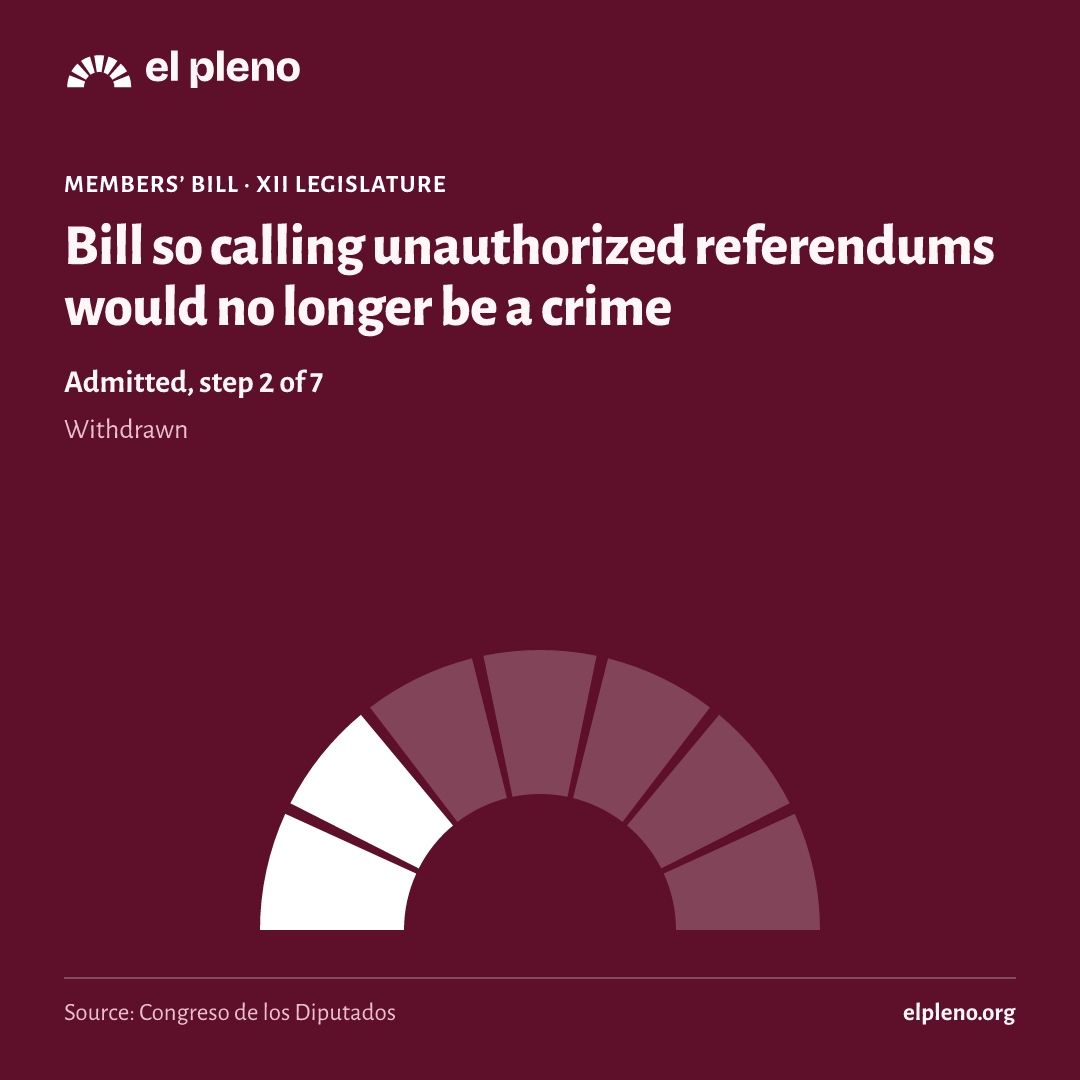
Source: Congreso de los Diputados, file 122/000178· updated 11 Nov
Automatic summary, not yet reviewed
- The bill, introduced by Esquerra Republicana, would amend the Criminal Code. It is not an approved law, only a text submitted for debate.
- It would remove section 5 of Article 472 of the Criminal Code.
- It would change the definition of the crime of sedition. The bill adds that violence against people is required, and that neither an authority calling elections or popular consultations by referendum without powers, nor those who facilitate, promote or ensure them, would be guilty of sedition.
- The explanatory statement says that declaring the independence of part of the national territory should not be a crime, and that violence against people must be used for rebellion to apply.
Who it affects
- Public authorities and officials: They would no longer be guilty of sedition for calling elections or popular consultations by referendum without having the powers to do so.
- People who facilitate, promote or ensure such processes or consultations: They would also not be considered guilty of sedition.
- Anyone charged with sedition: They would only be guilty if they use violence against people.
Words worth knowing
- Sedición (sedition)
- A crime punishing a public, tumultuous uprising, short of rebellion, to forcibly block the application of the laws or the duties of an authority.
- Rebelión (rebellion)
- A more serious crime than sedition, consisting of a violent uprising against the State.
- Proposición de Ley Orgánica (Organic Bill)
- A text proposed by members of parliament to amend a law affecting fundamental rights. Until passed, it has no legal effect.
It summarizes the text as it was introduced. It is written by artificial intelligence and may contain mistakes: the official text is what counts. Read the official text · How we make summaries
Where it stands
How far did it get?
It took 2 of 7 steps. It reached Admitted, and today it is withdrawn.
- Introduced9 February 2018Someone registers the text in the Congreso.
- Admitted13 February 2018The Bureau of the Congreso accepts it and, for a members’ bill, the plenary decides whether to consider it.
- Amendmentsnot reachedGroups propose changes.
- Committeenot reachedA committee goes through the text in detail.
- Plenarynot reachedAll 350 deputies vote.
- Senatenot reachedThe Senate can pass it, amend it or veto it.
- BOEnot reachedIt is published in the Official State Gazette (BOE) and comes into force.
See the 6 official steps on a timeline
Was there a plenary vote?
We have no plenary vote linked to this law in the Congreso’s data.
What happens next
What happens now?
Whoever introduced it withdrew it, or it was merged into another one. It goes no further.
Sources
Where does all this come from?
- Congreso de los Diputados, file 122/000178
Official title, type, author, dates and stage.
Retrieved 11 November 2026
- The data comes from the open files of the Congreso, the Senate and the BOE, unaltered.
- Each deputy’s province is the one of their seat on the day of the vote.
- We only say “passed” or “rejected” when the majority needed is certain; otherwise we say which side had more votes.