What it is
Bill to return hydroelectric plants to the State and make their profits public
It is a members’ bill. Introduced by parliamentary groups, the Senate, regional governments or citizens. It was introduced on 8 February 2018. Introduced by: Grupo Parlamentario Confederal de Unidos Podemos-En Comú Podem-En Marea.
Official title: Private member's bill on the reversal of hydroelectric dams.
Source: Congreso de los Diputados, file 122/000177· updated 11 Nov
Automatic summary, not yet reviewed
- The bill would require hydroelectric plant reversion files to be processed without delays: they must start three years before the concession ends and be resolved within one year at most. Lack of a decision would not allow the procedure to lapse.
- Once the plant is returned, the water authority would decide which public entity will run it under a special authorization. Profits would be publicly owned, and new concessions would have to follow the system operator's instructions and decarbonization requirements.
- The Ministry of Finance could transfer returned water rights free of charge to public entities for public utility or social interest purposes. If the plant does not exceed 5,000 kVA, it would go to the local municipality, county or province; otherwise, to the regional government.
- The bill proposes that public entities operating returned plants pay the economic activity tax on that operation, removing their usual exemption.
- Anyone who fails to remove or demolish the installations when their concession ends could not obtain new water use concessions, nor could companies in their corporate group.
- Reversion procedures already started and unresolved would be governed by the new law, and plants already returned would have one year to adapt. The law would take effect the day after publication, except for measures affecting the current budget year.
Who it affects
- Companies holding hydroelectric concessions: They would lose the plant when the concession ends, face fixed deadlines for reversion, and could be barred from new concessions if they fail to demolish the installations.
- Municipalities, provinces and regional governments: They could receive returned plants and their profits free of charge, and would report on reversion files.
- Residents of rural areas where the plants are located: Public profits should be used for the economic and social restoration of those territories.
- Electricity consumers: The bill aims to stop hydroelectric plants from being used to raise electricity prices.
Words worth knowing
- Reversión (reversion)
- Returning the plant installations to the State when the concession ends.
- Concesión (concession)
- A temporary permit to use a public asset, here water, in exchange for an investment.
- Salto hidroeléctrico (hydroelectric plant)
- A set of installations that use falling water to generate electricity.
- Caudal ecológico (ecological flow)
- The amount of water that must remain in the river to preserve its natural life.
- Consignas del operador del sistema (system operator instructions)
- Technical orders given by the power grid manager to plants to keep the system balanced.
It summarizes the text as it was introduced. It is written by artificial intelligence and may contain mistakes: the official text is what counts. Read the official text · How we make summaries
Where it stands
How far did it get?
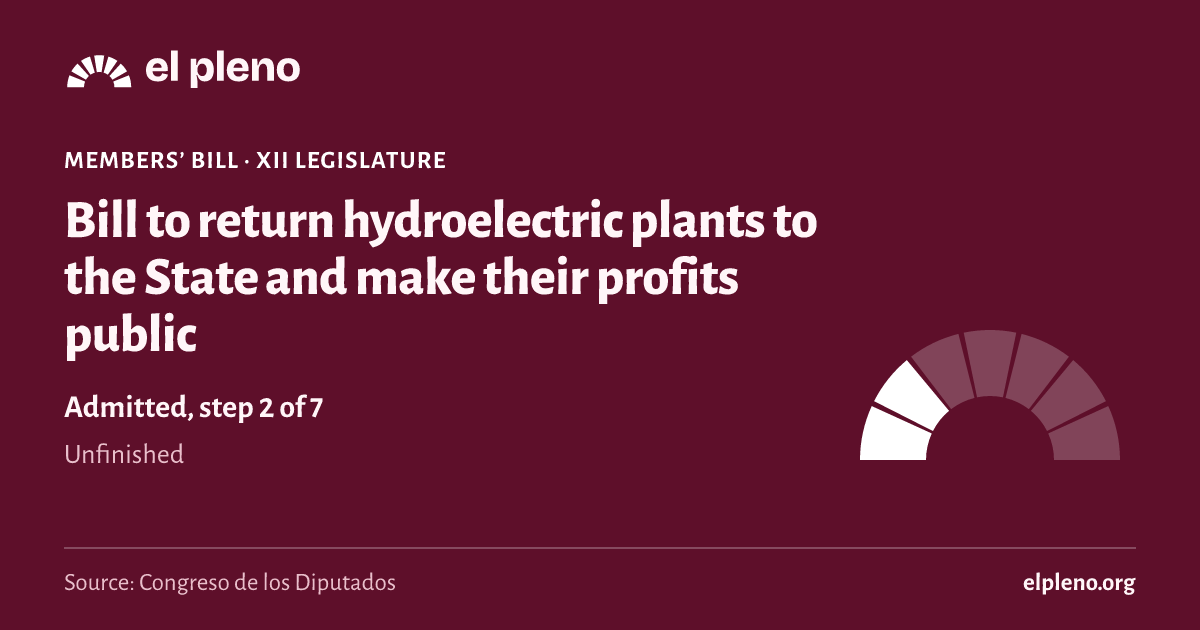
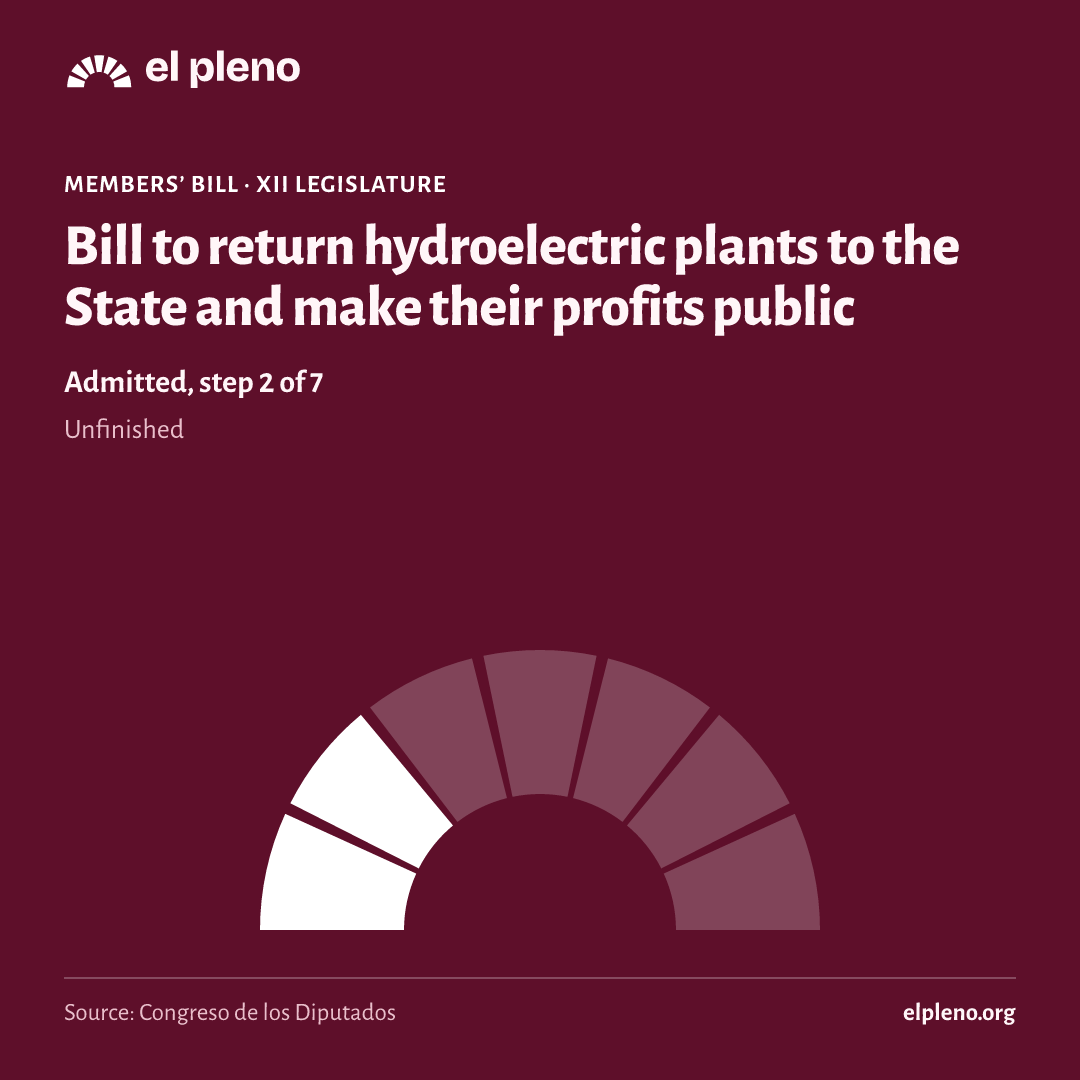
It took 2 of 7 steps. It reached Admitted, and today it is unfinished.
- Introduced8 February 2018Someone registers the text in the Congreso.
- Admitted13 February 2018The Bureau of the Congreso accepts it and, for a members’ bill, the plenary decides whether to consider it.
- Amendmentsnot reachedGroups propose changes.
- Committeenot reachedA committee goes through the text in detail.
- Plenarynot reachedAll 350 deputies vote.
- Senatenot reachedThe Senate can pass it, amend it or veto it.
- BOEnot reachedIt is published in the Official State Gazette (BOE) and comes into force.
See the 6 official steps on a timeline
Was there a plenary vote?
We have no plenary vote linked to this law in the Congreso’s data.
What happens next
What happens now?
The legislature ended before it finished. To go on, someone would have to introduce it again in the new Cortes.
It was presented again:
- XIII Legislature, Congreso de los Diputados· Unfinished Bill to return hydroelectric plants to the State
Sources
Where does all this come from?
- Congreso de los Diputados, file 122/000177
Official title, type, author, dates and stage.
Retrieved 11 November 2026
- The data comes from the open files of the Congreso, the Senate and the BOE, unaltered.
- Each deputy’s province is the one of their seat on the day of the vote.
- We only say “passed” or “rejected” when the majority needed is certain; otherwise we say which side had more votes.