What it is
Bill to stop evictions, make rent affordable and secure basic utilities
It is a members’ bill. Introduced by parliamentary groups, the Senate, regional governments or citizens. It was introduced on 30 January 2018. Introduced by: Grupo Parlamentario Confederal de Unidos Podemos-En Comú Podem-En Marea Grupo Parlamentario Mixto.
Official title: Private member's bill for a housing emergency law for vulnerable families in the housing field and energy poverty.
Source: Congreso de los Diputados, file 122/000172· updated 11 Nov
Automatic summary, not yet reviewed
- The bill would suspend evictions for a year from the main home when the person is at risk of residential exclusion and the claimant is a large-scale housing owner, and would require judges to weigh proportionality before ordering any eviction.
- Large-scale owners would have to offer social housing rent before suing, with contracts of at least five years and payments capped at 10%, 12% or 18% of income depending on income level. Failing to do so would be a serious offense with fines of 100,000 to 500,000 euros.
- Mortgage liability would be limited to the property itself: after handing over the home or its auction, the remaining debt would be considered fully settled, and the main home of guarantors could not be seized.
- For rentals, the bill would extend mandatory contract renewals to five or ten years depending on the landlord, tie prices to a reference index published by the National Statistics Institute, limit rent increases on renewals, and cap the deposit at one month.
- To expand public housing, it would require mandatory transfer of empty homes from large-scale owners (20 years) and private owners (10 years), a surcharge on property tax for empty homes, and a ban on selling the public housing stock.
- On utilities, access to water, gas and electricity would be guaranteed for households in residential exclusion, shutting off supply to vulnerable homes would be banned, a minimum vital consumption would be created, and non-compliant companies could be fined.
Who it affects
- Families at risk of residential eviction who cannot pay rent or their mortgage.: They would get an eviction moratorium, a social rent offer, guaranteed rehousing and, in some cases, debt cancellation.
- Large-scale housing owners: banks, investment funds, and anyone owning 5 apartments or more than 800 square meters.: They would have to offer social rent, hand over empty homes, and face fines if they fail to comply.
- Tenants of their main home.: They would get longer contracts, capped deposits, indexed prices and limits on rent increases.
- Guarantors and co-signers on mortgages.: Their main home could not be seized.
- Households struggling to pay water, electricity and gas.: Their supply would be guaranteed, with a social tariff and a minimum vital consumption, with no shut-offs.
Words worth knowing
- IPREM
- A yearly income indicator set by the Spanish State, used to calculate benefits and poverty thresholds.
- Dación en pago (handing over the property in payment)
- Giving the home to the bank in exchange for canceling the mortgage debt.
- Gran tenedor de viviendas (large-scale housing owner)
- Banks, investment funds, or individuals owning 5 apartments or more than 800 square meters, as defined by the bill itself.
- Lanzamiento (eviction order)
- A judicial or out-of-court order to remove a person from their home.
- Consumo Mínimo Vital (minimum vital consumption)
- A basic amount of water, electricity and gas every household would be guaranteed even if unable to pay.
It summarizes the text as it was introduced. It is written by artificial intelligence and may contain mistakes: the official text is what counts. Read the official text · How we make summaries
Where it stands
How far did it get?
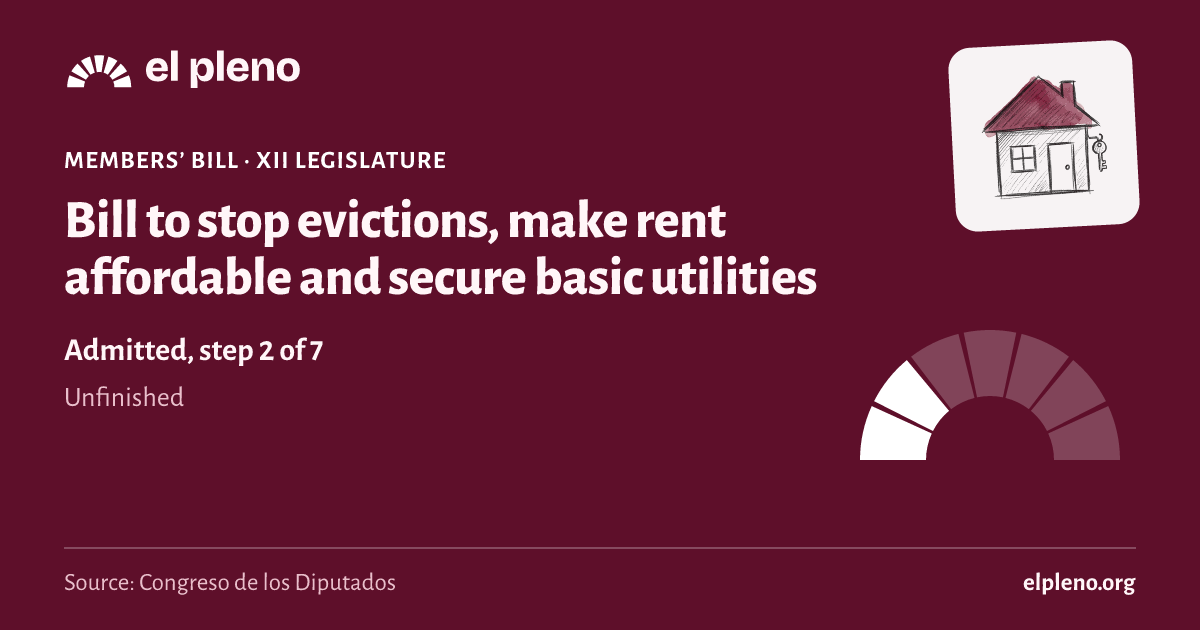
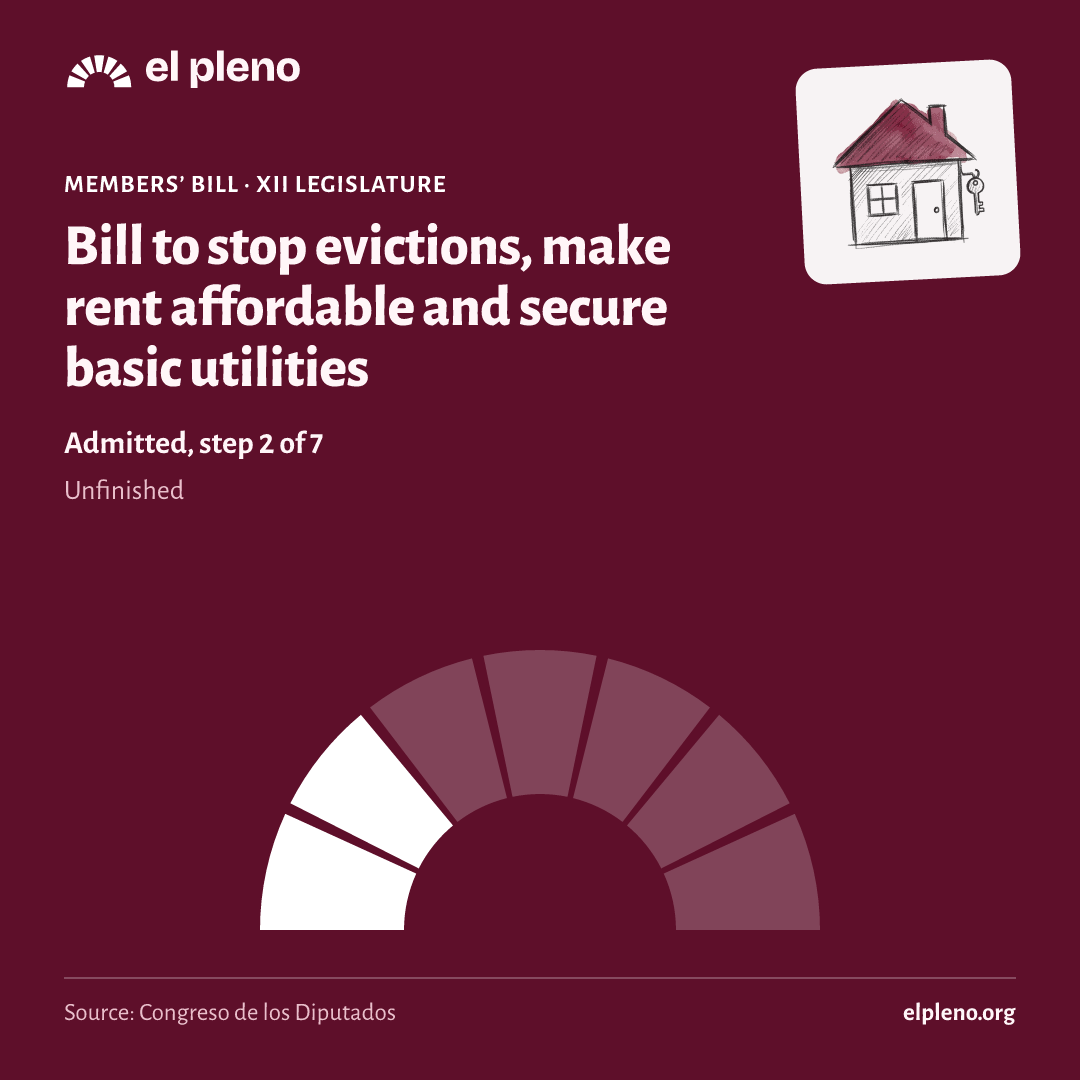
It took 2 of 7 steps. It reached Admitted, and today it is unfinished.
- Introduced30 January 2018Someone registers the text in the Congreso.
- Admitted6 February 2018The Bureau of the Congreso accepts it and, for a members’ bill, the plenary decides whether to consider it.
- Amendmentsnot reachedGroups propose changes.
- Committeenot reachedA committee goes through the text in detail.
- Plenarynot reachedAll 350 deputies vote.
- Senatenot reachedThe Senate can pass it, amend it or veto it.
- BOEnot reachedIt is published in the Official State Gazette (BOE) and comes into force.
See the 6 official steps on a timeline
Was there a plenary vote?
We have no plenary vote linked to this law in the Congreso’s data.
What happens next
What happens now?
The legislature ended before it finished. To go on, someone would have to introduce it again in the new Cortes.
It has not been presented again yet.
Sources
Where does all this come from?
- Congreso de los Diputados, file 122/000172
Official title, type, author, dates and stage.
Retrieved 11 November 2026
- The data comes from the open files of the Congreso, the Senate and the BOE, unaltered.
- Each deputy’s province is the one of their seat on the day of the vote.
- We only say “passed” or “rejected” when the majority needed is certain; otherwise we say which side had more votes.