What it is
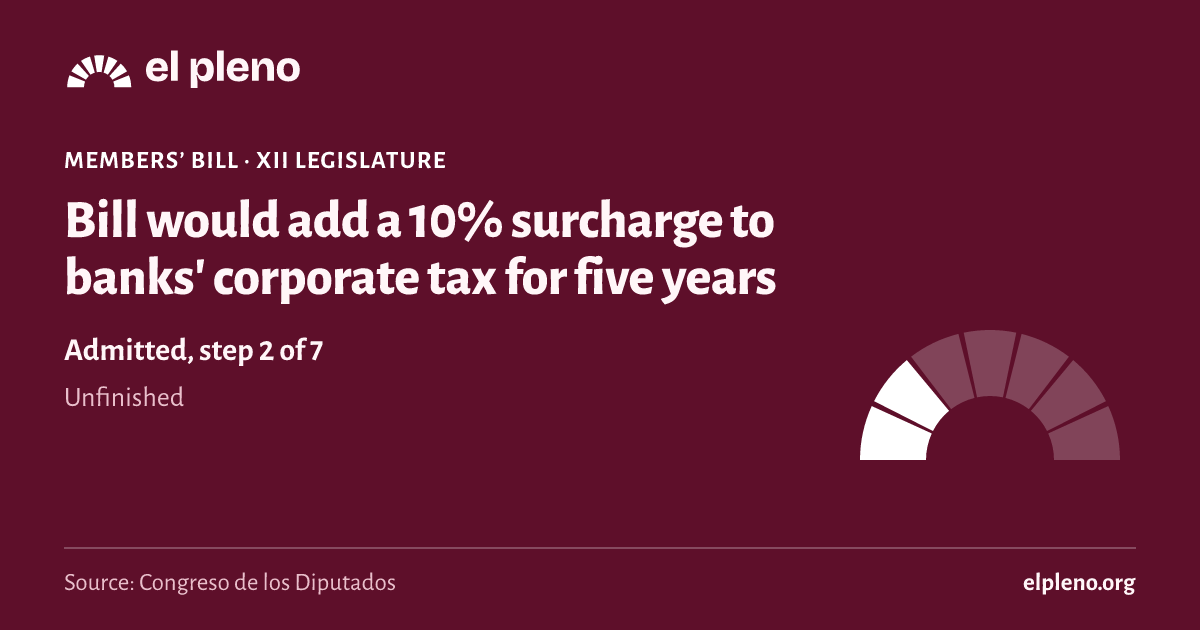
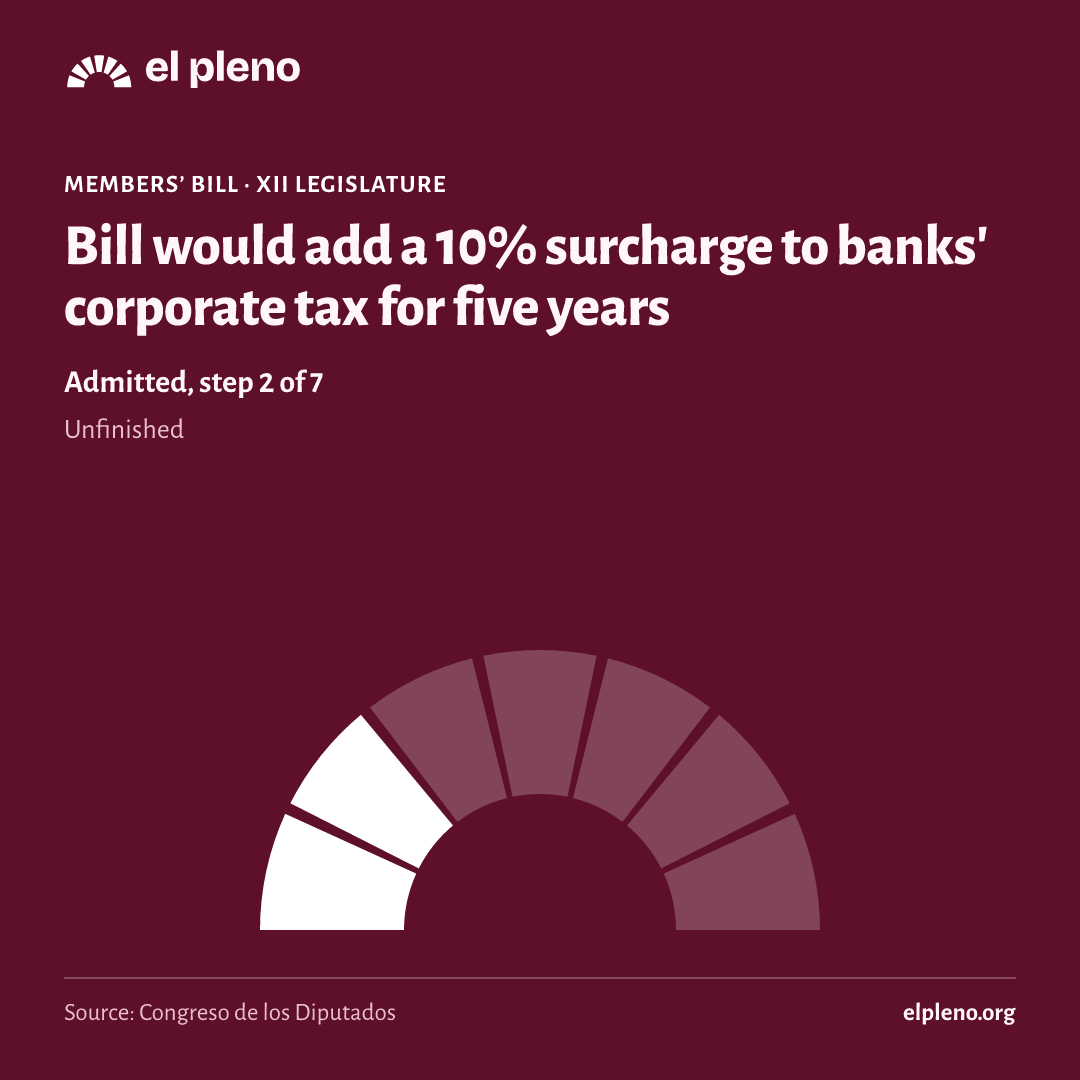
Bill would add a 10% surcharge to banks' corporate tax for five years
It is a members’ bill. Introduced by parliamentary groups, the Senate, regional governments or citizens. It was introduced on 19 January 2018. Introduced by: Grupo Parlamentario Confederal de Unidos Podemos-En Comú Podem-En Marea.
Official title: Private member's bill for the establishment of a solidarity surcharge on credit institutions.
Source: Congreso de los Diputados, file 122/000167· updated 11 Nov
Automatic summary, not yet reviewed
- The bill would raise the corporate income tax The personal income tax (IRPF in Spain): what people pay on what they earn from work, business or savings. rate for credit institutions by 10 percentage points, for tax periods starting in 2018.
- The surcharge would last five years and could be extended afterward for similar periods.
- The tax would take effect the day after its publication in the Official State Gazette (Boletín Oficial del Estado).
- The bill is justified by public aid to the banking sector during the crisis, which the text puts at more than €60,000 million unrecoverable, and by banks' low effective tax rates in 2015 and 2016.
Words worth knowing
- Impuesto de Sociedades
- Corporate income tax, the tax companies pay on their profits.
- Entidades de crédito
- Credit institutions: companies that can take deposits from the public and grant loans, such as banks.
- Esquemas de Protección de Activos (EPAs)
- Asset protection schemes: public guarantees covering potential losses for banks that bought intervened entities.
- FROB
- Fund for the Restructuring of the Banking Sector (Fondo de Reestructuración Bancaria), the public body that managed bank bailouts.
- income tax
- The personal income tax (IRPF in Spain): what people pay on what they earn from work, business or savings.
It summarizes the text as it was introduced. It is written by artificial intelligence and may contain mistakes: the official text is what counts. Read the official text · How we make summaries
Where it stands
How far did it get?
It took 2 of 7 steps. It reached Admitted, and today it is unfinished.
- Introduced19 January 2018Someone registers the text in the Congreso.
- Admitted30 January 2018The Bureau of the Congreso accepts it and, for a members’ bill, the plenary decides whether to consider it.
- Amendmentsnot reachedGroups propose changes.
- Committeenot reachedA committee goes through the text in detail.
- Plenarynot reachedAll 350 deputies vote.
- Senatenot reachedThe Senate can pass it, amend it or veto it.
- BOEnot reachedIt is published in the Official State Gazette (BOE) and comes into force.
See the 6 official steps on a timeline
Was there a plenary vote?
We have no plenary vote linked to this law in the Congreso’s data.
What happens next
What happens now?
The legislature ended before it finished. To go on, someone would have to introduce it again in the new Cortes.
It has not been presented again yet.
Sources
Where does all this come from?
- Congreso de los Diputados, file 122/000167
Official title, type, author, dates and stage.
Retrieved 11 November 2026
- The data comes from the open files of the Congreso, the Senate and the BOE, unaltered.
- Each deputy’s province is the one of their seat on the day of the vote.
- We only say “passed” or “rejected” when the majority needed is certain; otherwise we say which side had more votes.