What it is
Bill would remove the special music publishing contract from the law
It is a members’ bill. Introduced by parliamentary groups, the Senate, regional governments or citizens. It was introduced on 18 January 2018. Introduced by: Grupo Parlamentario Confederal de Unidos Podemos-En Comú Podem-En Marea.
Official title: Private member's bill to repeal Article 71 of Royal Legislative Decree 1/1996, of April 12, approving the consolidated text of the Intellectual Property Law.
Source: Congreso de los Diputados, file 122/000166· updated 11 Nov
Automatic summary, not yet reviewed
- The bill would repeal Article 71 of the Intellectual Property Law, which regulates a special contract for publishing musical and dramatic-musical works.
- According to the explanatory statement, under this contract the music publisher can collect up to 50% of the royalties generated by the music without working directly on its exploitation, which harms the authors.
- The text also criticizes that these contracts can last forever, because Article 71 removes from musicians the normal guarantees for terminating or ending a publishing contract.
- If passed, the law would take effect the day after its publication in the Official State Gazette, except for measures that increase spending or reduce budget revenues, which would wait until the following fiscal year.
Who it affects
- Music authors: Could keep all their royalties and end their contracts on the same terms as other authors.
- Music publishers: Would lose the special regime that lets them collect up to 50% of exploitation royalties.
- Heirs of authors: Would no longer be bound by royalty assignments made in perpetuity.
Words worth knowing
- Derogación (repeal)
- Removing or canceling a rule that was in force.
- Contrato de edición (publishing contract)
- A contract where an author gives a publisher the right to exploit the work, usually in exchange for a share of the income.
- Derechos de comunicación pública (public communication rights)
- The right to get paid when the work is broadcast or played publicly, for example on radio, TV, the internet or in venues.
- Entidad de gestión (collecting society)
- An organization that collects royalties from people who use the works and pays the authors, such as SGAE.
- Texto refundido (consolidated text)
- A single, organized version of a law that gathers and updates earlier rules.
It summarizes the text as it was introduced. It is written by artificial intelligence and may contain mistakes: the official text is what counts. Read the official text · How we make summaries
Where it stands
How far did it get?
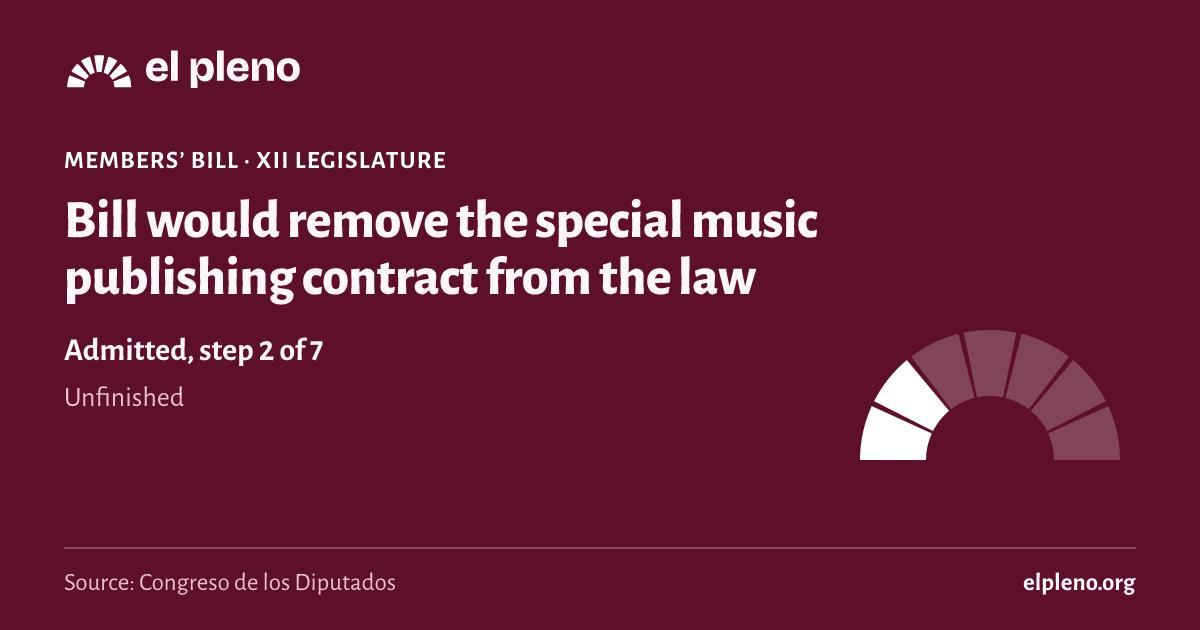
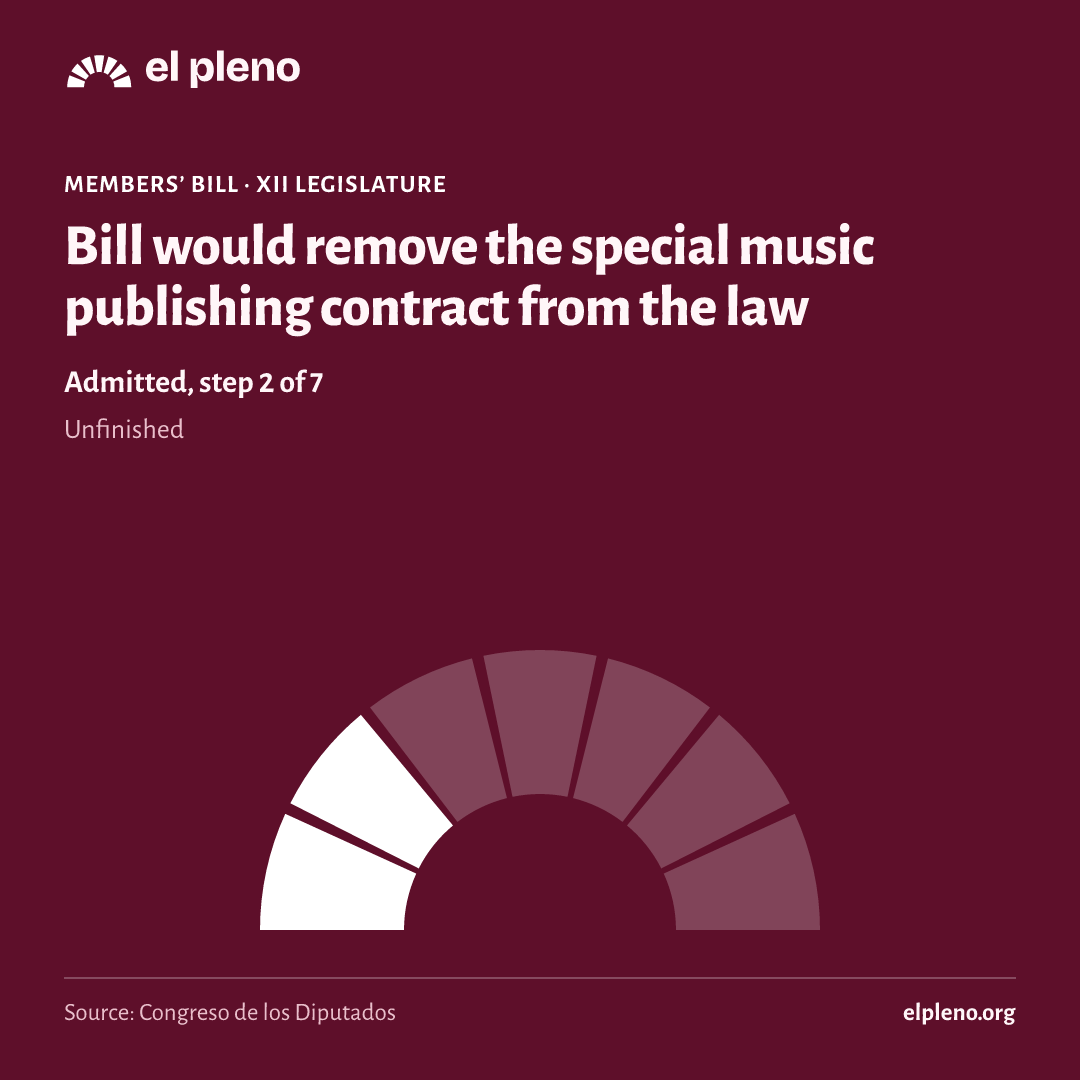
It took 2 of 7 steps. It reached Admitted, and today it is unfinished.
- Introduced18 January 2018Someone registers the text in the Congreso.
- Admitted30 January 2018The Bureau of the Congreso accepts it and, for a members’ bill, the plenary decides whether to consider it.
- Amendmentsnot reachedGroups propose changes.
- Committeenot reachedA committee goes through the text in detail.
- Plenarynot reachedAll 350 deputies vote.
- Senatenot reachedThe Senate can pass it, amend it or veto it.
- BOEnot reachedIt is published in the Official State Gazette (BOE) and comes into force.
See the 6 official steps on a timeline
Was there a plenary vote?
We have no plenary vote linked to this law in the Congreso’s data.
What happens next
What happens now?
The legislature ended before it finished. To go on, someone would have to introduce it again in the new Cortes.
It has not been presented again yet.
Sources
Where does all this come from?
- Congreso de los Diputados, file 122/000166
Official title, type, author, dates and stage.
Retrieved 11 November 2026
- The data comes from the open files of the Congreso, the Senate and the BOE, unaltered.
- Each deputy’s province is the one of their seat on the day of the vote.
- We only say “passed” or “rejected” when the majority needed is certain; otherwise we say which side had more votes.