What it is
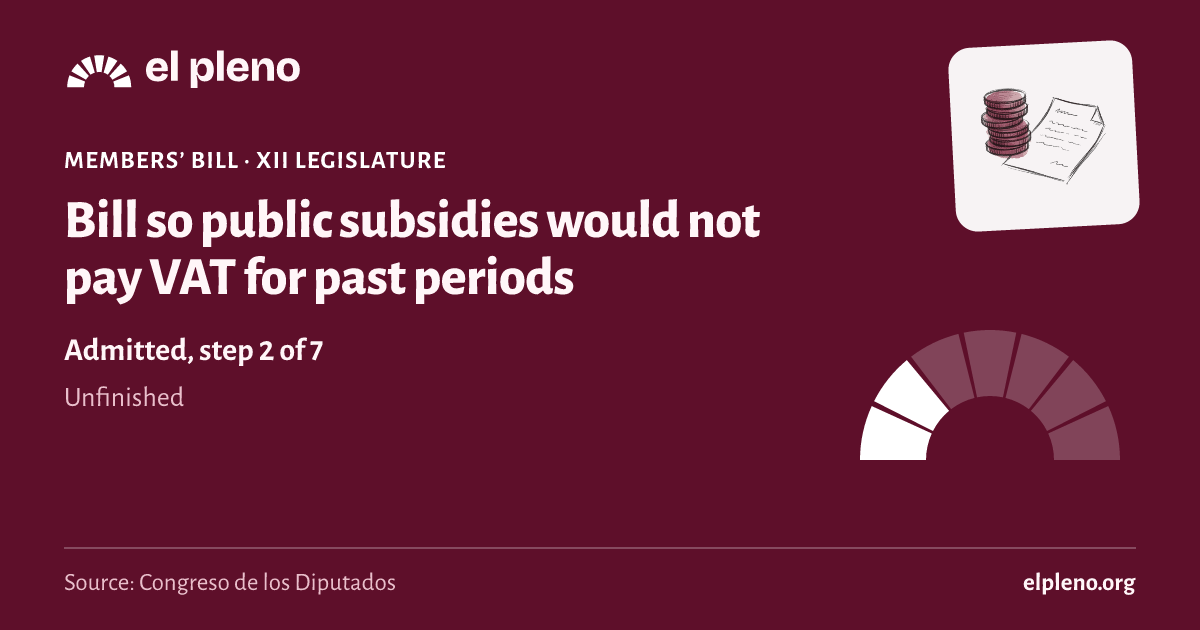
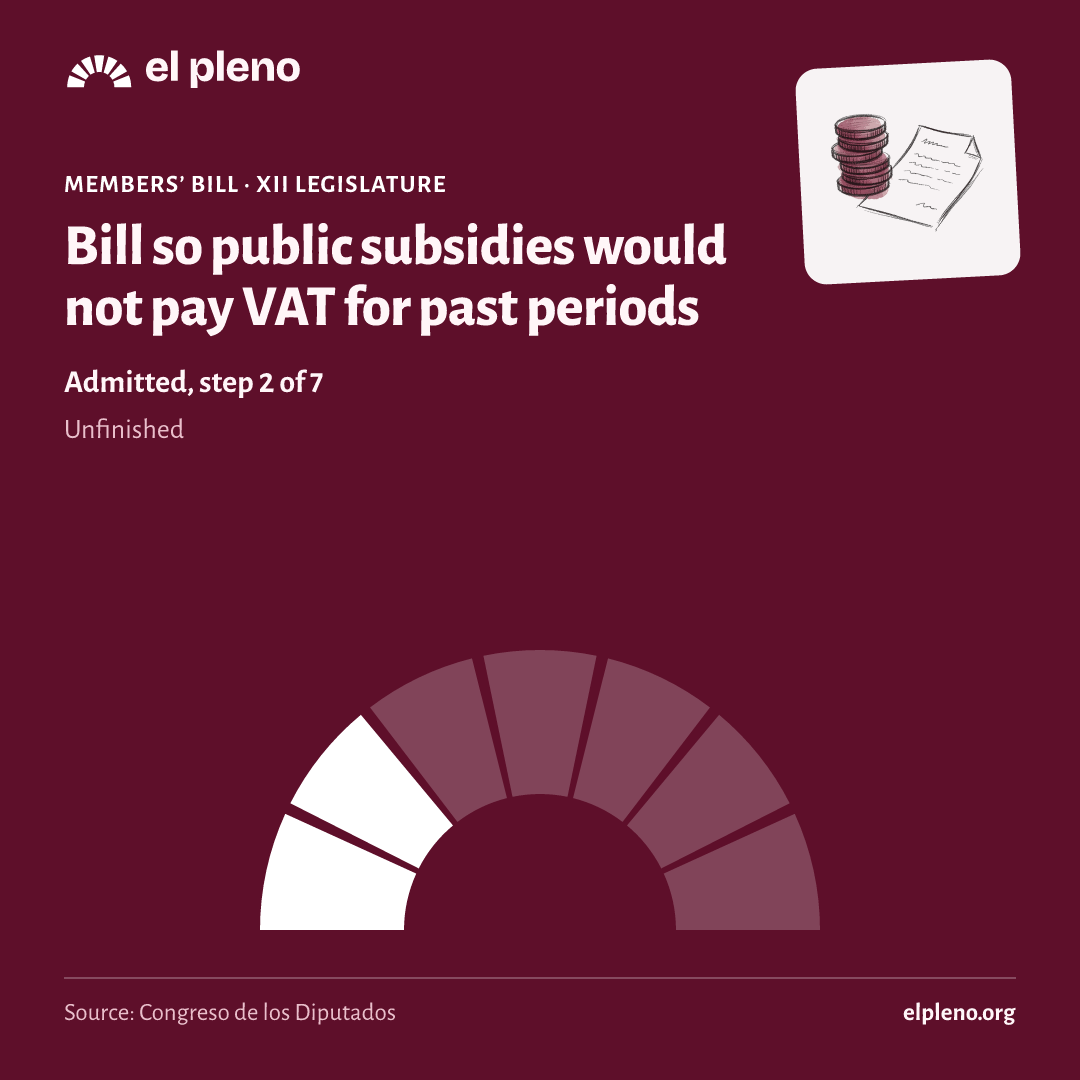
Bill so public subsidies would not pay VAT for past periods
It is a members’ bill. Introduced by parliamentary groups, the Senate, regional governments or citizens. It was introduced on 10 January 2018. Introduced by: Grupo Parlamentario Confederal de Unidos Podemos-En Comú Podem-En Marea.
Official title: Private member's bill on the treatment of Value Added Tax (VAT) in public grants.
Source: Congreso de los Diputados, file 122/000163· updated 11 Nov
Automatic summary, not yet reviewed
- The bill would make the clarification of the concept of a price-linked subsidy, made by Law 9/2017, apply to all non-prescribed tax periods, not only from its entry into force.
- The reason is that this concept comes from European Union law, which prevails over Spanish law, so the Tax Agency cannot limit its application to the date of the reform.
- The goal is to end tax claims against cultural entities, public transport, regional public TV channels and research centers that receive public subsidies.
- The law would enter into force the day after its publication in the Official State Gazette and would repeal any provisions that conflict with it.
Who it affects
- Cultural entities and facilities receiving public subsidies: They would no longer face VAT claims on those subsidies for non-prescribed periods.
- Public transportation services: Public contributions funding the service would not bear VAT for past periods.
- Regional and local public television channels: Their public subsidies would fall outside the VAT base for non-prescribed periods.
- R&D centers funded with public money: VAT claims on their funding would be avoided.
- Public administrations: Tax disputes and disruption to their funding would be reduced.
Words worth knowing
- Subvención vinculada al precio (price-linked subsidy)
- A public subsidy given in exchange for offering a service at a lower price; under European Union law, it may have to pay VAT.
- Periodos impositivos no prescritos (non-prescribed tax periods)
- Past tax years in which the Tax Agency can still review or claim taxes.
- Doctrina tributaria (tax doctrine)
- The criterion the Tax Agency uses to interpret tax laws.
- Base imponible (tax base)
- The amount on which a tax is calculated.
- Proposición de ley (bill)
- A text proposing a law that still must be debated and passed by Congress; it is not in force.
It summarizes the text as it was introduced. It is written by artificial intelligence and may contain mistakes: the official text is what counts. Read the official text · How we make summaries
Where it stands
How far did it get?
It took 2 of 7 steps. It reached Admitted, and today it is unfinished.
- Introduced10 January 2018Someone registers the text in the Congreso.
- Admitted30 January 2018The Bureau of the Congreso accepts it and, for a members’ bill, the plenary decides whether to consider it.
- Amendmentsnot reachedGroups propose changes.
- Committeenot reachedA committee goes through the text in detail.
- Plenarynot reachedAll 350 deputies vote.
- Senatenot reachedThe Senate can pass it, amend it or veto it.
- BOEnot reachedIt is published in the Official State Gazette (BOE) and comes into force.
See the 6 official steps on a timeline
Was there a plenary vote?
We have no plenary vote linked to this law in the Congreso’s data.
What happens next
What happens now?
The legislature ended before it finished. To go on, someone would have to introduce it again in the new Cortes.
It has not been presented again yet.
Sources
Where does all this come from?
- Congreso de los Diputados, file 122/000163
Official title, type, author, dates and stage.
Retrieved 11 November 2026
- The data comes from the open files of the Congreso, the Senate and the BOE, unaltered.
- Each deputy’s province is the one of their seat on the day of the vote.
- We only say “passed” or “rejected” when the majority needed is certain; otherwise we say which side had more votes.