What it is
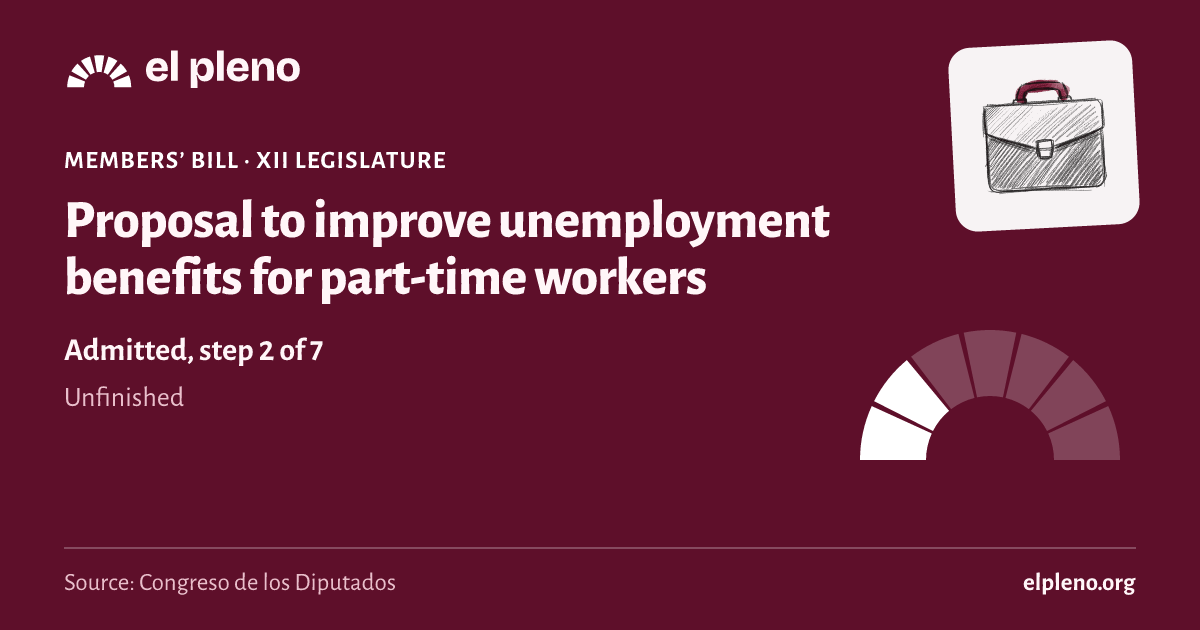
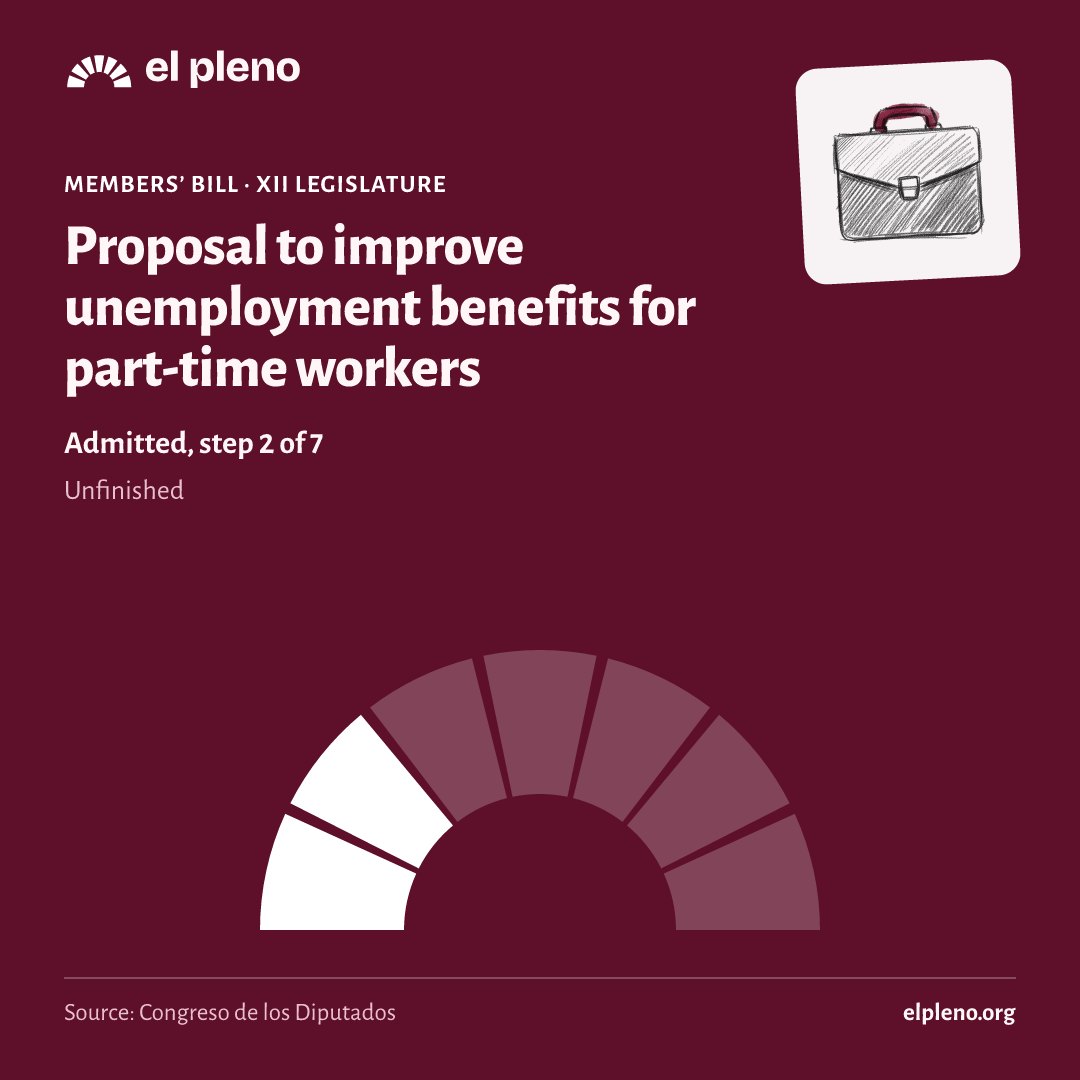
Proposal to improve unemployment benefits for part-time workers
It is a members’ bill. Introduced by parliamentary groups, the Senate, regional governments or citizens. It was introduced on 2 January 2018. Introduced by: Grupo Parlamentario Confederal de Unidos Podemos-En Comú Podem-En Marea.
Official title: Private member's bill on access to and duration of unemployment benefits in part-time work.
Source: Congreso de los Diputados, file 122/000161· updated 11 Nov
Automatic summary, not yet reviewed
- The bill responds to several rulings by European and Spanish Constitutional courts that found the current way of calculating unemployment benefits for part-time workers discriminatory, because it mostly harms women, who make up most part-time workers.
- The bill would rewrite Article 269.2 of the General Social Security Law: to qualify for unemployment benefits, all days registered with Social Security would count, even days without actual work, regardless of how working hours are distributed.
- It would repeal Article 3.4 of Royal Decree 625/1985, the rule that allowed counting only the days actually worked when calculating the length of unemployment benefits.
- The Government would have two months from the law's entry into force to issue the rules needed to apply it.
- The law would take effect the day after its publication in the official state gazette (BOE), except for measures that increase spending or reduce budget revenue, which would wait until the next fiscal year.
Who it affects
- Part-time workers: Would need fewer days worked to qualify and would receive benefits for longer.
- Permanent seasonal workers (fijos discontinuos): The same counting rule would apply to them, counting registered days even without actual work.
- Women, the majority of vertical part-time workers: The text says the current rule harms them disproportionately, and the bill seeks to remove that discrimination.
- Government and the State Public Employment Service: Would have to develop the law within two months and apply the new counting system.
Words worth knowing
- Prestación por desempleo
- Money the State pays to people who are unemployed, known as unemployment benefits.
- Carencia
- The minimum contribution period required to qualify for a benefit.
- Tiempo parcial vertical
- Someone who works only certain days of the week or month, even if they work the same total hours as another part-time worker.
- Base reguladora
- The reference amount used to calculate how much a benefit pays.
- Proposición de ley
- A bill introduced by a group of members of Congress; it is not an approved law.
It summarizes the text as it was introduced. It is written by artificial intelligence and may contain mistakes: the official text is what counts. Read the official text · How we make summaries
Where it stands
How far did it get?
It took 2 of 7 steps. It reached Admitted, and today it is unfinished.
- Introduced2 January 2018Someone registers the text in the Congreso.
- Admitted9 January 2018The Bureau of the Congreso accepts it and, for a members’ bill, the plenary decides whether to consider it.
- Amendmentsnot reachedGroups propose changes.
- Committeenot reachedA committee goes through the text in detail.
- Plenarynot reachedAll 350 deputies vote.
- Senatenot reachedThe Senate can pass it, amend it or veto it.
- BOEnot reachedIt is published in the Official State Gazette (BOE) and comes into force.
See the 6 official steps on a timeline
Was there a plenary vote?
We have no plenary vote linked to this law in the Congreso’s data.
What happens next
What happens now?
The legislature ended before it finished. To go on, someone would have to introduce it again in the new Cortes.
It has not been presented again yet.
Sources
Where does all this come from?
- Congreso de los Diputados, file 122/000161
Official title, type, author, dates and stage.
Retrieved 11 November 2026
- The data comes from the open files of the Congreso, the Senate and the BOE, unaltered.
- Each deputy’s province is the one of their seat on the day of the vote.
- We only say “passed” or “rejected” when the majority needed is certain; otherwise we say which side had more votes.