What it is
Bill to expand Spain's historical memory law and repair victims
It is a members’ bill. Introduced by parliamentary groups, the Senate, regional governments or citizens. It was introduced on 14 December 2017. Introduced by: Grupo Parlamentario Socialista.
Official title: Private member's bill amending Act 52/2007, of 26 December, recognizing and expanding rights and establishing measures in favor of those who suffered persecution or violence during the civil war and the dictatorship.
Source: Congreso de los Diputados, file 122/000157· updated 11 Nov
Automatic summary, not yet reviewed
- The bill would declare null and void, from the outset, the convictions and sanctions imposed for political, ideological or religious reasons during the Civil War and the dictatorship, as well as the courts that issued them.
- It would create a Truth Commission, with eleven members appointed by Congress and other institutions, to investigate human rights violations of the period and produce a final report binding on public authorities.
- The search for disappeared persons would become the responsibility of the State and of criminal courts, which would open investigations on their own initiative to locate, exhume and identify remains, supported by a new Directorate General and four-year search plans.
- A National DNA Bank would be created to identify the disappeared and stolen children, with free sample collection for victims.
- It provides for compensation: for people whose property was seized or who were fined between 1936 and 1945, and for the relatives of those who died defending democracy between 1968 and 1978, in the amount of €135,000.
- It strengthens the removal of Francoist symbols: local councils would have to remove them from streets and cemeteries, the Catholic Church would be asked to do the same in its churches, and the Valley of the Fallen would become a memory center, with Franco's remains moved out of the site.
- The bill sets up a sanctioning regime with fines from €200 to €150,000 for violations, and adds criminal offenses to punish glorifying Francoism and blocking the law by authorities and public officials.
- October 31 would be declared a day of remembrance and tribute to the victims, coinciding with the approval of the Constitution in 1978, and a public act in Congress is planned to ask forgiveness of Francoism's victims.
Words worth knowing
- Nulidad de pleno derecho (nullity from the outset)
- A ruling or rule is treated as if it never existed, without needing a judge to annul it.
- Comisión de la Verdad (Truth Commission)
- A temporary, non-judicial body that investigates past human rights violations and issues a report with recommendations.
- Justicia restaurativa (restorative justice)
- An approach to justice focused on repairing the harm to victims, not only on punishing the offender.
- Delito permanente (continuing offense)
- An offense whose effects continue until the situation ends, such as forced disappearance while the person is still missing.
- Exhumación (exhumation)
- Legally digging up a buried body, for example to identify it.
It summarizes the text as it was introduced. It is written by artificial intelligence and may contain mistakes: the official text is what counts. Read the official text · How we make summaries
Where it stands
How far did it get?
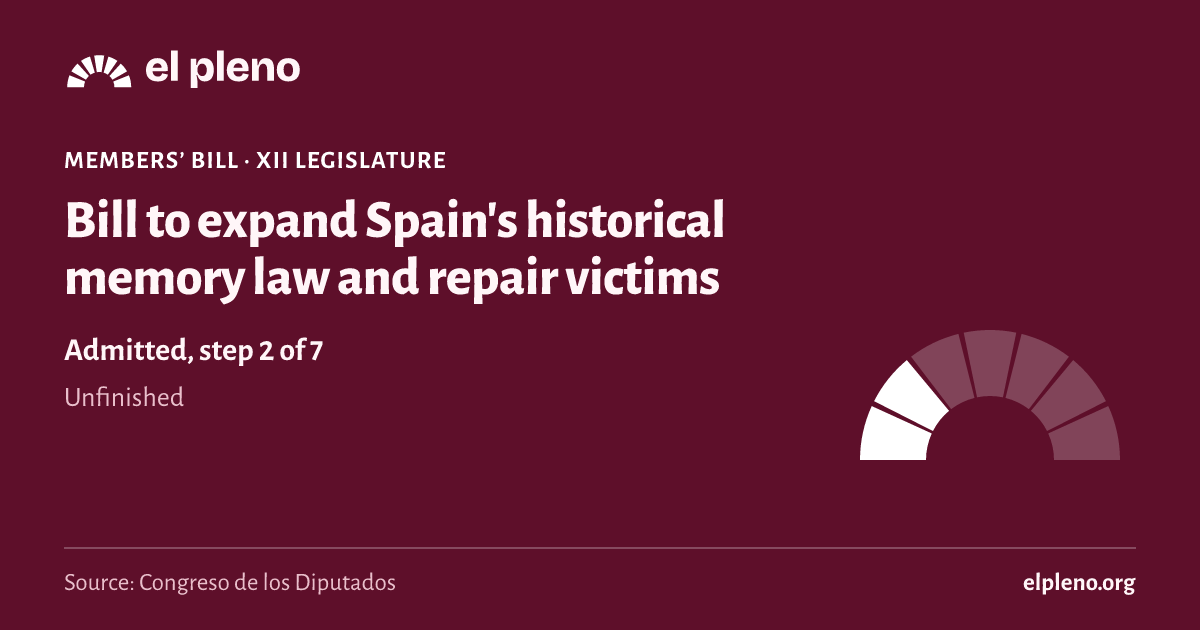
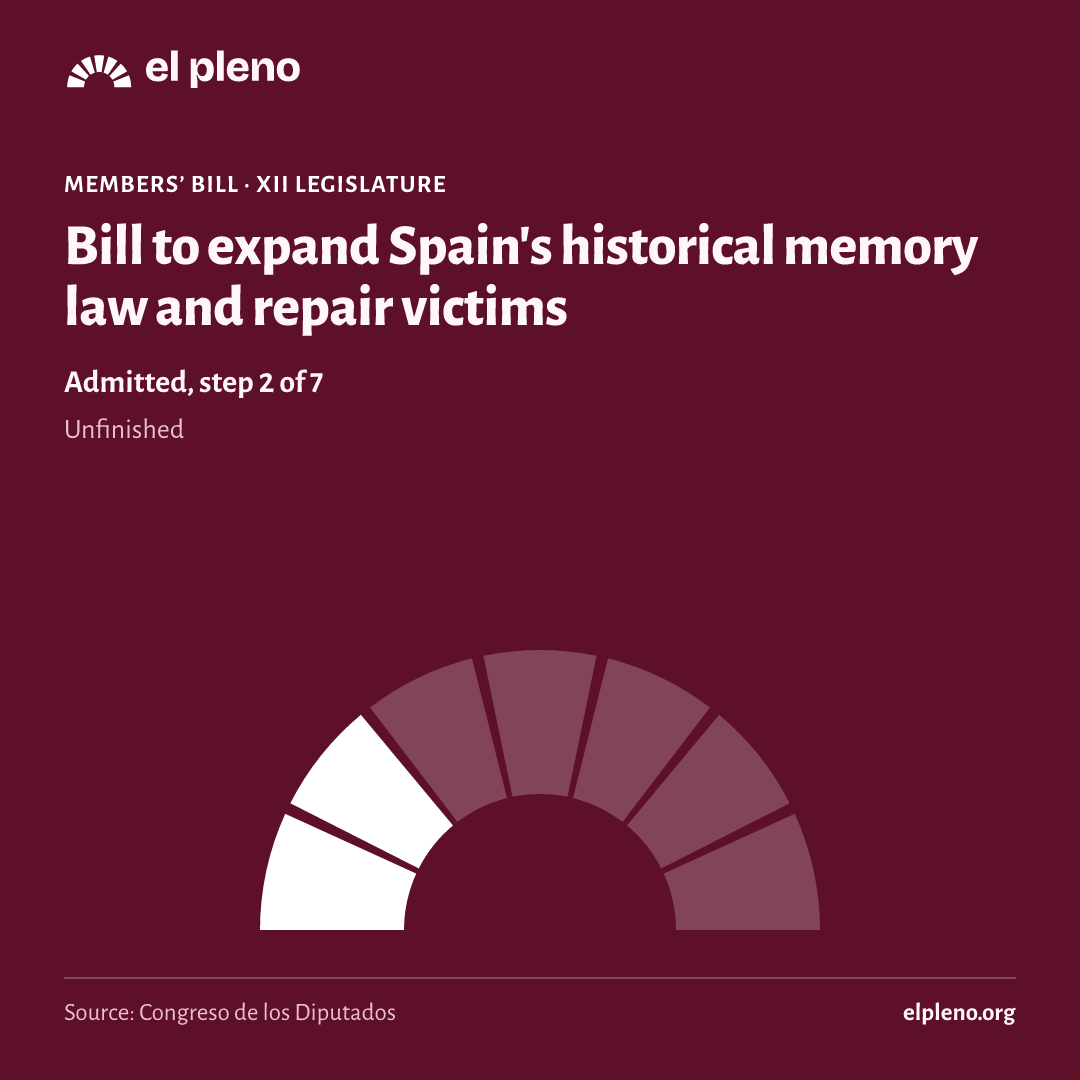
It took 2 of 7 steps. It reached Admitted, and today it is unfinished.
- Introduced14 December 2017Someone registers the text in the Congreso.
- Admitted19 December 2017The Bureau of the Congreso accepts it and, for a members’ bill, the plenary decides whether to consider it.
- Amendmentsnot reachedGroups propose changes.
- Committeenot reachedA committee goes through the text in detail.
- Plenarynot reachedAll 350 deputies vote.
- Senatenot reachedThe Senate can pass it, amend it or veto it.
- BOEnot reachedIt is published in the Official State Gazette (BOE) and comes into force.
See the 5 official steps on a timeline
Was there a plenary vote?
We have no plenary vote linked to this law in the Congreso’s data.
What happens next
What happens now?
The legislature ended before it finished. To go on, someone would have to introduce it again in the new Cortes.
It has not been presented again yet.
Sources
Where does all this come from?
- Congreso de los Diputados, file 122/000157
Official title, type, author, dates and stage.
Retrieved 11 November 2026
- The data comes from the open files of the Congreso, the Senate and the BOE, unaltered.
- Each deputy’s province is the one of their seat on the day of the vote.
- We only say “passed” or “rejected” when the majority needed is certain; otherwise we say which side had more votes.