What it is
State fund to pay for universal accessibility improvements
It is a members’ bill. Introduced by parliamentary groups, the Senate, regional governments or citizens. It was introduced on 5 December 2017. Introduced by: Grupo Parlamentario Confederal de Unidos Podemos-En Comú Podem-En Marea.
Official title: Private member's bill on the creation of a State Fund for the effective and real achievement of Universal Accessibility.
Source: Congreso de los Diputados, file 122/000154· updated 11 Nov
Automatic summary, not yet reviewed
- The bill would create a State Fund for Universal Accessibility, attached to the Ministry of Health, Social Services and Equality and managed together with the autonomous communities.
- The Fund would finance projects that make environments, products and services accessible, so that people with functional diversity can exercise their rights.
- The Fund would be fed by money from the State Budget and by 1% of the budget of each public works, service or supply contract.
- A governing council with public administrations and social organizations would run the Fund, and the Government would have to approve its regulations within six months.
Who it affects
- People with functional diversity, the intended beneficiaries of the accessibility improvements.: Projects would be financed so they can exercise their rights independently.
- Public sector entities that award contracts.: They would have to contribute 1% of the budget of their works, service or supply contracts.
- Autonomous communities and municipal administrations.: They would manage the Fund and sit on its governing council.
Words worth knowing
- Accesibilidad Universal (universal accessibility)
- The condition that environments, products and services must meet so that all people can use them autonomously and safely.
- Diversidad funcional (functional diversity)
- The term the text uses to refer to people with disabilities.
- Consejo Rector (governing council)
- A body made up of several people that administers and makes decisions about an organization or fund.
- Concesión administrativa (administrative concession)
- A contract under which a private company builds and operates a public work or service.
It summarizes the text as it was introduced. It is written by artificial intelligence and may contain mistakes: the official text is what counts. Read the official text · How we make summaries
Where it stands
How far did it get?
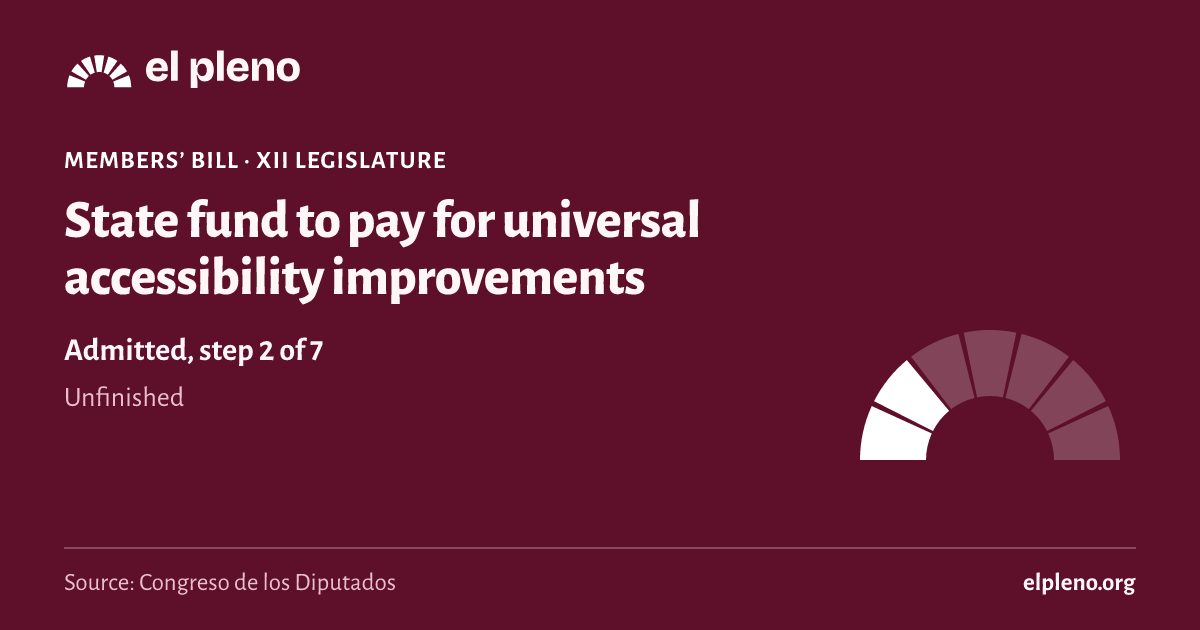
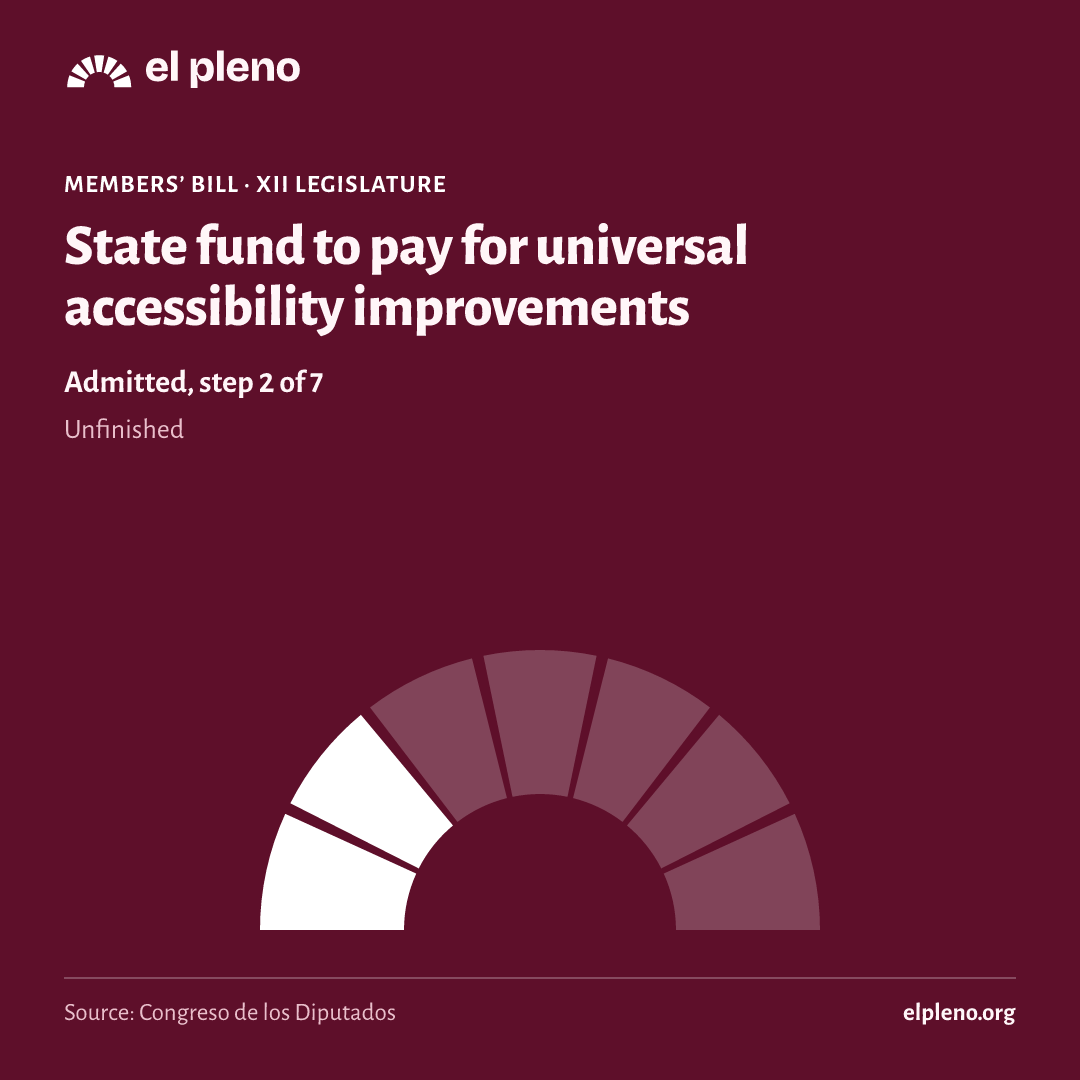
It took 2 of 7 steps. It reached Admitted, and today it is unfinished.
- Introduced5 December 2017Someone registers the text in the Congreso.
- Admitted12 December 2017The Bureau of the Congreso accepts it and, for a members’ bill, the plenary decides whether to consider it.
- Amendmentsnot reachedGroups propose changes.
- Committeenot reachedA committee goes through the text in detail.
- Plenarynot reachedAll 350 deputies vote.
- Senatenot reachedThe Senate can pass it, amend it or veto it.
- BOEnot reachedIt is published in the Official State Gazette (BOE) and comes into force.
See the 6 official steps on a timeline
Was there a plenary vote?
We have no plenary vote linked to this law in the Congreso’s data.
What happens next
What happens now?
The legislature ended before it finished. To go on, someone would have to introduce it again in the new Cortes.
It was presented again:
- XIII Legislature, Congreso de los Diputados· Unfinished State fund to pay for universal accessibility improvements
Sources
Where does all this come from?
- Congreso de los Diputados, file 122/000154
Official title, type, author, dates and stage.
Retrieved 11 November 2026
- The data comes from the open files of the Congreso, the Senate and the BOE, unaltered.
- Each deputy’s province is the one of their seat on the day of the vote.
- We only say “passed” or “rejected” when the majority needed is certain; otherwise we say which side had more votes.